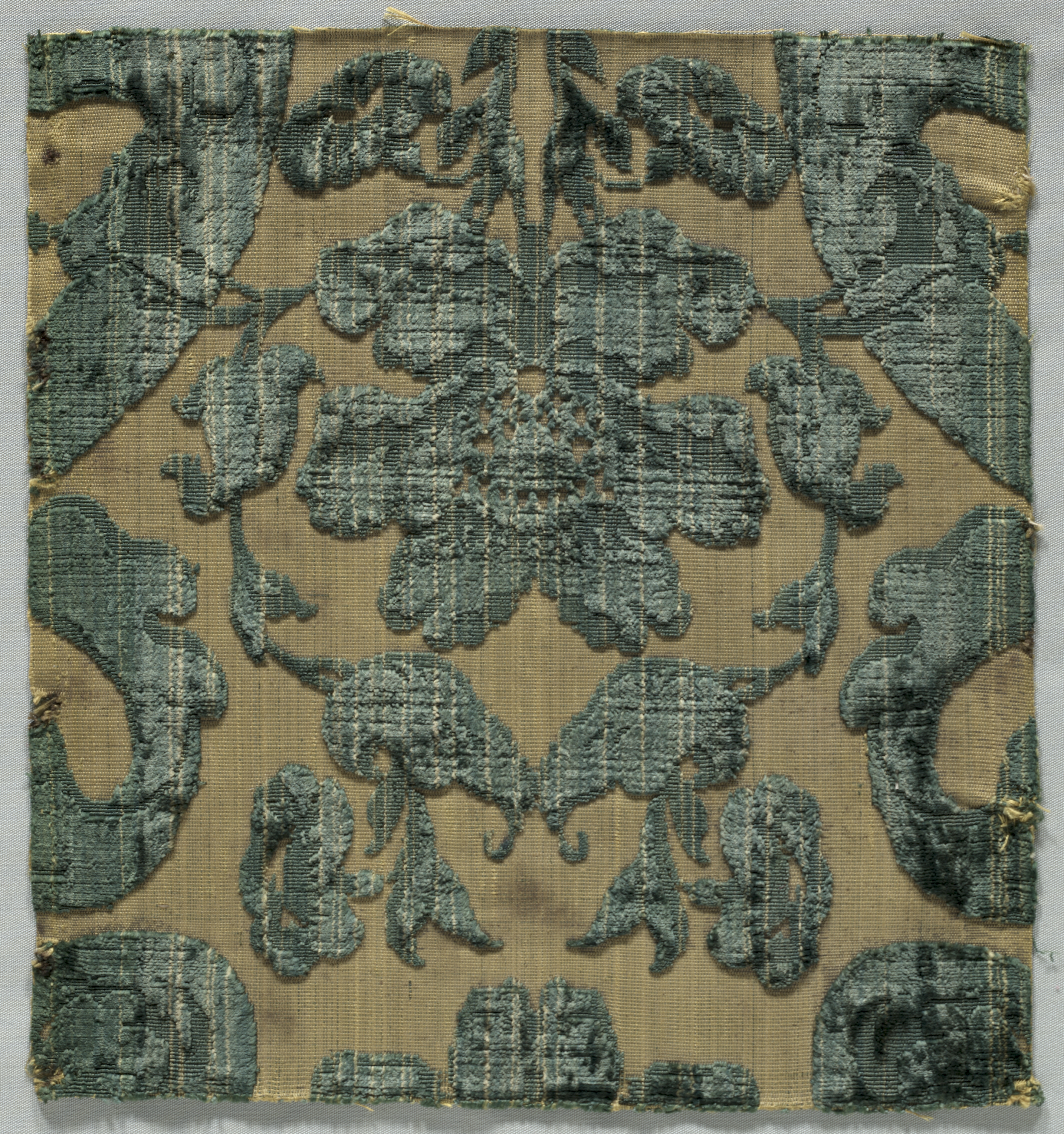
Deconstructing the Heirloom: The Velvet Fragment as a New DNA Strand
At Zoey Fashion Lab, our mandate extends beyond the mere preservation of historical textiles. We are engaged in a process of fabric deconstruction, wherein each artifact is not viewed as a static relic but as a living, mutable genetic code. The subject of this analysis—a velvet fragment originating from Italy in the early 17th century—presents a particularly potent case study. Designated as Reference: New DNA Strand, this piece is not simply a swatch of antique cloth; it is a biological blueprint, a repository of artisanal intelligence that, when decoded, can radically inform the future of avant-garde design.
This report dissects the fragment’s physical, historical, and technical properties, proposing a methodology for translating its inherent "genetic" information into a contemporary, disruptive aesthetic. We will explore how the opulence of the Baroque era can be re-engineered through the lens of modern deconstruction, yielding garments that are neither historical pastiche nor sterile futurism, but rather a hybrid organism born of both.
I. The Genetic Code: Physical and Technical Analysis
The fragment, measuring approximately 40cm x 25cm, is a testament to the technical virtuosity of early 17th-century Italian silk weaving. Our initial microscopy reveals a voided velvet construction, a technique of immense complexity where pile and ground are woven simultaneously to create a sculptural contrast. The ground is a tightly woven silk taffeta, providing structural integrity, while the pile—a lustrous, deep burgundy—rises in deliberate, rhythmic patterns. The original color, now faded to a rich, bruised plum, speaks to a history of light exposure, yet the depth of the dye’s molecular structure remains remarkably stable.
Structural Integrity and Wear Patterns
The fragment exhibits characteristic signs of age: crushed pile in high-contact areas, minor threadbare patches, and a subtle distortion along the selvedge. However, these are not flaws; they are mutations. They represent the garment’s interaction with its environment—the pressure of a hand, the friction of a chair, the humidity of a palazzo. For the avant-garde designer, these wear patterns are not to be replicated but to be amplified. The New DNA Strand approach dictates that we treat these imperfections as dominant genes, not recessive ones.
The weave density is exceptional, with approximately 120 warp threads per centimeter. This density created a fabric of immense weight and drape, designed to hold its shape in the voluminous silhouettes of the period. Yet, for our purposes, this density is a challenge. It represents a monolithic, closed structure. Our deconstruction protocol seeks to open this structure, to introduce porosity and fluidity where once there was rigidity.
II. Historical Context: The Baroque Genome
To understand the fragment’s potential, we must contextualize its origin. Early 17th-century Italy, particularly Venice and Genoa, was the epicenter of luxury textile production. Velvet was the fabric of the Church and the aristocracy, a material symbol of divine right and secular power. Its weight, its sheen, and its tactile richness were designed to overwhelm the senses, to enforce a hierarchy of touch and sight.
This historical "genome" is encoded with power dynamics—of wealth, of status, of unattainable beauty. The avant-garde designer must therefore engage in a form of genetic editing. We cannot ignore the fabric’s authoritarian past, but we can subvert it. By deconstructing the velvet’s inherent opulence, we can challenge the very notions of luxury and exclusivity it once represented.
The Paradox of Opulence
The velvet’s primary characteristic is its tactile seduction. It invites touch, yet its historical context forbade it for the commoner. This paradox is the core of its DNA. Our design strategy must exploit this tension. The goal is not to make velvet feel cheap, but to make its opulence uncomfortable, to create a visual and tactile dissonance that forces the viewer to question the fabric’s original purpose.
Consider the color. The original burgundy was a symbol of cardinalatial power and bloodline. In our re-imagining, we might retain this hue but render it through a process of acid-washing or laser-etching, creating a mottled, diseased surface. This would retain the genetic memory of the color while mutating its expression from one of authority to one of decay and vulnerability.
III. Avant-Garde Application: The Translation Protocol
The transition from historical artifact to avant-garde garment requires a rigorous, multi-stage protocol. We propose a three-tiered approach: Physical Deconstruction, Molecular Reconfiguration, and Silhouette Subversion.
Stage One: Physical Deconstruction
This stage involves the deliberate, controlled destruction of the weave. Using precision rotary cutters, we will excise the pile in specific geometric patterns, exposing the ground weave beneath. This creates a two-dimensional topographical map of the fabric’s structure. The removed pile will not be discarded; it will be collected and re-spun into a new, irregular yarn. This process echoes the biological concept of apoptosis—programmed cell death—whereby the old structure is dismantled to provide the building blocks for the new.
Further, we will employ a technique of selective heat distressing. By applying localized heat, we can cause the silk fibers to shrink and warp unevenly, producing a blistered, organic surface. This mimics the natural decay of the original fragment but accelerates and exaggerates it, creating a new texture that is both ancient and futuristic.
Stage Two: Molecular Reconfiguration
This is where the "New DNA" truly manifests. We will treat the deconstructed velvet with a bio-plastic polymer derived from cellulose. This is not a coating; it is an infusion. The polymer will penetrate the exposed ground weave, fusing with the silk at a molecular level. The result is a hybrid material that retains the velvet’s tactile depth but gains a new, almost rubbery flexibility and water-resistance.
This process allows us to manipulate the fabric in ways previously impossible. The treated material can be heat-pressed into sharp, architectural pleats that will hold their form permanently. It can be stretched and molded over forms to create three-dimensional, sculptural reliefs. The velvet is no longer a passive surface; it becomes an active, shape-shifting material.
Stage Three: Silhouette Subversion
The final stage is the construction of the garment itself. We reject the voluminous, body-concealing forms of the 17th century. Instead, we will employ an asymmetric, deconstructed tailoring approach. The treated velvet will be cut into long, ribbon-like strips and re-woven on a large-scale, open-loom structure, creating a garment that is part fabric, part architecture.
The design will feature a single, exaggerated sleeve constructed from the heat-molded pleats, while the body of the garment will consist of the re-woven strips, leaving deliberate gaps that reveal the skin beneath. This creates a visual and conceptual dialogue between the historical fabric’s desire to conceal and the modern body’s desire to be seen. The garment will be finished with hand-stitched seams using the re-spun yarn, each stitch a visible testament to the fabric’s journey from relic to revolution.
Conclusion: The Future of the Fragment
The Italian velvet fragment, Reference: New DNA Strand, is far more than a historical curiosity. It is a challenge. It challenges us to see beyond the surface, to understand that every textile is a complex system of information waiting to be decoded and re-encoded. By applying our deconstructionist methodology, we do not destroy the past; we metabolize it.
The resulting avant-garde garment will be a paradox: it will be heavy yet fluid, opulent yet distressed, historical yet utterly contemporary. It will be a wearable argument for the continuity of material knowledge, proving that the most radical future of fashion lies not in invention, but in the fearless reinterpretation of our own genetic textile heritage. At Zoey Fashion Lab, we do not copy the past; we extract its DNA and engineer a new species.