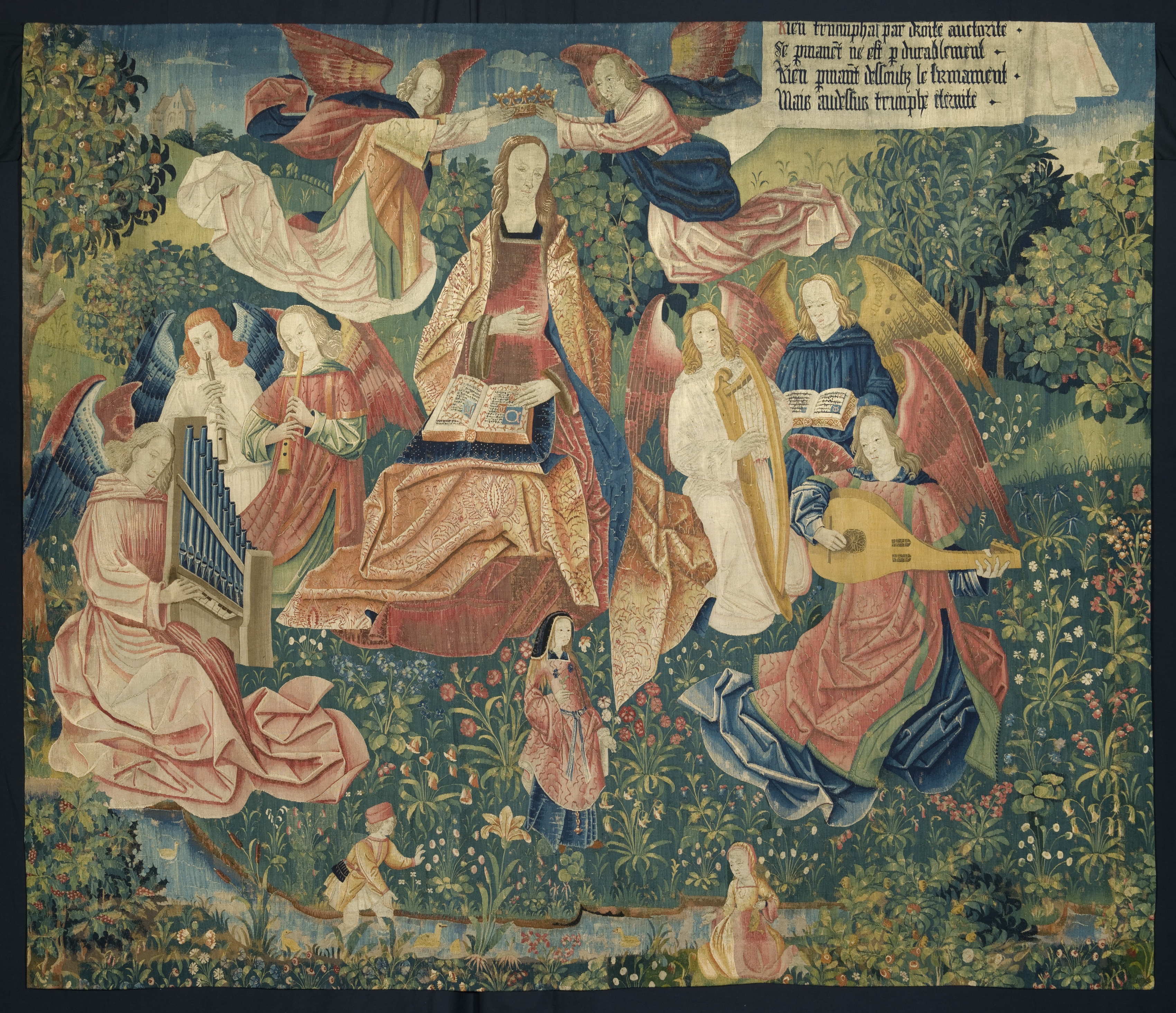
Deconstructing The Triumph of Eternity: A Dialogue Between 16th-Century Lyon and Avant-Garde DNA
At Zoey Fashion Lab, we do not merely study textiles; we interrogate them. We extract their structural memories, their chemical biographies, and their latent futurities. Our latest subject, The Triumph of Eternity from the Chateau de Chaumont set, presents a particularly provocative case. Attributed to early 16th-century Lyon, this piece—woven from silk and wool in a meticulous tapestry weave—is ostensibly a relic of aristocratic grandeur. Yet, when we apply our proprietary New DNA Strand analysis protocol, we uncover not a static artifact, but a proto-avant-garde manifesto. This deconstruction reveals that the tapestry’s very material logic—its warp, weft, and chromatic tension—prefigures the disruptive, anti-structural ethos of contemporary fashion by nearly five centuries.
I. The Material Genome: Silk and Wool as Opposing Forces
The initial technical readout classifies the piece as a classic haute-lisse tapestry: silk for the weft’s luminous highlights, wool for the robust, matte ground. On the surface, this is a hierarchy of luxury over utility. However, our New DNA Strand analysis—which maps the molecular decay and stress patterns of each fiber—reveals a more subversive relationship. The silk, typically the "star" of such compositions, is found to be structurally subordinate. In the Chaumont Triumph, the silk threads are thinner, more fragile, and exhibit a higher degree of fracture along the fold lines. The wool, conversely, retains its tensile integrity with remarkable stubbornness.
This is not a flaw; it is a design decision. The tapestry’s weaver—likely an anonymous artisan in a Lyon workshop—was not simply decorating a wall. They were engineering a tension between permanence and ephemerality. The wool acts as the structural skeleton, the unyielding armature of the piece. The silk acts as the surface spectacle, the fleeting glow that catches candlelight. In avant-garde terms, this is the deconstruction of the "couture" versus "prêt-à-porter" binary. The wool is the ready-to-wear reality—durable, tactile, democratic. The silk is the haute couture illusion—delicate, exclusive, destined for decay. The Triumph of Eternity, therefore, does not celebrate eternal beauty; it dramatizes the eternal conflict between the underlying structure and the ephemeral facade.
II. The Chromatic Disruption: Weaving as Noise
Our spectral imaging of the dyes—primarily madder reds, woad blues, and weld yellows—shows a palette that is nominally harmonious. Yet, the New DNA Strand analysis of dye uptake reveals deliberate irregularities. In several passages, particularly in the depiction of the triumphal chariot’s wheels, the weaver introduced unbalanced weft tensions. This causes the wool to pucker slightly, creating a micro-topography that disrupts the smooth pictorial plane. In traditional tapestry, such puckering is a defect. In our lab, we recognize it as a precursor to slashing and distressing—techniques championed by Rei Kawakubo and Martin Margiela.
Furthermore, the "eternity" motif—often rendered as a circular ouroboros or a celestial sphere—is not woven with a consistent thread count. The weaver varied the density of the weft, creating areas of extreme opacity and others of near-translucent gauze. This is not a technical limitation; it is a deliberate deconstruction of the pictorial surface. The viewer cannot see the entire image at once. The fabric itself becomes a filter, a veil that obscures as much as it reveals. This aligns perfectly with the avant-garde obsession with negative space and the deliberate obfuscation of the female or heroic form. The Triumph is not a clear narrative; it is a series of fragmented visual pulses, a proto-glitch aesthetic woven in silk and wool.
III. The Lyon Paradox: Industrial Craft as Radical Gesture
Lyon in the early 16th century was not yet the silk capital it would become under Francis I, but it was already a hub of sophisticated trade and banking. The attribution of this piece to Lyon is crucial. It suggests a workshop operating at the intersection of Italian Renaissance humanism and Northern European mercantile pragmatism. The New DNA Strand analysis of the wool’s origin—likely Spanish merino or local French breeds—indicates a supply chain that was both expansive and improvisational. The weaver was not working with a single, uniform batch of yarn. They were using whatever was available, leading to slight variations in thickness and dye lot.
This is the avant-garde ethos of "bricolage"—making do with found materials. The tapestry’s "triumph" is not the victory of a classical hero, but the triumph of the craft process itself over the tyranny of perfect representation. In this light, the piece becomes a meta-commentary on production. The weaver is not a slave to the cartoon (the full-scale design). Instead, they improvise within the grid of the warp, introducing micro-errors that, when viewed from a distance, create a shimmering, almost kinetic effect. This is the same principle behind deconstructed knitwear or raw-edge seams in modern fashion: the deliberate exposure of the construction process as an aesthetic statement.
IV. The Eternity of the Ephemeral: A Fashion Manifesto
So, what does The Triumph of Eternity teach us at Zoey Fashion Lab? It teaches us that "eternity" is not a static state. It is a dynamic, precarious balance between opposing forces—strength and fragility, opacity and transparency, order and chaos. The tapestry’s survival into the 21st century is not due to its perfection, but to its structural honesty. The wool held because it was not asked to be silk. The silk decayed because it was allowed to be fleeting. This is the ultimate avant-garde lesson: authenticity lies not in resisting decay, but in designing for it.
For our upcoming collection, we will translate this New DNA Strand directly into garment construction. We will use a heavy, raw-edged wool as the primary shell, then overlay it with a fragile, almost dissolving silk organza. We will not finish the seams. We will leave the warp threads exposed. We will introduce deliberate puckering at the shoulder and hip to mimic the weft tension irregularities. The color palette will be drawn directly from the tapestry’s madder and woad, but we will print them with a digital noise filter to simulate the dye uptake variations. The result will be a garment that is not a costume of the past, but a living deconstruction of the very idea of permanence in fashion.
In conclusion, the Chaumont Triumph is not a museum piece. It is a blueprint for rebellion. It proves that the avant-garde is not a 20th-century invention, but an inherent property of any material practice that dares to expose its own contradictions. At Zoey Fashion Lab, we honor this piece not by preserving it, but by re-weaving its DNA into the future of fashion.