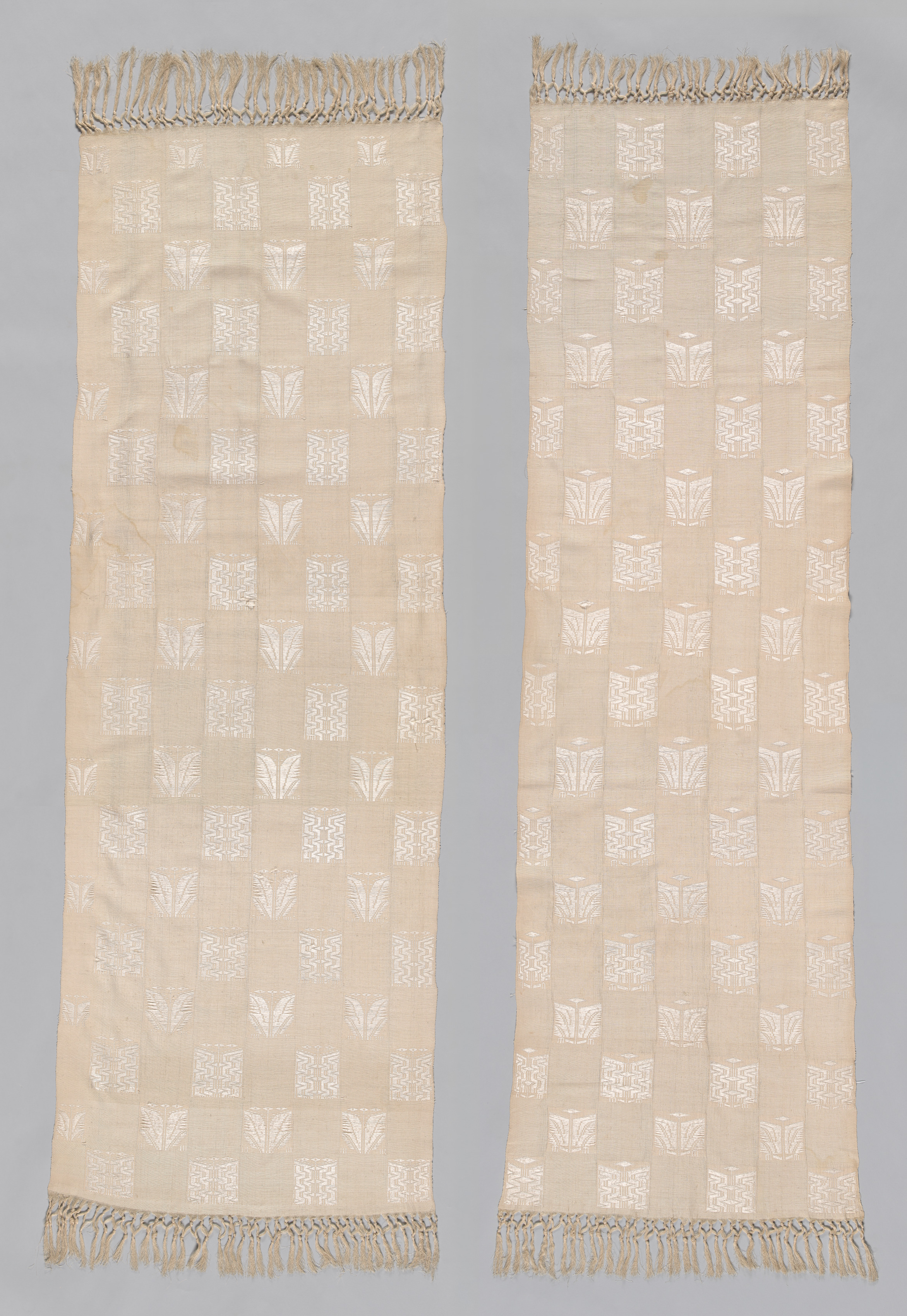
Deconstructing the Archive: The Lamba Landy Fotsy as Proto-Avant-Garde Artifact
At Zoey Fashion Lab, our mandate is not merely to catalogue garments but to interrogate their latent futurism. We approach the archive not as a repository of the past, but as a resonance chamber for ideas yet to materialize. In this analysis, we turn our deconstructive lens to a pair of Lamba Landy Fotsy shawls from Madagascar, dating to the 16th–17th centuries. These are not passive textiles; they are complex, multi-layered texts that prefigure the avant-garde’s obsession with material honesty, structural subversion, and cultural hybridity. Through a technical and conceptual dissection, we will demonstrate how these silken artifacts—woven from both Bombyx mori (cultivated mulberry silk) and Borocera cajani (wild indigenous silk)—operate as a radical precursor to contemporary fashion’s most disruptive impulses.
I. Material Dialectics: The Politics of Wild and Domestic Silk
The first point of avant-garde rupture lies in the material composition. The Lamba Landy Fotsy is not a monolith. It is a dialogue between two distinct silks, each carrying a specific ecological and economic signature. The inclusion of Bombyx mori—the domesticated, Chinese-origin silkworm—signals participation in the vast Indian Ocean trade networks. Its thread is uniform, lustrous, and even, representing a globalized standard of luxury. In contrast, the Borocera cajani (known locally as landibe) is endemic to Madagascar. Its cocoon is wild, harvested from the forest, and its fiber is coarser, more textured, and irregular in diameter. It possesses a natural, earthy beige or amber tone that resists the pristine whiteness of its cultivated cousin.
From a Zoey Fashion Lab perspective, this is not a defect but a deliberate aesthetic strategy. The juxtaposition creates a palpable tension—a play between the manufactured and the organic, the global and the local. This is the essence of deconstruction: revealing the seams of production. The weaver did not hide the difference; they highlighted it, creating a surface that is simultaneously smooth and rugged. This is a proto-avant-garde gesture, echoing the later works of designers like Issey Miyake or Yohji Yamamoto, who championed the beauty of irregularity and the integrity of raw materials over the oppressive perfection of haute couture. The Lamba Landy Fotsy declares that luxury is not monolithic; it is a negotiation between disparate forces.
II. Structural Subversion: The Unfinished Hem and the Draped Form
Moving beyond the fiber, the construction of the shawl itself is a study in structural subversion. Unlike the Western tailored garment, which imposes shape upon the body through cutting and seaming, the Lamba is a rectilinear, woven form. It is a simple rectangle, yet its function is infinitely complex. It is worn wrapped, draped, and folded, its form dictated by the wearer’s body and movement rather than by pre-determined patterns. This is a radical departure from the European sartorial logic of the 16th century, which was obsessed with corsetry, rigid silhouettes, and the imposition of architectural structure.
Furthermore, the technical analysis of the weave reveals a fascinating detail: the presence of unfinished or deliberately fringed edges. In many examples, the warp threads are left loose, creating a fringe that is not a decorative afterthought but an integral part of the weaving process. This is an explicit rejection of the "finished" garment. It exposes the loom’s logic, the very skeleton of the textile. In avant-garde terms, this is akin to leaving the seams on the outside or exposing the boning of a corset. It is a statement of process over product, of becoming over being. The Lamba’s open, flowing form is a precursor to the conceptual fashion of the late 20th century, which liberated the body from the tyranny of the cut, championing fluidity, modularity, and the garment as a responsive skin rather than a static shell.
III. Chromatic Silence and the Archive’s Resonance
The name "Fotsy" translates to "white" in Malagasy. However, this is not the sterile, optical white of bleached cotton. It is a nuanced, textural white that absorbs and reflects light differently across its dual-silk surface. This chromatic restraint is a powerful avant-garde tool. In a historical context where European courts were drowning in polychromatic velvets, brocades, and jewel-toned embroidery, the Lamba Landy Fotsy offers a study in monochromatic purity. Its power lies not in color, but in surface texture and the subtle interplay of shadow and light across the irregular wild silk fibers.
This "chromatic silence" is a direct precursor to the minimalist and conceptual movements in fashion. It aligns with the Japanese avant-garde’s reverence for "ma" (negative space) and the Western modernist pursuit of essential form. The shawl is not a canvas for pictorial representation; it is an object of contemplation in itself. The "Archive Resonance" reference—the 16th to 17th century—is crucial here. This was a period of intense globalization, yet the Lamba resists narrative illustration. It does not depict the arrival of Europeans or the exchange of goods. Instead, it internalizes the encounter, translating it into a material dialectic. The result is a garment that is both deeply local and radically cosmopolitan, a silent witness to history that speaks through its fibers rather than its imagery.
IV. Avant-Garde Lineage: From the Malagasy Highlands to the Global Runway
For Zoey Fashion Lab, the Lamba Landy Fotsy is not a historical curiosity; it is a design blueprint. Its principles—material honesty, structural fluidity, and chromatic restraint—are the foundational pillars of the contemporary avant-garde. We see its DNA in the deconstructed tailoring of Rei Kawakubo, where garments are left raw and unfinished. We see it in the sculptural draping of Madame Grès, who treated fabric as a living, malleable substance. We see it in the sustainable fashion movement, which champions local, biodegradable fibers like Borocera cajani over petroleum-based synthetics.
The shawl’s ability to be worn in multiple ways—as a shoulder wrap, a head covering, a skirt, or a sling—also prefigures the modular, multi-functional designs championed by futuristic fashion. It is a garment that adapts to the wearer, not the other way around. This is the ultimate act of anti-fashion: a rejection of seasonal trends in favor of timeless, adaptable utility. The Lamba Landy Fotsy proves that the avant-garde is not about novelty for its own sake, but about a return to fundamental principles—a radical re-evaluation of the relationship between body, fiber, and environment.
In conclusion, this pair of shawls is a masterclass in subversive elegance. By fusing the global standard of Bombyx mori with the wild, untamed spirit of Borocera cajani, the Malagasy weavers created an object that defies easy categorization. It is a luxury good that critiques luxury, a traditional garment that is profoundly futuristic. As we continue to mine the archive for resonant ideas, the Lamba Landy Fotsy stands as a testament to the fact that true innovation often lies hidden in the most unexpected corners of history, waiting for a discerning eye to bring its radical potential back into the light.