Deconstructing the Lunar Gaze: A Blueprint for SS26
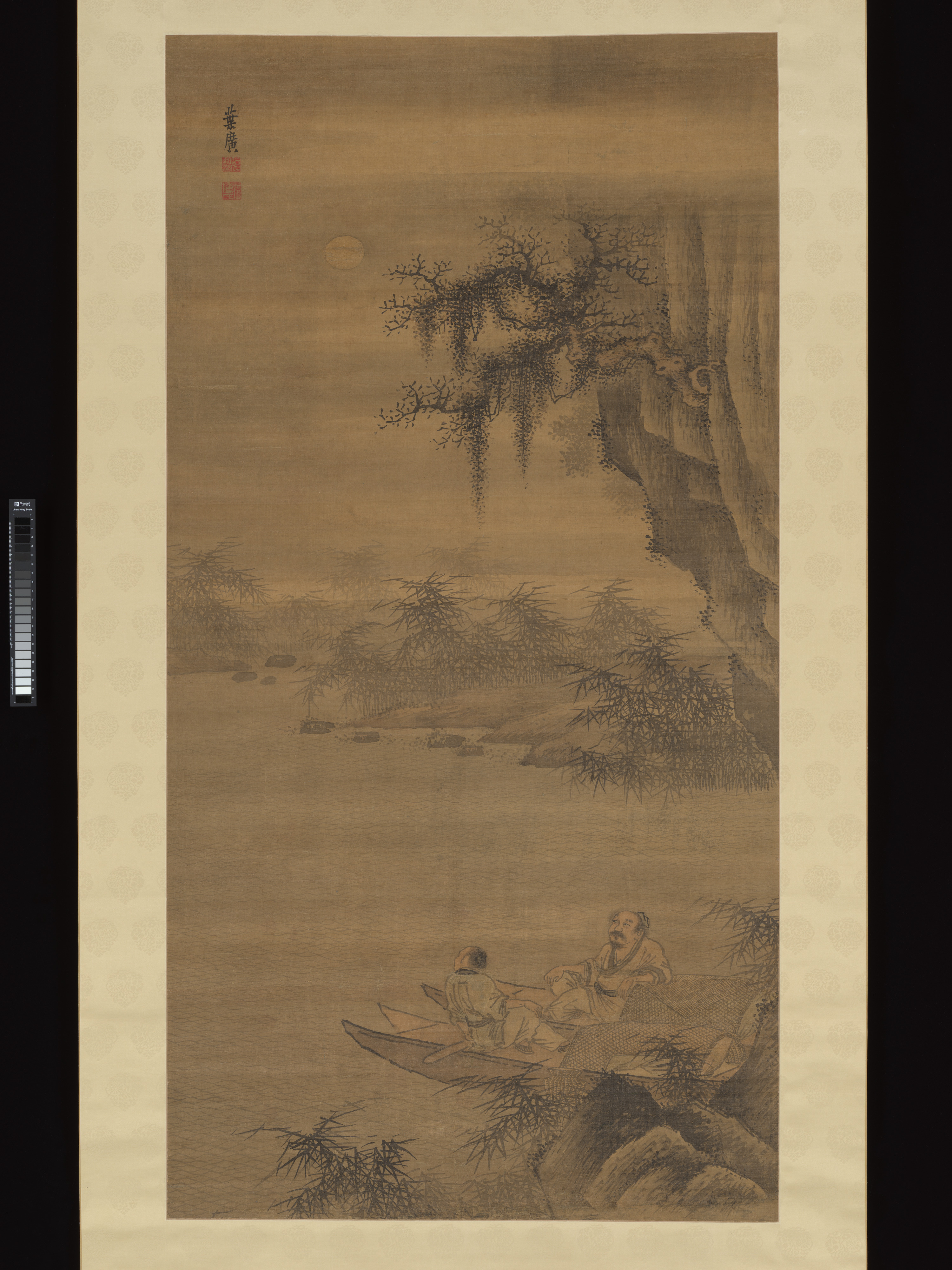
The hanging scroll, “Fisherman Viewing the Moon,” is not a relic. It is a schematic. Within its ink-washed silk and restrained color field lies a radical proposition for Spring/Summer 2026: that stillness is the ultimate luxury, and that the act of looking can be re-architected into wearable form. For Zoey Fashion Laboratory, this Chinese origin piece—a lone figure, a vast water body, a celestial orb—becomes a masterclass in negative space, temporal distortion, and the subversion of the utilitarian silhouette. We are not recreating a pastoral scene. We are extracting its gravitational pull and translating it into garments that defy the body’s static geometry.
Silhouette as Horizon: The Asymmetric Lunar Drift
The first structural extraction is the horizon line—that razor-thin demarcation between the fisherman’s world and the moon’s reflection. In our SS26 proposition, this becomes a radical asymmetry in the shoulder and hem architecture. Forget the balanced, two-shouldered jacket. Instead, envision a single, sculpted shoulder pad that extends into a cantilevered wing, mimicking the moon’s arc, while the opposite side dissolves into a fluid, raw-edged train that pools at the ankle like water receding from the shore. This is not a costume; it is a kinetic drape system.
The fabric is a double-faced technical silk—one side matte, ink-black, absorbing light; the other side with a liquid, pearlized finish that catches ambient luminescence. The garment’s interior is structured with a memory-wire substructure, allowing the wearer to manipulate the silhouette in real-time, bending the wing to shield the face or flattening it to a mere whisper of a shoulder. The hem, meanwhile, is weighted with micro-glass beads, creating a gravitational pull that anchors the garment, visually echoing the fisherman’s static boat. The result is a silhouette that is perpetually in a state of becoming—never fully settled, always referencing the moon’s pull on the tide.
Materializing the Void: Ink Washes and Light Filtration
The scroll’s genius lies in its negative space—the unmarked silk that reads as fog, water, and sky. For our couture analysis, this void is not emptiness; it is structural breath. We introduce a new textile innovation: ‘Lunar Wash’ organza. This is a multi-layered, laser-cut silk organza that has been treated with a reactive dye, creating gradients of opacity that mimic the ink wash’s tonal shifts. The layers are not fused but held in a floating lattice of transparent monofilament, allowing air and light to pass through, creating a living, shifting surface.
This material is deployed in a modular vestment—a sleeveless, high-collar tunic that appears to be solid from the front but dissolves into sheer, pixelated sections at the back. The pixelation is deliberate: a digital deconstruction of the moon’s glow, rendered in hand-embroidered, micro-sequined crescents that catch light only when the wearer moves. This garment is not about coverage; it is about curating perception. The wearer becomes a filter, a lens through which the urban landscape is softened, blurred, and re-framed as a poetic vista.
The Fisherman’s Contemplative Core: A Study in Restraint
The fisherman’s posture—bent, still, contemplative—informs our approach to the torso. In SS26, we reject the aggressive, shoulder-heavy power suit. Instead, we propose the ‘Contemplative Corset’: a boned, but flexible, understructure that does not cinch the waist but rather supports the spine in a forward, introspective curve. This is achieved through a helical steel-bone system that runs diagonally from the sternum to the lower back, encouraging a posture of inward focus rather than outward display.
Over this, we layer a deconstructed kimono sleeve, cut in a single, continuous piece with the back panel, allowing the arm to move freely within a vast, billowing volume. The sleeve is not sewn at the underarm; it is left open, creating a ventilated gap that reveals a glimpse of the underlayer—a flash of silver, like moonlight on water. This is a study in restraint: the garment does not shout; it whispers, it suggests, it invites the viewer to lean in, mirroring the fisherman’s own act of intimate observation.
Chromatic Reduction: From Ink to Luminescence
The scroll’s palette is austere: black ink, mineral greens, and the pale, cool white of the moon. Our SS26 color story is a chromatic reduction to three core tonalities. First, ‘Abyssal Ink’—a near-black, but with a subtle olive undertone, evoking the deep water. Second, ‘Moth Wing’—a pale, dusty grey with a faint iridescence, reminiscent of the moon’s surface. Third, ‘Reflective Jade’—a muted, almost translucent green, used only as an accent, appearing in stitching, piping, or as a lining flash.
This is not a minimalist retreat but a strategic intensification. By removing chromatic noise, the eye is forced to engage with texture, silhouette, and the play of light and shadow. A garment in ‘Abyssal Ink’ will not read as flat black; it will shift and shimmer as the Lunar Wash layers catch different angles of light. The color becomes a behavioral element, not a decorative one.
Structural Innovation: The Modular Moon Anchor
The final, and most radical, element is the ‘Moon Anchor’—a hybrid accessory/wearable structure. It is a crescent-shaped, rigid frame, crafted from recycled aluminum and wrapped in the same technical silk. It can be worn in multiple configurations: as a necklace that extends to a chest plate, as a belt that morphs into a hip cage, or as a handheld object, held like a fan, to cast a shadow over the face. It is a tool for spatial manipulation, allowing the wearer to create their own private eclipse, to shield themselves from the world or to frame their own gaze outward.
This is not ornamentation; it is functional sculpture. The Moon Anchor’s curvature is mathematically derived from the scroll’s depiction of the moon’s reflection on water—a distorted ellipse, not a perfect circle. This imperfection is key; it introduces a subtle, unsettling dynamism to the wearer’s profile, a constant reminder of the fluid, shifting nature of perception. It is the definitive avant-garde statement of the collection: fashion as a tool for re-calibrating one’s relationship to time, space, and the celestial.
In conclusion, “Fisherman Viewing the Moon” is not a source of inspiration; it is a structural and philosophical blueprint. For SS26, Zoey Fashion Laboratory will not present garments that depict a scene. We will present garments that embody the act of contemplation itself—garments that slow the gaze, that alter posture, that create personal atmospheres. This is couture as a meditative technology, a radical pause in the relentless forward motion of fashion.