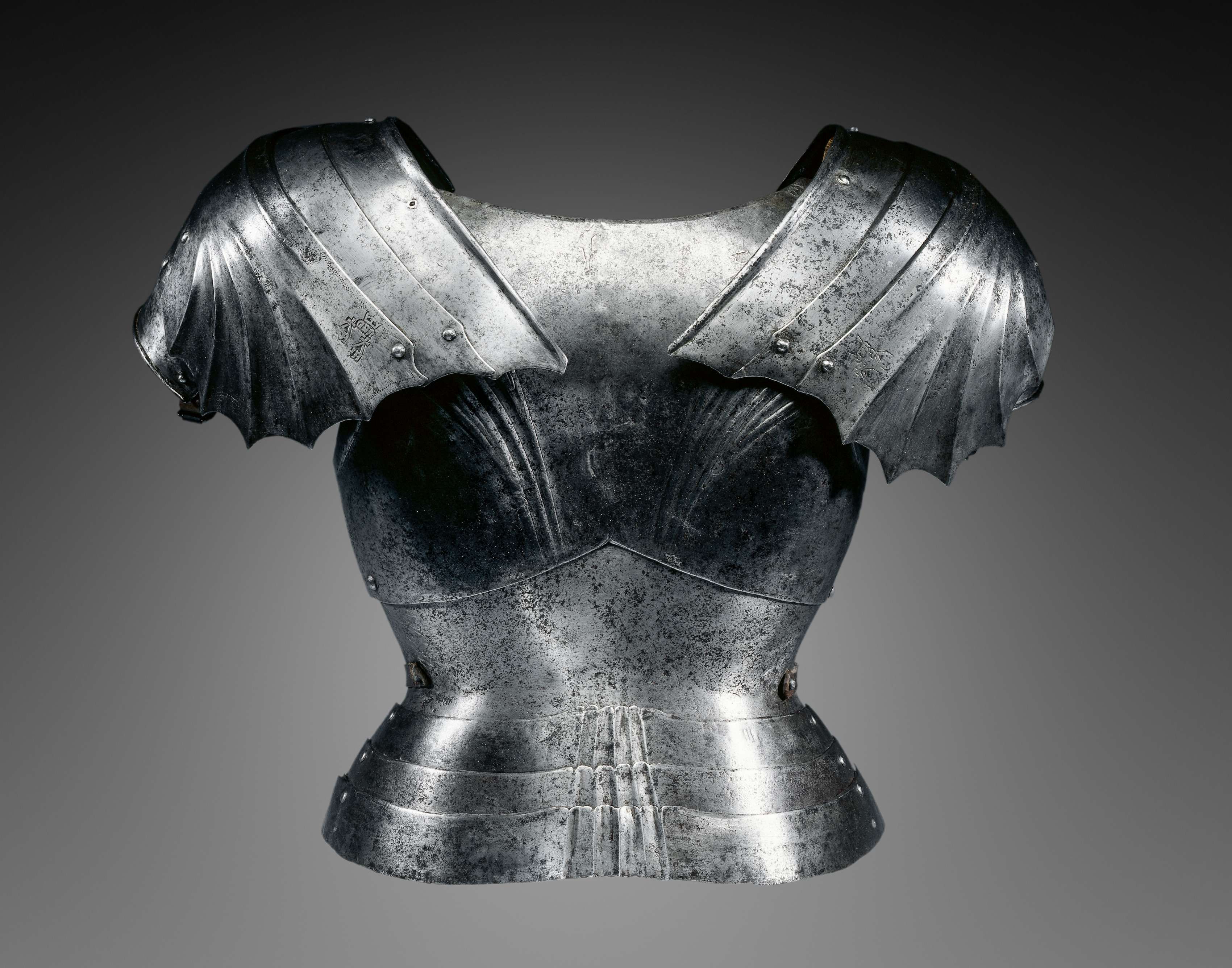
Deconstructing the Gothic Backplate: A New DNA Strand for Zoey Fashion Lab
At Zoey Fashion Lab, our mandate extends beyond the mere replication of historical garments. We are engaged in a process of fabric deconstruction—a forensic and artistic dissection of material culture to extract its latent structural and philosophical DNA. In this analysis, we turn our attention to a singular artifact: the Gothic Backplate from late 15th-century Germany. This object, forged from steel and now fitted with modern leather straps, is not a relic to be displayed in a glass case. Rather, it is a primordial genetic sequence that, when re-sequenced through an avant-garde lens, yields a radical new form of wearable architecture.
I. Metallurgical Memory: The Steel Substrate
The primary material of the original backplate—low-carbon steel—is often misread as a symbol of rigidity. In our deconstruction, we identify it as a medium of memory. The steel was hammered, not cast, a process of incremental displacement that left microscopic stress lines—a topographical map of the armorer’s intent. For the avant-garde designer, this translates into a rejection of smooth, homogenous surfaces. The new DNA strand we propose does not mimic the polished finish of museum restorations. Instead, we embrace the patina of conflict: the micro-scratches, the subtle asymmetries, and the differential oxidation that records the passage of time. Our fabrication protocol calls for a steel alloy that is intentionally distressed, not to appear old, but to appear lived-in before it is even worn.
This steel is not a shell; it is a second skeleton. In the original, the backplate’s curvature was ergonomic, following the thoracic kyphosis. Our avant-garde iteration exaggerates this curve into a deliberate scoliotic silhouette—a spine that has been twisted by the weight of history. The structural integrity is maintained not through thickness, but through geometric tension. We propose a series of perforated, lattice-like cutouts along the vertebral column, reducing mass while creating a shadow-play that mimics the ribs beneath the skin. This is not armor; it is an exoskeletal confession.
II. The Anachronistic Strap: Leather as a Temporal Disruptor
The modern leather straps are the most provocative element of the original artifact. They are an anachronism—a 20th-century intervention on a 15th-century object. In our deconstruction, this is not an error but a deliberate temporal suture. The leather, vegetable-tanned and dyed a deep oxblood, represents the organic against the mineral. It is the skin that binds the steel. For the new strand, we escalate this tension: the leather is not merely functional; it becomes a narrative ligament.
We propose straps that are cut with raw, unfinished edges, stitched with a visible, oversized thread in a contrasting shade of bone-white. These straps do not simply hold the plate in place; they are routed through the steel’s perforations in a complex, asymmetrical crisscross pattern, creating a visual language of binding and liberation. The leather is treated with a wax finish that will crack and wear with movement, ensuring that each garment becomes a unique fossil of its wearer’s kinetic history. This is not a restoration of function; it is a re-purposing of the strap as a sculptural element that draws the eye across the back’s landscape.
III. The New DNA Strand: From Defense to Expression
The core of our analysis lies in the translation of the backplate’s functional DNA—its purpose of defense—into a new genetic code of expressive vulnerability. The original plate was designed to deflect a sword blow. Our avant-garde iteration is designed to deflect a gaze, to create a barrier that is simultaneously porous. The DNA sequence we have isolated is the “parry-and-reveal” motif.
In practical terms, this manifests as a garment that is worn over a sheer, translucent base layer. The backplate is articulated—not as a single rigid piece, but as a series of overlapping steel scales, each connected by a micro-hinge. This allows for a fluid, serpentine movement that is antithetical to the original’s static posture. The scales are polished on the interior, creating a mirrored effect that reflects the wearer’s skin, while the exterior is left matte and dark. The result is a dialectical garment: from behind, it is a monolithic shadow; from the side, it is a shimmering, fragmented mirror.
Furthermore, we have extracted the “gusset” principle from the original’s construction—the flexible leather joints at the shoulders and waist. In our new strand, this is exaggerated into a series of leather-and-steel hybrid tendons that run down the lateral sides of the torso. These tendons are not hidden; they are exposed, functioning as both structural support and as a visual metaphor for the muscular system. The wearer’s own body becomes the armature upon which this new exoskeleton is mounted.
IV. Avant-Garde Application: The Silhouette of the Future
The final output is a garment that defies categorization. It is neither armor nor clothing, but a wearable architectural fragment. The silhouette is elongated, with the backplate extending slightly below the natural waist, terminating in a sharp, asymmetrical point that mimics the “fauld” of the original. The shoulders are built up with a subtle, padded steel bolster, creating a powerful, almost predatory line. The garment is designed to be worn over a minimalist, high-necked knit in a raw silk or technical merino, allowing the cold steel to contrast with the soft, breathable textile.
This is not a costume. It is a prosthetic for the psyche. It grants the wearer a posture of historical authority while simultaneously acknowledging the fractured, contemporary self. The leather straps are not adjusted for comfort; they are adjusted for narrative tension—some tight, some loose, creating a deliberate asymmetry that speaks to the imbalance of modern life. The steel is not polished to a mirror finish; it is treated with a proprietary acid wash that creates a mottled, lunar surface, suggesting a material that has been through a cosmic storm.
V. Conclusion: The Backplate as a Living Codex
In conclusion, the Gothic Backplate is not a dead object. It is a codex written in steel and leather, containing the genetic instructions for a new form of avant-garde expression. By deconstructing its material properties, its anachronistic additions, and its functional logic, Zoey Fashion Lab has isolated a viable New DNA Strand. This strand, when spliced into a contemporary design practice, yields a garment that is at once a historical citation, a sculptural object, and a deeply personal interface. The backplate becomes a dialogue between the 15th century’s fear of the blade and the 21st century’s fear of exposure. We do not wear this armor to protect the body; we wear it to expose the skeleton of our own design philosophy. This is the future of fashion—not as novelty, but as archaeological prophecy.