Deconstructing the Body Guard: An Avant-Garde Reading of Early 16th-Century Armor
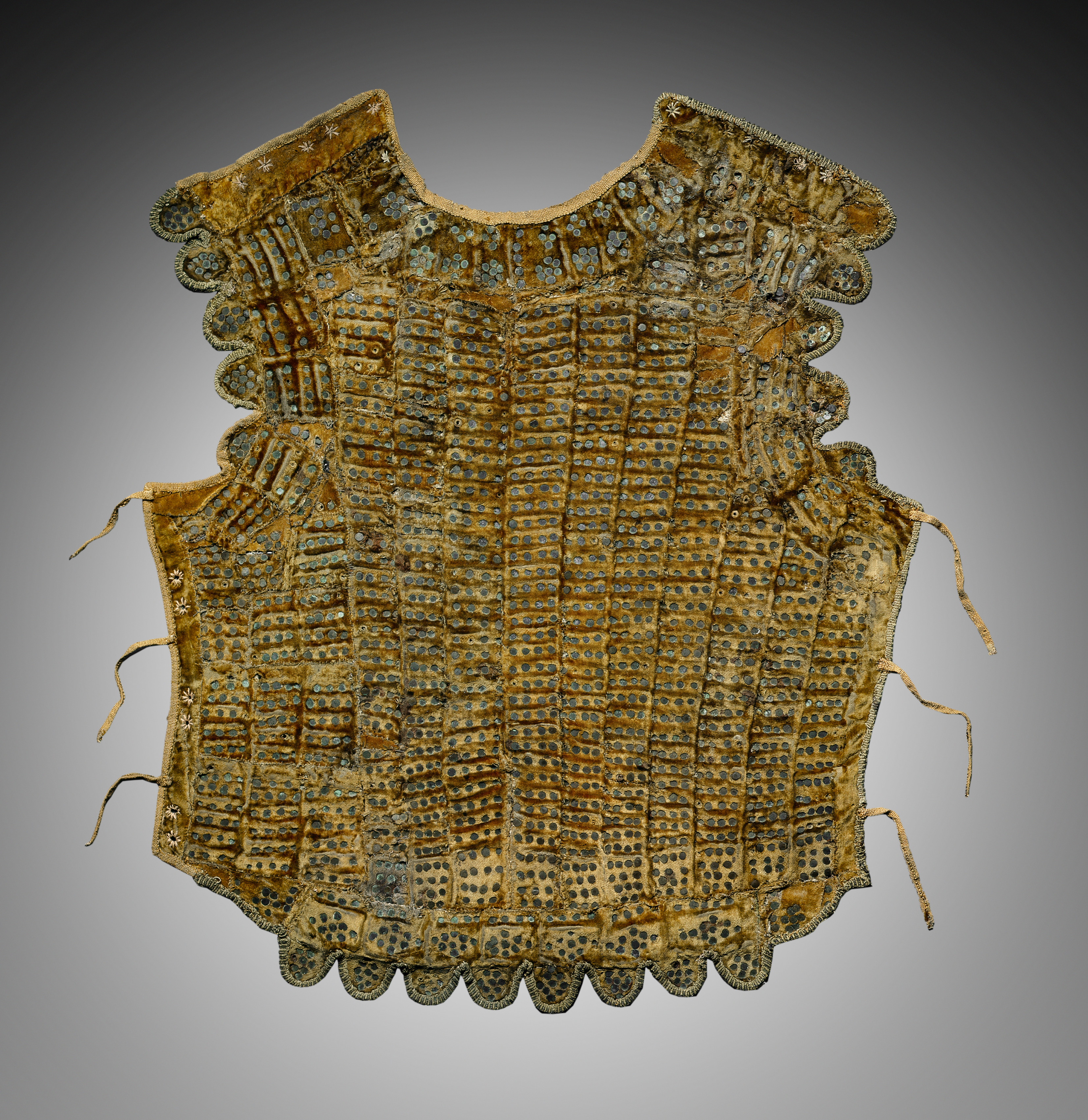
At Zoey Fashion Lab, we do not merely study garments; we interrogate them. We pull at the threads of history to expose the structural DNA that binds protection, power, and aesthetic expression. Today, our Chief Fabric Deconstructionist turns to a singular artifact: the Body Guard (Brigandine), attributed to Italy, circa early 16th century. Composed of linen, gold velvet, steel, and brass, this piece is not a relic of the past but a prophetic blueprint for contemporary avant-garde design. Our analysis will dissect its material syntax, its ergonomic logic, and its subversive potential, ultimately re-framing it as a proto-cybernetic exoskeleton rather than a mere military defense.
Material Dialectics: The Soft and the Unyielding
The brigandine’s genius lies in its paradoxical material marriage. The outer shell—a rich, gold velvet—speaks a language of courtly luxury, of light catching on woven silk, of status displayed in the sunlit halls of a Renaissance palazzo. Yet beneath this supple, almost feminine surface lies a brutal core: hundreds of small, overlapping steel plates, riveted in place and visible only through the lining or the brass rivet heads that dot the velvet like a constellation of metallic stars. This is not a simple layering; it is a dialectical tension. The velvet is the signifier of social performance; the steel is the signifier of physical survival. For the avant-garde designer, this tension is pure gold. It challenges the binary of hard/soft, interior/exterior, and offers a template for garments that are simultaneously armor and adornment.
Consider the brass rivets. They are not hidden; they are proudly displayed on the exterior, puncturing the velvet in precise geometric rows. In a traditional reading, these are functional fasteners. In our deconstructionist lens, they are deliberate scarification—a rhythmic pattern that transforms the garment’s surface into a topographic map of its own internal structure. This is the essence of techwear avant-garde: the visible articulation of the unseen. The modern designer can reinterpret this by using exposed hardware, magnetic closures, and structural boning that mimics the rivet’s role as both a functional anchor and a decorative motif. The brigandine teaches us that honesty of construction need not be ugly; it can be opulent.
Ergonomic Intelligence: The Second Skin of War
Unlike the rigid, monolithic plate armor of contemporary knights, the brigandine was a masterpiece of distributed load and mobility. The small steel plates, often referred to as “lames,” were riveted to the linen or leather base in an overlapping pattern, much like fish scales or roof tiles. This allowed the torso to flex, twist, and bend with remarkable freedom, while still providing a formidable barrier against slashing blades and thrusting pikes. The linen lining—soft, breathable, and moisture-wicking—served as a comfort layer, preventing chafing and absorbing sweat. This is the same ergonomic logic found in modern high-performance sportswear and ballistic vests.
From an avant-garde perspective, the brigandine is an early prototype of biomechanical clothing. It does not simply cover the body; it collaborates with it. The garment’s articulation points—the shoulders, the waist, the hips—are engineered to follow the body’s natural kinetic chain. In our lab, we see this as a precursor to exoskeletal fashion, where garments are not passive shells but active agents that enhance the wearer’s physical capabilities. Imagine a modern brigandine reconstructed with carbon-fiber plates and memory-foam padding, articulated with micro-hinges, and covered in a bio-morphic, iridescent fabric. The result would be a garment that is both a sculpture and a performance enhancer—a true Body Guard for the 21st-century urban warrior.
The New DNA Strand: From Historical Artifact to Genetic Code
Our reference to a “New DNA Strand” is not metaphorical whimsy; it is a methodological call to action. We propose that the brigandine’s construction logic—its pattern of overlapping, articulated segments—constitutes a structural genetic code that can be isolated, mutated, and re-expressed in entirely new materials and contexts. In biological DNA, a gene is a sequence of instructions. In fashion DNA, the brigandine’s “gene” is the tessellation of protective units.
We can isolate this gene and splice it into a modern avant-garde collection. Instead of steel, we might use recycled PET plastic or 3D-printed biopolymers that mimic the plate structure but are lightweight and sustainable. Instead of gold velvet, we might use a living algae-based textile that photosynthesizes, turning the garment into a wearable ecosystem. The brass rivets could become conductive copper threads that integrate smart sensors, monitoring the wearer’s heart rate or environmental toxins. The brigandine’s DNA is not confined to its historical materials; it is a logic of protection and flexibility that can be re-coded for a future where fashion is functional, responsive, and ecologically conscious.
This is the avant-garde imperative: to see the past not as a museum piece but as a laboratory. The brigandine’s overlapping plates are a fractal pattern that can be scaled up to architectural proportions or scaled down to micro-embroidery. Its gold velvet is a reminder that even in the most utilitarian objects, there is room for radical beauty. The brass rivets are a testament to the power of repetitive detail to create a hypnotic visual rhythm. By extracting this DNA strand, we are not copying history; we are evolving it.
Avant-Garde Synthesis: The Body Guard as Performance Artifact
In the context of a Zoey Fashion Lab runway presentation, the Body Guard would not be worn as a costume. It would be re-contextualized as a wearable sculpture, a commentary on contemporary vulnerability. The model would move not with the stiffness of a soldier but with the fluidity of a dancer, highlighting the garment’s articulated joints. The gold velvet would be treated with a photochromatic finish, shifting from deep burgundy in low light to brilliant gold under the spotlight, echoing the brigandine’s dual nature of concealment and display. The steel plates would be replaced with mirror-polished aluminum, reflecting the audience and the environment, turning the wearer into a living prism.
The brass rivets would become oversized, almost grotesque, exaggerated hardware that draws the eye to the seams and intersections—the very points where vulnerability and protection meet. This is not a nostalgic re-enactment; it is a critical commentary on the modern human condition. We are all, in a sense, wearing invisible brigandines—layers of digital armor (our phones, our social media personas) over our soft, vulnerable flesh. The avant-garde Body Guard makes this invisible armor visible, tangible, and strangely beautiful. It asks the viewer: What is your steel? What is your velvet?
Conclusion: The Eternal Return of the Plate
The Italian brigandine of the early 16th century is not an endpoint; it is a starting point. Its synthesis of luxury and lethality, of flexibility and rigidity, of pattern and function, offers an inexhaustible well of inspiration for the avant-garde designer. At Zoey Fashion Lab, we see this artifact as a Rosetta Stone for a new language of fashion—one that prioritizes agency, adaptability, and aesthetic audacity. The Body Guard is not a relic to be preserved under glass; it is a living organism whose DNA we are only beginning to sequence. By deconstructing its materials, its ergonomics, and its symbolic weight, we unlock a future where clothing is not just worn but inhabited, not just seen but felt. The steel is still there, hidden beneath the velvet—and that is precisely the point. The future of fashion is not soft, nor is it hard; it is a brilliant, articulated synthesis of both.