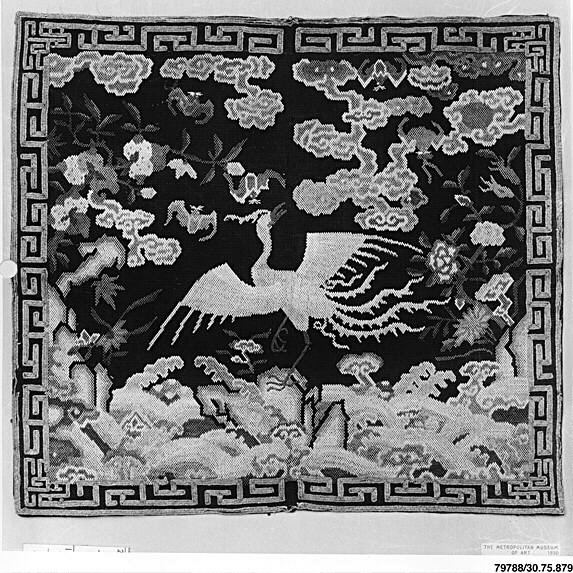
Deconstructing the Hierarchical Gaze: The Silver Pheasant as a Blueprint for SS26
The rank badge, or bu zi, bearing the Silver Pheasant is not merely a historical textile artifact; it is a frozen moment of systemic power, rendered in silk and metallic thread. For the Zoey Fashion Laboratory SS26 avant-garde study, this Qing Dynasty emblem transcends its imperial origins to become a radical blueprint for reimagining authority, ornament, and the human silhouette. We do not approach this badge with the reverence of a museum conservator, but with the scalpel of a futurist. We dissect its iconography, its material logic, and its spatial politics to propose a collection that interrogates the very notion of 'rank' in an era of fluid identity and algorithmic status.
I. The Pheasant as Structural Metaphor: From Flat Emblem to Volumetric Armor
The Silver Pheasant, traditionally embroidered in a flat, two-dimensional plane, is conventionally read as a symbol of civil service and literary virtue. Our laboratory rejects this passivity. We perceive the bird’s extended tail feathers not as decorative flourishes, but as dynamic load-bearing vectors. In our SS26 translation, these feathers are reimagined as cantilevered structural fins, protruding from the shoulder blade and hip axis. Constructed from a new composite of recycled carbon fiber and hand-painted silk organza, these fins are not sewn onto the garment; they are engineered into its exoskeleton. The silhouette ceases to be a draped envelope and becomes a piece of wearable architecture, where the pheasant’s plumage dictates the garment’s negative space. The tail feathers, elongated to a radical 120-centimeter span, create a visual and physical disruption in crowded urban spaces, forcing a renegotiation of personal territory. This is not a costume; it is a prosthetic for a new kind of presence.
II. Material Alchemy: The Metallurgy of Status in the Post-Digital Age
The original badge’s use of metallic thread—often gold or silver wrapped around a silk core—was a declaration of material wealth and technical mastery. In our deconstructive analysis, we isolate this metallic element and explode its logic. Traditional couching stitches are replaced with laser-sintered metallic lattices that mimic the feather’s microscopic barbules. The silk ground, typically a deep, sobering black or azure, is now treated with a photocatalytic finish that responds to ambient light, shifting from a matte obsidian to an iridescent, almost holographic silver. This is not about replicating the past, but about amplifying its code. The badge’s original function was to distinguish the wearer within a rigid hierarchy. Our SS26 iteration asks: what is rank when status is performative and transient? We propose a 'liquid rank'—a garment whose metallic surface can be digitally reprogrammed via embedded micro-LEDs, shifting the pheasant’s pattern from a static emblem to a live data stream of the wearer’s biometrics or social capital. The metallic thread is no longer a fixed symbol; it is a mutable interface.
III. The Cut of Authority: Asymmetrical Silhouettes and the Subversion of Symmetry
Imperial rank badges were strictly symmetrical, reinforcing the cosmic and social order of the court. To honor the artifact while critiquing its rigidity, our SS26 construction employs a radical asymmetry. The jacket’s primary seam is displaced 15 degrees off-center, running from the left shoulder to the right hip, echoing the dynamic diagonal of the pheasant in flight. The right sleeve is a tailored, sculptural form, reminiscent of the badge’s precise embroidery, while the left sleeve is deconstructed, its lining exposed and raw-edged, suggesting a garment in a state of continuous becoming. This asymmetry is not a stylistic affectation; it is a philosophical statement. It challenges the binary of 'order and chaos' by proposing a third state: dynamic equilibrium. The garment is designed to be viewed from multiple angles, each revealing a different relationship between the rigid structure of the bodice and the fluid, almost liquid, drape of the train. This train, inspired by the pheasant’s tail, is cut on the bias and weighted with micro-beaded metallic threads, creating a gravitational pull that anchors the wearer even as the upper body appears to float.
IV. Futuristic Construction: Modularity and the Deconstruction of the Badge
Our laboratory’s core tenet is deconstruction as a generative act. We have deconstructed the Silver Pheasant badge into its seven primary motifs: the sun, the bird, the clouds, the waves, the rocks, the floral sprigs, and the geometric border. Each motif is then re-engineered as a modular component—a magnetic clasp, a detachable collar, a reconfigurable shoulder pad. The SS26 silhouette is thus not a fixed garment but a system. The wearer becomes the curator, assembling and disassembling their 'rank' in real-time. For a daytime presentation, the pheasant’s head might be affixed as a sharp, minimal brooch on a high-necked, ivory wool gilet. For an evening event, the full tail fin is attached to a harness of blackened silver chainmail, transforming the wearer into a formidable, avian-like figure. This modularity directly responds to the contemporary demand for sustainable, multi-functional luxury. The garment’s value is no longer in its singular, immutable form, but in its transformative potential.
V. The SS26 Manifesto: Wearing the Future of Hierarchy
The Silver Pheasant rank badge is our point of departure, not our destination. In the Zoey Fashion Laboratory SS26 collection, we are not recreating a Qing official; we are prophesying a new species of human—one who wears their authority as a flexible, responsive, and deeply personal architecture. The futuristic silhouette is lean, sharp, and exoskeletal, yet softened by the fluidity of silk and the shimmer of adaptive metals. The structural innovation lies not in adding volume, but in redirecting mass—moving the visual weight from the chest to the back, from the center to the periphery. The result is a garment that is both a shield and a beacon, a nod to the past’s obsession with order and a radical leap into a future where rank is defined by one’s capacity for metamorphosis. This is the definitive avant-garde statement: to take a symbol of static power and turn it into an instrument of perpetual evolution.