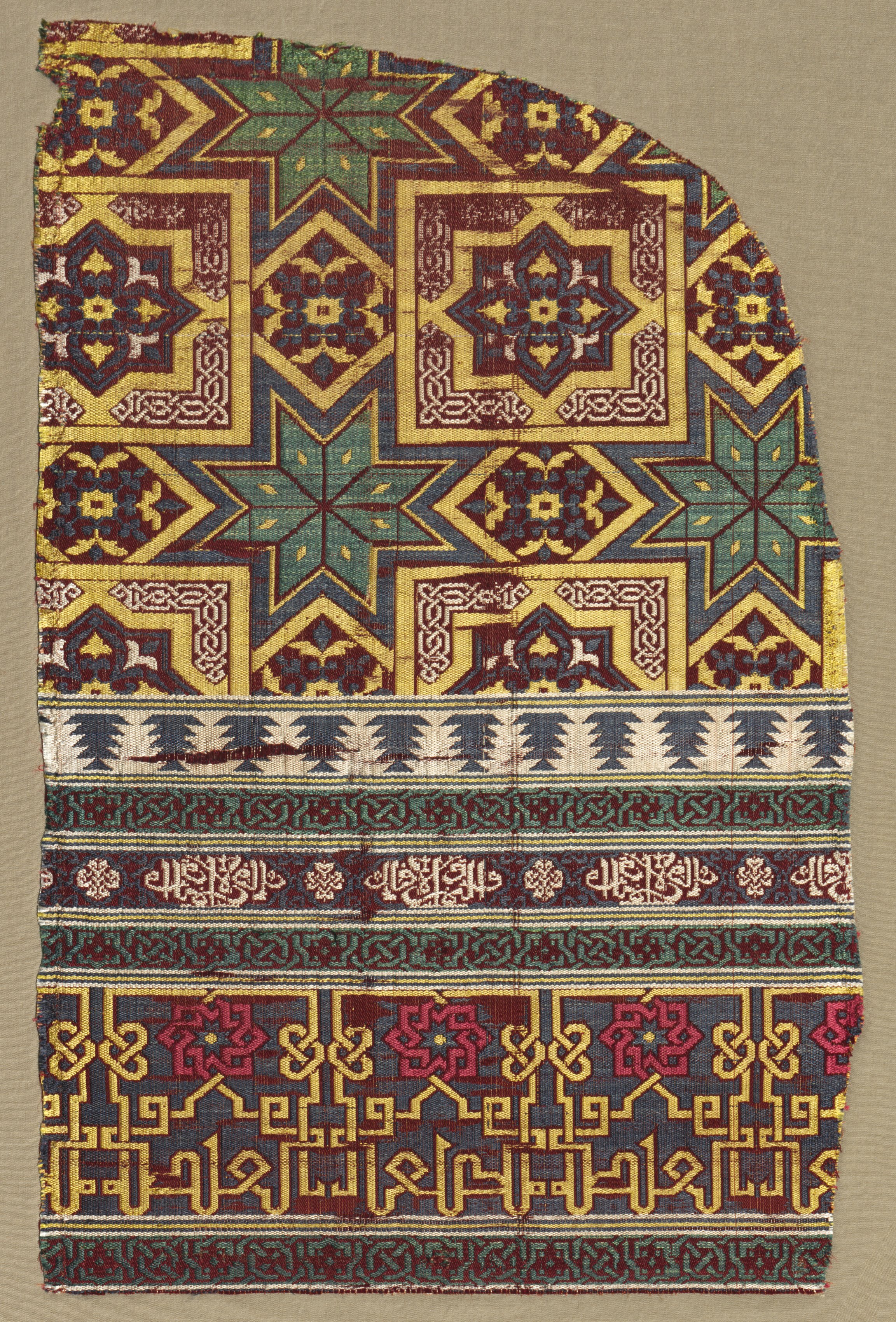
Technical Deconstruction: The Alhambra Fragment
The provided fragment is a masterclass in sophisticated textile engineering from 14th-15th century Nasrid Spain. Its construction utilizes two distinct but complementary weave structures: lampas and taqueté. This is not merely decorative; it is a hierarchical system of structural expression. The taqueté, a weft-faced compound weave, likely forms the dense, colorful ground or primary bands. Its structure creates a smooth, durable surface ideal for showcasing intricate geometric patterns through color blocks. The lampas weave, more complex and often considered the pinnacle of medieval silk weaving, would be employed for the most elaborate decorated bands. Lampas allows for the simultaneous weaving of a ground fabric and a pattern weft, creating raised, detailed motifs with a subtle relief effect. The "DNA" of this textile lies in this very combination—the robust, graphic base of taqueté supporting the ornate, narrative quality of lampas. For Zoey Fashion Lab, this translates to a foundational principle: hybrid construction creates depth and narrative. Avant-garde is not just surface treatment; it is born from the intelligent fusion of structural techniques.
Pattern Analysis: Geometry as Sacred Language
The fragment’s decorated bands are a lexicon of Nasrid art, speaking in a vocabulary of infinite repeat, interlacing, and vegetal stylization. Expect to see complex star polygons, interwoven strapwork (sebka), and highly abstracted palmettes or "ataurique." Crucially, these patterns are non-representational, adhering to Islamic aniconism, yet profoundly expressive. They represent a mathematical ideal, a frozen moment of cosmic order. The patterns do not "end" at the fragment's edge; they imply continuation infinitely in all directions. This is not a floral print; it is a system. For our avant-garde translation, this systemic thinking is key. The pattern is not a motif to be appliquéd, but a living grid that can dictate garment construction—seam lines can follow strapwork, darts can disappear into geometric transitions, and the body itself becomes the frame that continues the infinite pattern.
Avant-Garde Translation: The "New DNA Strand"
The directive to reference a "New DNA Strand" is our core creative catalyst. We are not replicating; we are transcribing the fragment's genetic code into a contemporary genome. The original DNA—Silk, Geometry, Sacred Restraint, Layered Light—must undergo a molecular transformation.
Material Genome Sequencing
Silk remains our foundational amino acid, but its expression mutates. We sequence its properties: luster, fluidity, strength. We then splice this with modern counterparts. Imagine: Bi-Phase Silk: Lamé silk yarns woven with conductive metallic micro-threads, allowing the fabric to carry a low-current luminescence that traces the geometric patterns, literally making the heritage glow. Structural Hybrids: Fusing technical mesh (evoking the openwork of pierced plaster in the Alhambra) with devoré velvet, where the pattern is chemically "burned" away, creating a literal deconstruction of positive and negative space. The taqueté's density is reimagined in neoprene or bonded technical gabardine for sharp, architectural silhouettes, while the lampas' relief is expressed through 3D laser-sintered overlays on liquid jersey.
Pattern Recombinant Engineering
We do not print the pattern; we grow it from the garment's architecture. Using parametric design software, the original geometric bands are fed into an algorithm that maps them onto a 3D body scan. The pattern distorts, stretches, and recomposes according to movement and tension points. A star polygon might expand over the shoulder blade, its points elongating into seams. The interlacing becomes a literal construct—straps, harness detailing, and asymmetric closures that weave across the body. The "infinite repeat" is broken and made finite, focusing the eye on curated fragments of the geometry, much like the original artifact is a fragment of a larger whole.
Proposed Collection Direction: "Nasrid Sequence"
This analysis culminates in a proposed collection direction that embodies the deconstructed principles.
Silhouette & Construction
Silhouettes oscillate between rigid architecture and fluid drape, mirroring the lampas/taqueté duality. Sharp, tailored pieces—a blazer with seam lines derived from geometric banding—are contrasted with bias-cut gowns where the patterns are not printed but created through layered, laser-cut appliqués that cast shadow-play on the body. Modularity is key: bands of different techniques (a ribbed knit band, a technical woven band, a luminescent band) can be assembled and reassembled, allowing the wearer to construct their own "fragment."
Color & Finish
The original fragment's palette—likely deep reds, blues, golds, and ivories—is distilled into a modern, mineral-based spectrum: Alhambra Ochre, Patina Verdigris, Starlight White, and Deep Cistern Blue. The true avant-garde play is in finish and interaction. Fabrics are treated with prismatic coatings that fracture light, so color shifts as the wearer moves. Matte and lustrous textures are juxtaposed within a single garment, echoing the differential sheen of the original weave structures.
Conclusion: The Alhambra fragment is not a relic, but a blueprint. For Zoey Fashion Lab, its value lies in its systemic intelligence: the structural hybridity, the algorithmic patterning, the dialogue between restraint and opulence. By sequencing its DNA and engineering a new strand, we create an avant-garde language that is deeply rooted in technical history yet fundamentally forward-facing. The result is not historical costume, but a wearable manifesto on geometry, light, and the enduring power of woven code.