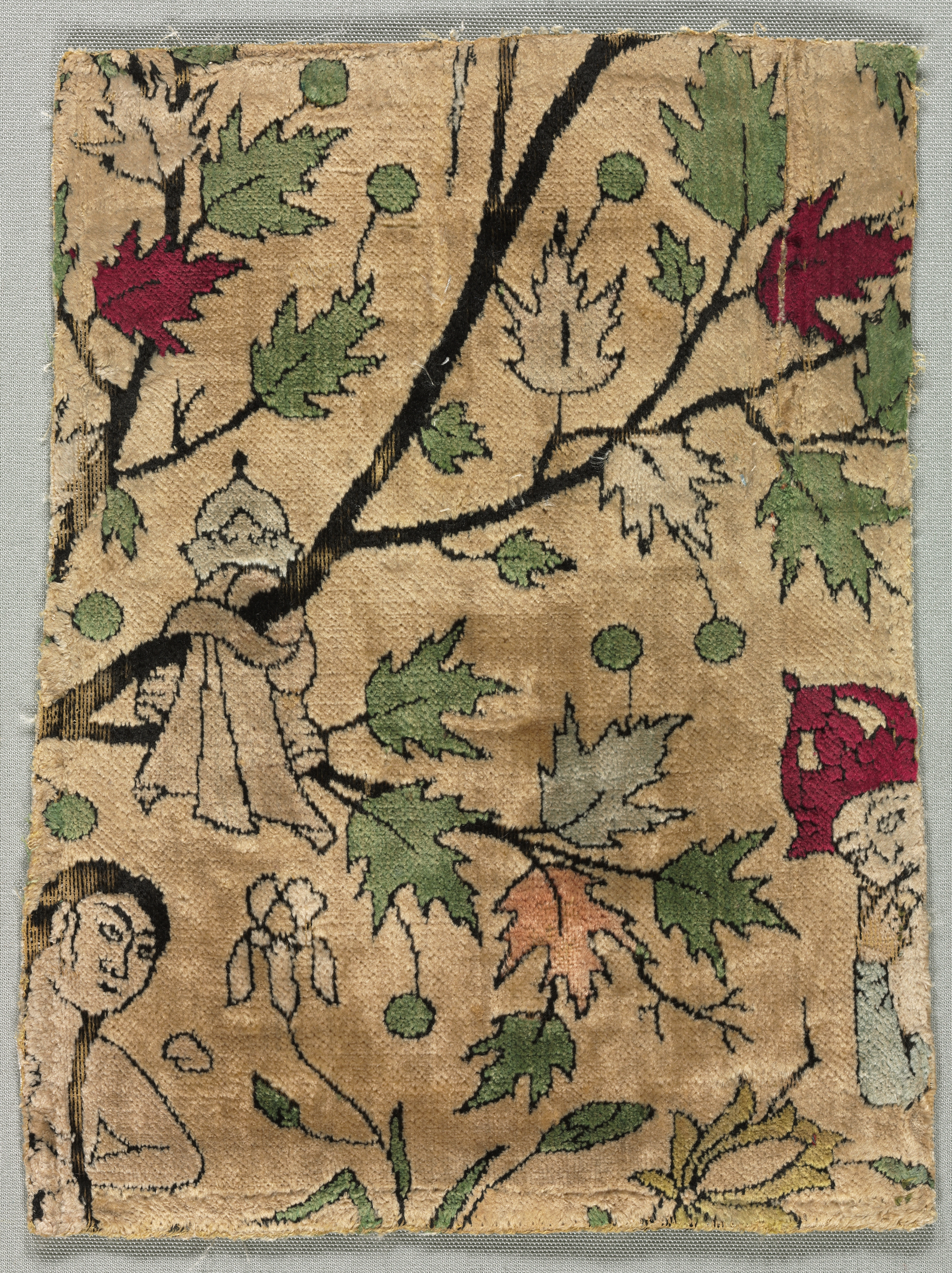
Deconstructing the Haptic: Velvet Fragment, Khusrau Sees Shirin Bathing
At Zoey Fashion Lab, our mandate is not merely to observe historical textiles but to interrogate their structural DNA, extracting the genetic code of their construction to inform a new, avant-garde vernacular. The subject of this analysis is a fragment of profound significance: a Safavid-period velvet from Kashan, Iran (1501-1722), depicting the iconic literary moment of Khusrau Sees Shirin Bathing. This is not a passive relic; it is a repository of radical textile intelligence. By dissecting its technical architecture—specifically its silk composition, cut velvet construction, and the ingenious method of pile-warp substitution—we uncover a blueprint for a new aesthetic language that we term the "New DNA Strand." This analysis will deconstruct the fragment’s material logic and translate its principles into avant-garde design directives for Zoey Fashion Lab.
I. The Material Matrix: Silk as a Conductor of Light and Narrative
The fragment’s primary material, silk, is the foundational element of its optical and tactile power. In the Safavid context, silk was not merely a fiber; it was a medium of imperial prestige and poetic expression. The high-twist, lustrous filament of Iranian silk possesses a unique refractive index, capable of producing a chameleonic sheen that shifts with the angle of observation. For the avant-garde designer, this is not a nostalgic quality but a dynamic, interactive surface. The New DNA Strand interprets this as a directive for responsive materiality—fabric that is not static but performs a dialogue with the wearer and the environment. We are exploring bio-engineered silks and liquid-crystal-infused polymers that mimic this shifting luminosity, creating garments that appear to change color and texture in real-time, echoing the fragment's ability to capture and redirect light.
Furthermore, the narrative content—Khusrau’s voyeuristic glimpse of Shirin bathing—is embedded within the very fibers. The velvet does not merely illustrate a story; it encodes desire and concealment within its structure. The dense pile of the velvet suggests the lush, hidden garden, while the recessed ground (the void) becomes the space of revelation. This duality is a core principle of our avant-garde approach: the garment must simultaneously reveal and conceal, creating a tension between the exposed and the obscured. We translate this into cutouts that are not arbitrary but are strategically placed to mimic the voyeuristic gaze, using sheer panels and engineered negative space that echo the fragment’s narrative of looking and being looked at.
II. The Architecture of Cut Velvet: Sculpting Volume and Void
The technical specification of "cut velvet" is the first critical node in our deconstruction. In this technique, the warp threads are looped over metal rods and subsequently sliced, creating a raised, plush pile. The uncut loops, in contrast, remain as a lower, matte ground. This creates a topographical relief—a sculptural landscape within the fabric itself. The Safavid weavers were masters of this relief, using multiple heights of pile to create a three-dimensional image. For Zoey Fashion Lab, this is a direct antecedent to our exploration of structural draping and three-dimensional printing. We are not interested in flat, two-dimensional garment construction. Instead, we are developing textiles that are pre-sculpted, where the garment's form is intrinsic to the fabric's construction.
The cut-pile technique also speaks to a philosophy of tactile hierarchy. The touch of a cut velvet is an experience of alternating textures: the plush, soft peaks of the pile against the firmer, smoother ground. This haptic contrast is a powerful tool. Our avant-garde collections integrate this principle through the use of laser-cut felt, heat-bonded neoprene, and metallic foils that are applied in patterns mimicking the velvet’s relief. The result is a garment that invites touch, rewarding the observer with a sensory experience that goes beyond the visual. The fragment teaches us that fabric is not a passive surface but an active participant in the wearer's presence, altering the perception of the body beneath it.
III. Pile-Warp Substitution: The Logic of Selective Density
The most sophisticated technical innovation in this fragment is pile-warp substitution. Unlike standard velvet, where the pile is continuous, this technique allows the weaver to introduce different colored or textured pile warps at specific, predetermined points. This is not a printed image; it is a woven one, where each color is a separate, physically present thread. The image of Khusrau and Shirin is not painted on the fabric; it is built into its very skeleton. This is the ultimate form of material intelligence. For the avant-garde, this is a paradigm shift. It moves us away from surface decoration and toward integrated functionality.
We interpret pile-warp substitution as a model for selective performance. In contemporary smart textiles, this principle is being applied to create fabrics with variable thermal regulation, moisture wicking, or even conductive properties that are woven directly into specific zones of a garment. A jacket, for instance, might have a dense, insulating pile in the core, a breathable, open weave at the underarms, and a conductive, metallic warp at the cuffs for touch-screen compatibility—all within a single, seamless piece of fabric. The Safavid fragment is a 500-year-old proof of concept for this kind of zonal engineering. The New DNA Strand at Zoey Fashion Lab is dedicated to pushing this further, integrating micro-LEDs and fiber-optic threads using the same principle of selective substitution, creating garments that are not just worn but are active, communicative systems.
IV. Synthesis: The New DNA Strand and the Avant-Garde Imperative
The velvet fragment of Khusrau Sees Shirin Bathing is more than a historical artifact; it is a masterclass in material poetry and technical audacity. Its avant-garde relevance lies not in its iconography but in its structural philosophy. The Safavid weaver was a radical innovator, pushing the limits of the loom to create a fabric that was simultaneously a painting, a sculpture, and a narrative. At Zoey Fashion Lab, we adopt this ethos. Our New DNA Strand is a methodology that treats fabric as a living system, capable of light, movement, and selective response.
Our designs, inspired by this fragment, will not replicate its floral motifs or courtly scenes. Instead, we will distill its core principles: the optical dynamism of silk, the sculptural relief of cut pile, and the selective logic of warp substitution. We will create garments that are asymmetrical, with built-in volumes that shift with the body's motion. We will use color not as decoration but as a structural element, woven in to create depth and shadow. We will employ modern equivalents of pile—from flocked surfaces to 3D-printed lattices—to create a new kind of haptic luxury. The result will be a collection that is undeniably avant-garde, yet deeply rooted in the most sophisticated textile engineering of the past. The fragment is not a mirror to the past; it is a lens to the future, and Zoey Fashion Lab is using it to forge a new path in wearable art.