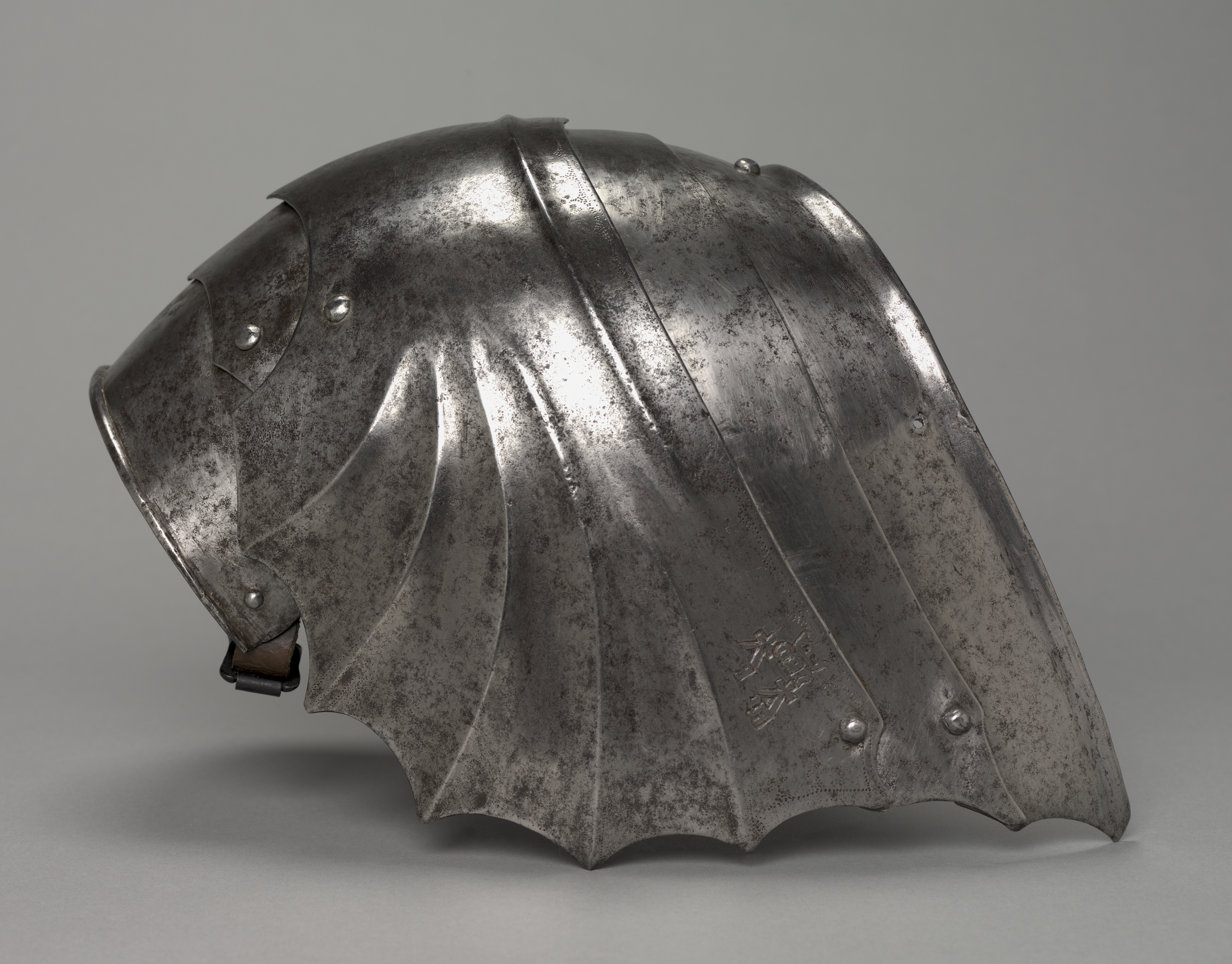
Deconstructing the Milanese Shadow: The Gothic Fan-Shaped Pauldron as Avant-Garde DNA
At Zoey Fashion Lab, our mandate extends beyond the mere cataloging of garments. We dissect the skeletal architecture of historical dress to extract the genetic code that can be re-sequenced into future-forward silhouettes. Today’s subject—the Gothic Fan-Shaped Pauldron (left), forged in Milanese steel circa the late 15th century—presents a paradox. It is a relic of defensive warfare, yet its sculptural arrogance and asymmetric geometry render it a progenitor of contemporary avant-garde design. This analysis deconstructs the pauldron not as armor, but as a prototype for wearable architecture, a "New DNA Strand" that challenges the relationship between the human form and its metallic exoskeleton.
I. Metallurgical Semiotics: Steel as a Second Skin
The technical specification of the piece—steel—is not a passive material choice but an active agent in its aesthetic terrorism. Milanese steel of this period was renowned for its high carbon content and meticulous tempering, allowing for plates that were simultaneously rigid and remarkably thin. In the context of the avant-garde, this steel is not merely protective; it is a declaration of intent. Unlike the supple draping of silk or the pliable stretch of jersey, steel refuses to conform. It imposes its own will upon the body, creating a negative space that the wearer must inhabit.
For Zoey Fashion Lab, this translates into a design philosophy of controlled aggression. The pauldron’s surface, likely polished to a mirror sheen or left with a subtle patina, interacts with light as a dynamic, shifting canvas. In our reinterpretations, we explore how this metallic skin can be oxidized, brushed, or laser-etched to produce a textural dissonance—a dialogue between the brutalist reality of the forge and the delicate precision of the atelier. The steel is not a costume; it is a structural exoskeleton that redefines the wearer’s posture, forcing a carriage of defiance that is inherently theatrical.
II. The Fan Form: A Study in Asymmetric Dynamics
The defining feature of this pauldron is its fan-shaped articulation. Composed of overlapping lames that radiate outward from the shoulder joint, the form is a masterclass in functional engineering and visual drama. This is not a symmetrical, mirrored piece; it is a left-side component, designed to be worn in counterpoint to the right. This asymmetry is the seed of its avant-garde DNA. In historical context, the fan shape allowed for arm mobility while deflecting blows. In our contemporary lens, it becomes a kinetic sculpture that moves with the body, each lame catching light and shadow in a perpetually shifting tableau.
The fan’s expansion creates a powerful silhouette of magnification. It visually amplifies the shoulder, creating a triangular, almost predatory profile. This is a direct challenge to the minimalist, body-hugging norms of modern fashion. The avant-garde designer’s task is to harness this expansion—to translate the rigid fan into flexible materials like molded leather, resin, or even 3D-printed polymers—while retaining its visual force. The pauldron teaches us that protection can be reimagined as provocation, that the most compelling fashion often arises from a distortion of the human silhouette.
III. The New DNA Strand: Decoding for the Modern Atelier
To treat this pauldron as a "New DNA Strand" is to isolate its core genetic markers: articulation, asymmetry, and volumetric expansion. In our lab, we have extracted these markers to generate a series of experimental prototypes. The first is a shoulder cage constructed from interlocking carbon-fiber lames, worn over a sheer, liquid-silk base. The lames are not riveted but connected via micro-hinges, allowing for a fluidity that the original steel could never achieve. This is the pauldron’s DNA spliced with biomechanics.
A second iteration explores the fan form in a deconstructed knit. Using a jacquard loom, we have engineered a fabric that mimics the graduated ridges of the steel fan, but in a pliable, body-conscious form. This knit is then anchored at the shoulder with a single, polished steel clasp—a literal reference to the original—while the rest of the garment dissipates into an asymmetrical train. The result is a garment that is both armor and whisper, a study in the tension between hardness and softness.
This genetic material also informs our approach to garment construction. The pauldron’s lames are a lesson in modularity. Each piece is individually shaped and then assembled, creating a whole that is greater than the sum of its parts. We apply this principle to modern tailoring, creating jackets with removable, fan-like epaulettes that can be reconfigured for different occasions. The wearer becomes the armorer, actively participating in the garment’s transformation.
IV. Avant-Garde Context: From Battlefield to Catwalk
The leap from 15th-century Milan to the contemporary runway is less radical than it appears. The avant-garde is, at its core, a movement of estrangement—making the familiar strange. The pauldron, divorced from its martial purpose, becomes a tool of psychological armor. It shields not from swords, but from the banality of conventional dress. Designers like Rei Kawakubo or Yohji Yamamoto have long mined this territory, using exaggerated shoulders and sculptural forms to challenge normative beauty. The Gothic pauldron is a historical precedent for their work, a tangible proof that the body can be a canvas for radical geometric expression.
Our analysis concludes that this Milanese artifact is not a relic but a prophecy. It foretells a fashion where clothing is not merely worn but inhabited; where each piece is a statement of individual power and aesthetic rebellion. The fan-shaped pauldron, in its cold steel glory, whispers to us across centuries: the body is not a limit, but a launching point. At Zoey Fashion Lab, we are listening, and we are forging the next iteration of this metallic dream.
V. Technical Preservation and Future Application
Finally, the technical preservation of the piece informs our material research. The original steel’s resilience and its ability to hold a precise edge are qualities we seek to replicate in sustainable, high-performance fabrics. We are experimenting with recycled metal-infused textiles and bio-resins that offer similar structural integrity without the weight. The pauldron’s left-side orientation also prompts a discussion on asymmetric design systems—how a single, dominant element can unbalance a composition in a way that is visually arresting. This is not a flaw but a feature, a deliberate disruption that forces the eye to travel, to engage, and to question. The Gothic fan-shaped pauldron is thus not a costume piece for historical reenactment; it is a blueprint for the future of sculptural fashion, a metallic strand of DNA that will continue to mutate and inspire for generations to come.