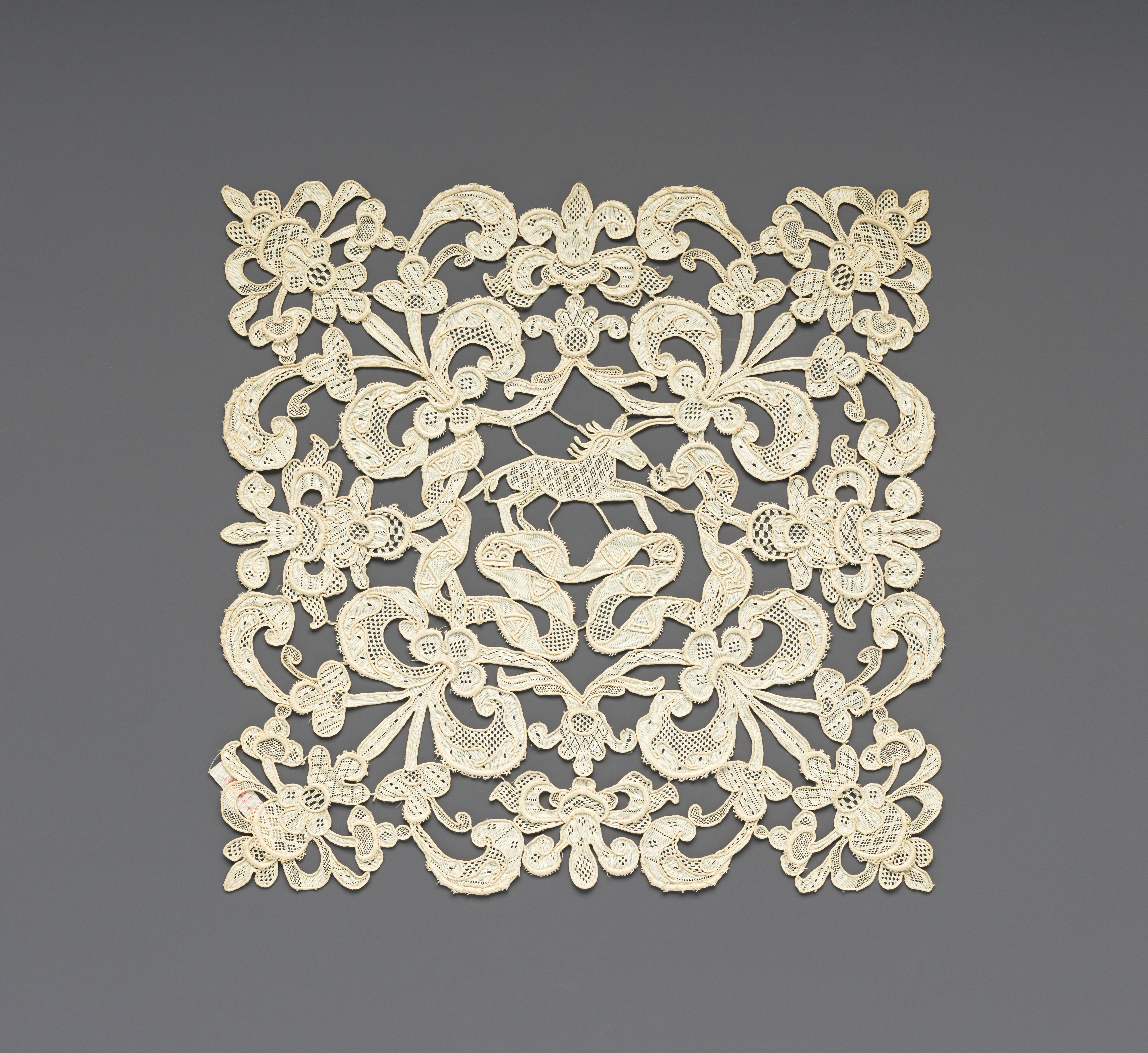
The Chalice Veil: A Structural Reckoning in Needle Lace
In the relentless trajectory of contemporary fashion, the chalice veil emerges not as a nostalgic relic but as a radical proposition—a tectonic shift in how we perceive drapery, volume, and the very architecture of the female form. For Zoey Fashion Laboratory’s SS26 directive, this garment is dissected not as a ceremonial accessory but as a standalone study in negative space, gravitational defiance, and the alchemy of handcrafted rigidity. The chalice veil, in its canonical form, is a study in concealment. Yet, in our avant-garde reconfiguration, it becomes a tool of exposure—exposing the structural logic of the body through a lens of futuristic silhouette.
The material substrate, needle lace, is typically relegated to the lexicon of heritage and heirloom. We reject this passivity. Under the laboratory’s lens, needle lace is transmuted into a semi-rigid composite, a lattice of micro-architecture that holds its own against the forces of motion. The SS26 iteration does not drape; it stands. The lace is treated with a bio-resin finish, allowing each loop and knot to function as a load-bearing node. This is not the soft, yielding lace of a Victorian collar. This is a lace that has been trained, disciplined, and weaponized into a sculptural exoskeleton. The result is a garment that hovers between textile and armor, a futuristic carapace that whispers of digital fabrication yet is entirely hand-wrought.
Deconstructing the Silhouette: From Chalice to Column
Traditional chalice veils are defined by their conical fall, a funneling of fabric that mimics the liturgical vessel. Our SS26 proposition subverts this geometry. We invert the chalice. The veil now originates at the shoulders, flaring outward to a dramatic, cantilevered hem that hovers inches above the ground. This inverted chalice silhouette creates a powerful visual paradox: the garment appears to be suspended in a state of perpetual levitation. The internal structure, a hidden lattice of memory wire and micro-carbon ribs, is entirely invisible, allowing the needle lace to appear as if it has been frozen mid-air. This is the core of our structural innovation—a zero-gravity drape that challenges the Newtonian expectations of fabric behavior.
The futuristic silhouette is further articulated through strategic fenestration. Rather than using the veil as a monolithic shield, we have excised geometric apertures—triangular, rhomboid, and elliptical—that trace the body’s kinetic meridian. These are not random cutouts; they are calculated negative spaces that reveal the kinetic energy of the wearer. As the model moves, the lace’s rigid lattice interacts with these apertures, creating a moiré effect of shadow and light. The body becomes a projector, and the veil becomes a screen for a constantly shifting pattern of luminosity. This interplay is not merely aesthetic; it is a commentary on the future of wearable technology, where garments become responsive interfaces between the self and the environment.
Material Alchemy: The New Rigidity of Lace
The choice of needle lace is a deliberate act of subversion. In the hands of Zoey Fashion Laboratory, this delicate craft is subjected to a process of thermal reformation. The lace is hand-molded over three-dimensional armatures, then heat-set to lock in a permanent, undulating topography. The result is a fabric that possesses the tensile strength of a composite material while retaining the intricate, almost fractal, visual complexity of its handmade origins. Each piece is unique, its imperfections celebrated as evidence of human intervention in a world increasingly dominated by algorithmic perfection.
This material treatment allows for a new taxonomy of garment construction. The chalice veil is no longer a single, draped entity. It is a modular system. The veil can be disassembled into three distinct components: the collar chassis, the coronal midriff, and the basal train. Each component is independently articulated, allowing for a range of silhouettes from a sharp, shoulder-hugging capelet to a full, cathedral-length statement. This modularity is the future of haute couture—a move away from static garments toward adaptive, transformative pieces that respond to the wearer’s context and ritual.
Contextualizing the Global Frontier
Our “Global Frontier” origin is not a geographical marker but a conceptual one. It represents a synthesis of disparate cultural techniques—the geometric precision of Andean backstrap weaving, the airy filigree of Venetian lace, and the brutalist structuralism of contemporary Japanese design. The chalice veil, in this iteration, is a borderless object. It speaks to a world where craft is not bound by nationality but by a shared commitment to material truth. The veil’s color palette—a stark, undyed ecru punctuated by panels of iridescent, mineral-infused thread—reflects this frontier. It is a palette of the earth and the machine, of raw organic matter and polished cybernetic surfaces.
The structural innovation of SS26 lies in the veil’s ability to redefine the wearer’s posture. The rigid collar chassis forces a subtle elongation of the cervical spine, while the weight distribution of the coronal midriff encourages a deliberate, measured gait. This is not a garment that adapts to the body; it is a garment that re-architects the body. The wearer becomes a moving sculpture, a living testament to the power of couture to dictate physical presence. In a future where digital avatars dominate, the chalice veil asserts the primacy of the physical—a tactile, volumetric, and undeniably human artifact.
As we conclude this standalone study, the chalice veil stands as a testament to the laboratory’s core thesis: that the most radical future lies not in new technologies but in the re-imagination of ancient ones. By weaponizing needle lace, inverting the chalice silhouette, and embracing modular construction, we have created a garment that is both a relic of a forgotten future and a blueprint for the next century of fashion. It is a quiet, powerful rebellion against the flatness of the digital age—a three-dimensional manifesto in thread and air.