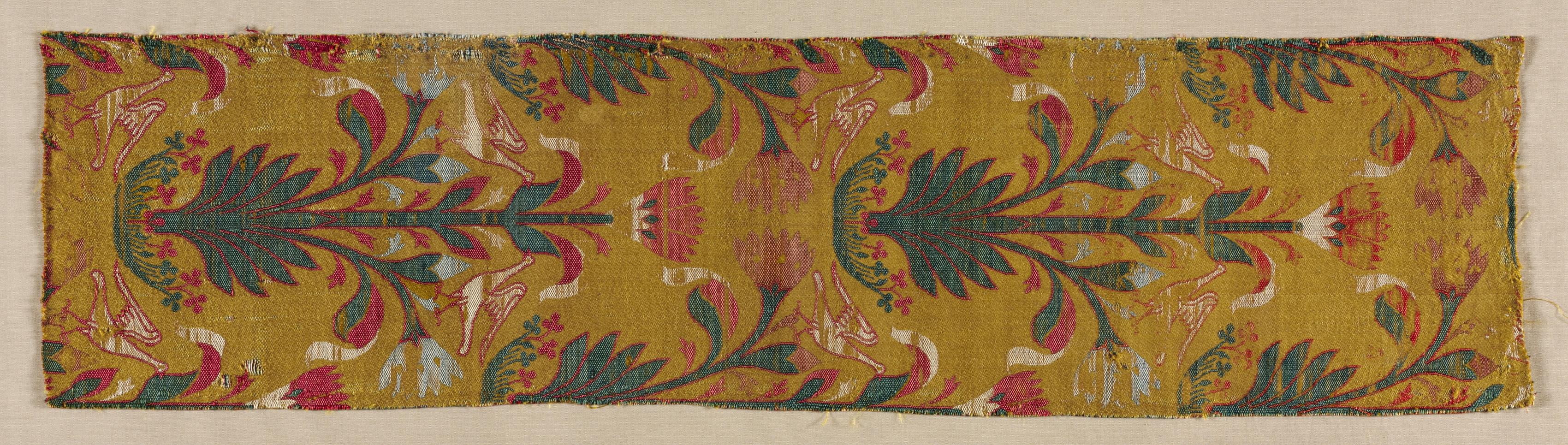
Deconstructing the Genetic Code of Andalusian Luxury: The Silk Fragment as a New DNA Strand
At Zoey Fashion Lab, our mandate transcends the mere observation of historical textiles. We approach each artifact not as a relic to be preserved under glass, but as a living biological specimen—a strand of cultural DNA whose double helix can be unzipped, decoded, and re-spliced into the avant-garde silhouettes of tomorrow. The subject of this analysis, a 15th-century Mudejar silk fragment from Spain, executed in a complex lampas weave, presents a particularly potent genetic sequence. Its technical sophistication, cultural hybridity, and material opulence offer a blueprint for a new aesthetic language, one that speaks fluently in the dialect of rupture, reconstruction, and radical beauty.
I. The Genetic Sequence: Technical Mastery of the Lampas Weave
The lampas weave is not a simple textile; it is a structural paradox. It is a compound weave system that employs two distinct sets of warps and wefts—a ground weave, typically a plain or twill, and a pattern weave, often a satin or twill, which floats across the surface to create the figural design. The technical genius of the Mudejar weavers lies in their ability to orchestrate this dual system into a single, cohesive fabric. The ground provides structural integrity, a silent, unyielding skeleton, while the pattern weft acts as the expressive voice, laying down lustrous, unbroken threads of silk that catch light with a liquid, almost metallic sheen.
For Zoey Fashion Lab, this structural duality is a direct metaphor for the contemporary avant-garde. We are not interested in flat, singular narratives. The lampas weave offers a tectonic layering that we can translate into three-dimensional garment construction. Imagine a bias-cut gown where the ground weave is represented by a rigid, architectural underlay of bonded organza, while the pattern weft manifests as a floating, independent layer of iridescent silk taffeta, cut on the cross-grain and allowed to billow and detach from the body. The garment would possess a kinetic tension—a visible dialogue between the internal structure and the external, expressive surface. This is not mere decoration; it is engineered movement.
II. Cultural Hybridity: The Mudejar Signature as a Post-Modern Precedent
The term "Mudejar" refers to the Muslims who remained in Christian Spain after the Reconquista, and their art is a profound testament to cultural coexistence. This fragment is not purely Islamic nor purely Christian; it is a synthesis. The interlacing geometric motifs, the arabesque foliage, and the stylized Kufic inscriptions—if present—are filtered through a Hispano-Flemish aesthetic that favored heraldic beasts and courtly scenes. This fusion is not a compromise; it is a creative mutation. It demonstrates that the most innovative art arises not from purity, but from the friction of divergent traditions.
In our avant-garde practice, this historical precedent validates our own methodology of radical collage. We reject the tyranny of a single source. The Mudejar fragment teaches us that identity is fluid, that a garment can be a palimpsest of influences. For our new collection, we propose a series of looks that splice the visual vocabulary of this fragment with the brutalist geometry of contemporary architecture. A tailored blazer, for instance, might feature the fragment's intricate, repeating stars laser-cut into a rigid, matte-black leather, creating a shadow-play that echoes the original's interplay of light and void. The sleeves would be reconstructed from a deconstructed, de-threaded silk jacquard, leaving only the warp threads hanging like a spectral fringe, evoking the fragment's own structural dissolution. This is not cultural appropriation; it is cultural re-sequencing, a respectful but radical re-reading of a shared heritage.
III. Material Alchemy: Silk as a Liquid Metal
The material itself—silk—is the primary protagonist. In its raw state, silk is a continuous protein filament, a liquid crystal extruded by a silkworm. In the 15th century, its production was a closely guarded secret, and its trade was worth more than gold. The Mudejar weavers exploited silk's unique optical properties: its triangular cross-section acts as a prism, refracting light to produce a shimmering, iridescent effect that changes with the viewing angle. This is not a static color; it is a dynamic chromatic event.
Zoey Fashion Lab's avant-garde interpretation must amplify this inherent alchemy. We will not treat silk as a delicate, precious material to be handled with reverent caution. Instead, we will subject it to processes of transformation that border on the violent. We propose a technique of thermal shock treatment: silk satin will be pleated, then rapidly heated and cooled, causing the fibers to permanently deform into sharp, sculptural ridges that mimic the topography of the original fragment's woven relief. This creates a fabric that is simultaneously soft and rigid, fluid and architectural. In another iteration, we will treat the silk with a micro-encapsulated metallic finish, not a flat foil, but a suspension of iron particles that oxidize over time, creating a living patina on the garment's surface. The wearer would not just wear a dress; they would wear a living artifact, a piece of jewelry that breathes and changes.
IV. The New DNA Strand: A Design Manifesto
Our analysis concludes with a synthesis. The Mudejar silk fragment is not a historical curiosity; it is a genetic blueprint for a new mode of dress. Its technical complexity challenges us to engineer garments with multiple, interactive layers. Its cultural hybridity licenses us to fuse disparate sources without anxiety. Its material opulence demands a radical, transformative approach to textile manipulation.
We propose a capsule collection titled "Iberian Chromosome." The key looks will include:
1. The Structural Gown
A floor-length column constructed from a double-faced silk lampas, but woven on a modern, computerized jacquard loom with a subversive twist: the pattern weft is not silk, but a fine, high-tensile steel thread. The result is a fabric that is soft to the touch but possesses an internal, unyielding memory. The garment can be crushed, twisted, and folded into a compact form, yet will spring back to its original, voluminous silhouette when released. This is programmable drapery, a direct descendant of the Mudejar weaver's control over their dual-warp system.
2. The Deconstructed Overcoat
An oversized, asymmetric coat where the front is a pristine panel of the original fragment's pattern, digitally printed onto a heavy silk velvet, while the back is a chaotic, deconstructed lattice of exposed seams, raw edges, and floating warp threads. This garment is a visible deconstruction, exposing the very mechanics of its construction, much like the back of a tapestry reveals the loose threads and knots that hold the image together.
3. The Kinetic Bodice
A sculptural bodice that uses the lampas principle of independent layers. A rigid, corseted base of molded resin is overlaid with a series of individually articulated silk petals, each attached on a micro-hinge. As the wearer moves, the petals open and close, revealing and concealing the body in a constant, organic flux. This is living architecture, a wearable interpretation of the fragment's interlacing, non-linear geometry.
In conclusion, the 15th-century Mudejar silk fragment is not merely a textile; it is a catalyst for innovation. By decoding its structural DNA—its dual-weave technology, its cultural fusion, and its material intelligence—Zoey Fashion Lab can forge a new avant-garde that is deeply rooted in history yet radically future-facing. We do not copy; we re-sequence. We take the ancient strand and splice it with the contemporary, creating a new genetic code for fashion that is as complex, as beautiful, and as enduring as the original.