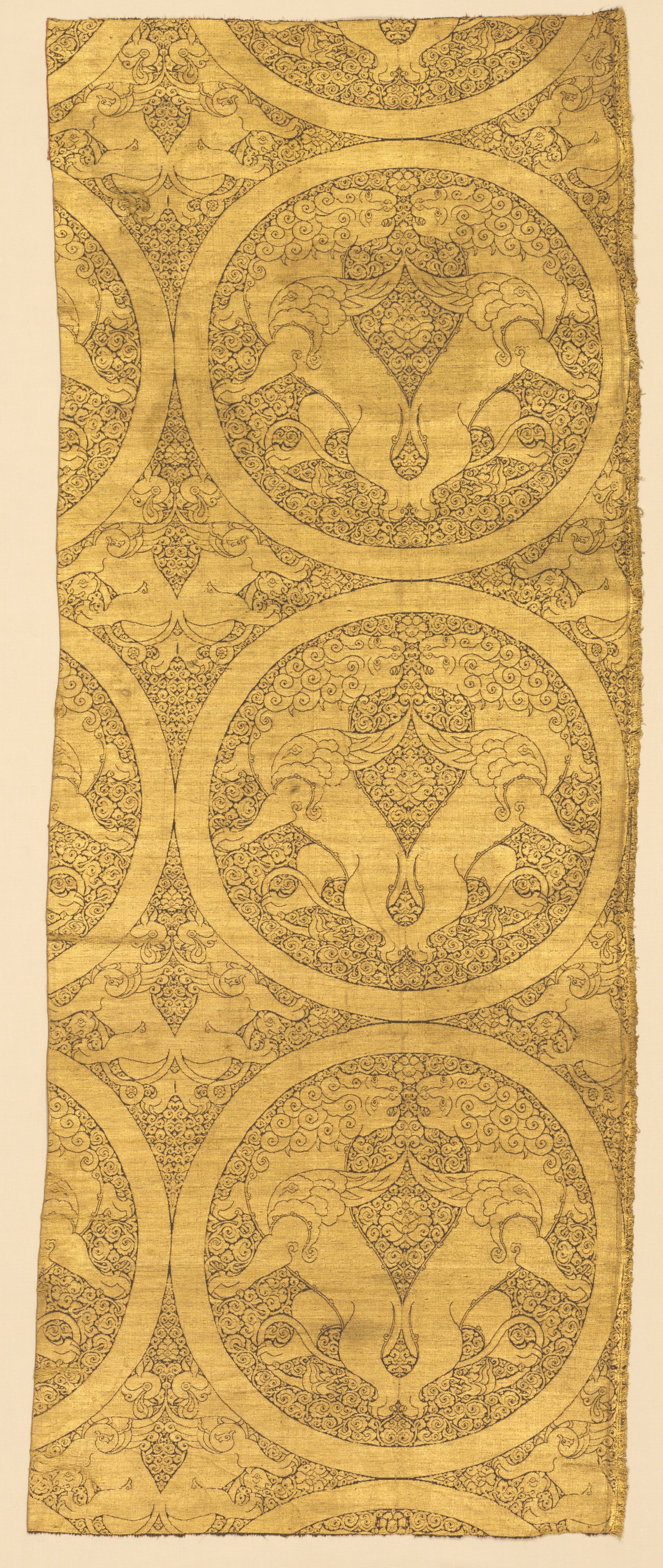
Deconstructing the Luminous Beast: A Technical and Conceptual Analysis of the Central Asian Cloth of Gold
At Zoey Fashion Lab, our mandate transcends the mere replication of historical textiles. We engage in a process of fabric deconstruction, dissecting not only the physical warp and weft but also the socio-cultural DNA embedded within each thread. The subject of today’s analysis—a fragment of Central Asian cloth of gold featuring winged lions and griffins—presents a fascinating paradox. It is a relic of imperial power and nomadic mysticism, yet its technical DNA shares a startling affinity with the principles of modern, avant-garde construction. This analysis will dissect the artifact’s materiality, its symbolic lexicon, and its structural logic, ultimately proposing a new design framework that we term the “New DNA Strand.”
I. Technical Autopsy: The Lampas Weave as Proto-Structural Engineering
The technical specification—silk and gold thread, lampas—is not a simple descriptor but a blueprint for a sophisticated structural system that predates modern composite materials by centuries. The lampas weave is a compound structure, typically featuring two warps and two wefts. In this Central Asian example, the ground weave is a fine, closely-set silk, providing a supple and drapable base. The pattern weave, however, is where the genius lies. Here, a secondary weft of gilded gold thread (often silver-gilt on a silk core) is floated across the surface to create the design.
From a deconstructionist perspective, this is not mere decoration. The gold thread functions as a structural exoskeleton. The silk warp maintains tensile integrity and flexibility, while the gold weft introduces a rigid, non-elastic compressive strength. This dual-system is the exact logic found in modern carbon-fiber or fiberglass composites. The gold does not simply sit on top; it is interlocked into the silk matrix, creating a fabric that is simultaneously flexible and unyielding. For the avant-garde designer, this suggests a radical departure from drape-based design. Instead, we can conceive of garments that hold their own architectural shape—sharp, geometric shoulders that do not require padding, or sculptural collars that stand away from the body without interfacing. The lampas structure offers a self-supporting textile architecture.
II. The Symbolic Lexicon: Winged Lions and Griffins as Avant-Garde Personas
The iconography—winged lions and griffins—is not arbitrary. These are not passive motifs; they are active agents of power and protection. The griffin, a chimera of eagle and lion, represents dominion over both earth and sky. The winged lion, often associated with royal or solar divinity, embodies a fusion of terrestrial strength and celestial transcendence. In the context of Central Asian courts along the Silk Road, these creatures were not mere mythological decorations; they were political propaganda woven in gold, asserting the wearer’s connection to divine authority and their control over vast trade networks.
For Zoey Fashion Lab’s avant-garde narrative, we reinterpret these beasts not as historical curiosities but as psychological archetypes. The winged lion becomes a metaphor for the modern, multifaceted identity—grounded in reality yet capable of soaring into the digital or conceptual realm. The griffin represents the hybridity of contemporary fashion itself, a fusion of disparate elements (technology and craft, structure and fluidity). In our new collection, we do not reproduce these creatures literally. Instead, we abstract their essence into geometric talismans. A sharp, angular lapel might echo a lion’s mane; a sleeve construction that flares asymmetrically could suggest a folded wing. The garment becomes a protective armor for the modern individual, a suit of psychological resilience.
III. The New DNA Strand: Translating Ancient Logic into Modern Form
The “New DNA Strand” is our internal codename for this translation process. It acknowledges that the original fabric is a genetic code—a sequence of material choices, structural decisions, and symbolic meanings. Our task is to extract this code, mutate it, and re-sequence it for a contemporary context. This involves three distinct phases:
Phase One: Material Mutation. The original uses gold thread, which is heavy and costly. In our avant-garde iteration, we replace the metal with lightweight, high-luster polymer films or recycled metallic yarns. The silk base is substituted with a technical microfiber or a bio-based nylon that offers superior moisture-wicking and stretch recovery. The structural logic of the lampas remains—the dual-warp system—but the materials are updated for performance and sustainability. The result is a fabric that looks like cloth of gold but behaves like activewear, offering the wearer unrestricted movement while maintaining a metallic, sculptural presence.
Phase Two: Pattern Deconstruction. Instead of weaving a full, realistic griffin, we deconstruct the creature’s anatomy into a binary grid. The curve of a wing is translated into a series of sharp, faceted polygons. The lion’s muscular haunch becomes a series of overlapping, asymmetrical darts. These geometric abstractions are then woven into the fabric using a jacquard loom, but the pattern is randomized in scale and placement. This creates a digital camouflage of myth—from a distance, the garment appears to be a shimmering, metallic surface. Up close, the wearer and observer discover the fragmented, coded language of ancient power.
Phase Three: Garment Architecture. The final step is the cut. Traditional tailoring relies on seams to create shape. Our approach, informed by the lampas’ self-supporting nature, uses zero-waste, origami-inspired folding. The fabric is pleated and folded to create volume, with the metallic weft acting as a “memory wire” that holds the fold in place. A jacket, for instance, is not sewn from panels but folded from a single, continuous piece of fabric. The resulting silhouette is stark, almost brutalist, yet it moves with a fluid, organic quality—a direct contradiction that mirrors the griffin’s dual nature. The garment is a wearable sculpture, a piece of architectural armor that is both ancient and futuristic.
IV. Conclusion: From Relic to Prototype
The Central Asian cloth of gold is not a dead artifact. It is a living blueprint. By deconstructing its technical weave, we uncover a proto-composite material logic. By analyzing its iconography, we find a universal language of power and hybridity. By re-sequencing this DNA through the “New DNA Strand” methodology, we produce garments that are not mere costumes but functional prototypes for a new kind of luxury—a luxury defined not by opulence alone, but by intelligence, structural innovation, and a deep, resonant connection to the past. At Zoey Fashion Lab, we do not copy history; we re-animate its genetic code to create the future of fashion.