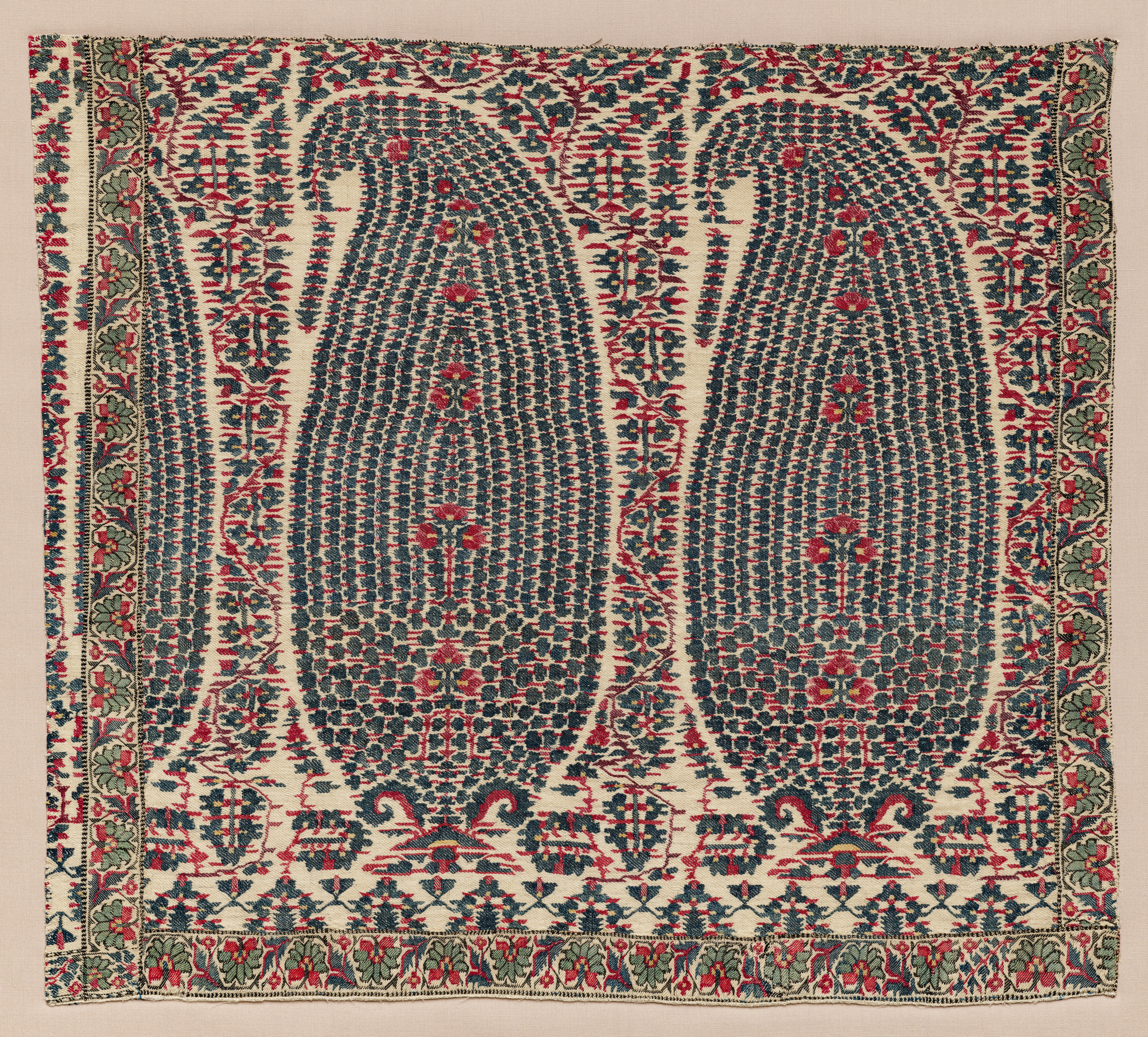
Deconstructing the Archive: The Kashmir Shawl Border as Avant-Garde Blueprint
At Zoey Fashion Lab, our mandate transcends the mere reproduction of historical garments. We engage in a practice of fabric deconstruction—a forensic and poetic excavation of textile artifacts to extract their latent, radical potential. Today, our subject is a fragment of a shawl border from Kashmir, a piece that on the surface speaks of imperial luxury, but beneath its woven surface holds a blueprint for a distinctly avant-garde aesthetic. This analysis will dissect the technical, cultural, and philosophical layers of this fragment, revealing how its ancient logic can be re-coded for contemporary, disruptive fashion.
Technical Autopsy: The Logic of Tapestry Twill
The fragment’s construction—wool and silk in tapestry twill—is not a mere historical footnote; it is the primary source of its structural genius. Unlike conventional weaving where weft threads are shot across the entire width, tapestry twill employs discontinuous wefts, each color worked back and forth only within its designated design area. This creates a fabric that is simultaneously structurally rigid and visually fluid. The wool provides a matte, resilient ground, while the silk wefts introduce a lustrous, almost liquid counterpoint. The twill interlacing, as opposed to a plain weave, allows for a diagonal, supple drape that defies the stiffness one might expect from a tapestry.
For the avant-garde designer, this technique is a manifesto against the tyranny of the seamless. The fragment reveals that beauty can be constructed from deliberate interruption. Each color block is a discrete event, a pixel of intention, that only coalesces into a coherent image at a distance. This is not a print; it is a three-dimensional, tactile architecture of thread. The deconstructionist eye sees not a finished border, but a system of modular, interlocking components—a precursor to modern digital weaving and algorithmic pattern generation. The fragment’s edge, likely a selvedge or a deliberately finished terminus, is not a boundary but a statement of self-containment, a complete world within a finite frame.
Cultural Palimpsest: The Resonance of the Archive
The provided archive resonance—“在人类文明的长河中,器物与绘画不仅是时代技艺的结晶,更是文化碰撞与美学交融的无声见证” (In the long river of human civilization, objects and paintings are not only the crystallization of the era’s techniques, but also the silent witnesses to cultural collision and aesthetic fusion)—is critical to our interpretation. Dating from the 16th to 17th centuries, this fragment is not a purely “Kashmiri” object. It is a product of the Mughal court’s Persianate aesthetic, which itself absorbed influences from Central Asia, China, and, through trade, the European Renaissance. The stylized floral motifs, the cypress forms, and the intricate arabesques are not naive depictions of nature; they are a sophisticated visual language of political power and spiritual cosmology.
This cultural palimpsest is the avant-garde’s raw material. We do not view this fragment as a relic to be preserved under glass, but as a node in a network of global exchange. The “collision” mentioned in the archive is precisely the generative force we seek. To wear this fragment today is not to cosplay as a Mughal noble; it is to acknowledge that identity is always hybrid, always constructed from borrowed and re-contextualized elements. The avant-garde act is to take the border—a liminal, decorative space—and make it the center. The fragment’s status as a fragment, severed from its original whole, is its most potent asset. It embodies incompleteness as a philosophical stance, rejecting the totalitarian logic of the “complete garment” in favor of a narrative that is open, partial, and suggestive.
Avant-Garde Re-coding: From Ornament to Structure
How does Zoey Fashion Lab translate this analysis into a forward-looking aesthetic? We propose a three-pronged strategy of re-coding.
1. Scale and Proportion Distortion
The original border is a subordinate element, framing a larger shawl. Our first act of deconstruction is to explode the scale. We will magnify the border’s intricate pattern to a monumental proportion, making it the entire garment’s surface. The delicate, miniature floral motifs become abstract, almost topographic landscapes when enlarged. The twill’s diagonal structure becomes a bold, architectural ribbing. This is not a print enlargement; we will use jacquard weaving with discontinuous wefts to replicate the original’s tactile depth, creating a fabric that is a literal, oversized translation of the fragment’s logic. The garment becomes a walking archive, where the border’s “frame” has swallowed the “picture.”
2. Material Subversion
We will honor the original’s wool and silk duality but introduce a third, disruptive element: recycled metallic thread or even bio-based iridescent filaments. This is not ornamentation; it is a commentary on the historical value system. The original silk’s luster signified wealth and imperial access. Our metallic thread, sourced from industrial waste, signifies a post-industrial, circular economy. The fabric will retain the matte/lustrous tension of the original, but the luster will now be tinged with a dissonant, almost cybernetic glow. This is a deliberate anachronism, a glitch in the historical record that forces the viewer to question the material hierarchy of luxury.
3. Structural Fragmentation
The most radical act is to embrace the fragment’s inherent incompleteness. We will design garments that are deliberately unfinished. Jackets with raw, un-hemmed edges that echo the fragment’s cut. Dresses that feature detachable panels, each a complete tapestry in itself, allowing the wearer to reconstruct the garment daily. This is not deconstruction for its own sake; it is a philosophical statement about the fluidity of identity and the rejection of fixed forms. The wearer becomes a co-author, a curator of their own sartorial narrative. The garment is no longer a static object but a dynamic system of possibilities, mirroring the fragment’s own journey through time.
Conclusion: The Fragment as Future
This Kashmir shawl border, a silent witness to centuries of cultural exchange, is not a relic of the past. It is a prophetic text for the future of fashion. Its technical sophistication (tapestry twill) teaches us about modular construction and tactile depth. Its cultural hybridity reminds us that purity is a myth and that innovation arises from collision. Its fragmented state offers a model for a post-modern aesthetic that values the partial over the complete, the suggestive over the declarative.
At Zoey Fashion Lab, we do not preserve the archive; we detonate it. We extract the structural DNA of this fragment—its logic of interruption, its dialogue of materials, its philosophy of the border—and re-sequence it into garments that are provocative, intelligent, and deeply rooted in a global consciousness. The result is not a historical costume, but a new species of fashion, born from the deconstruction of a masterpiece, destined to become an archive of the future.