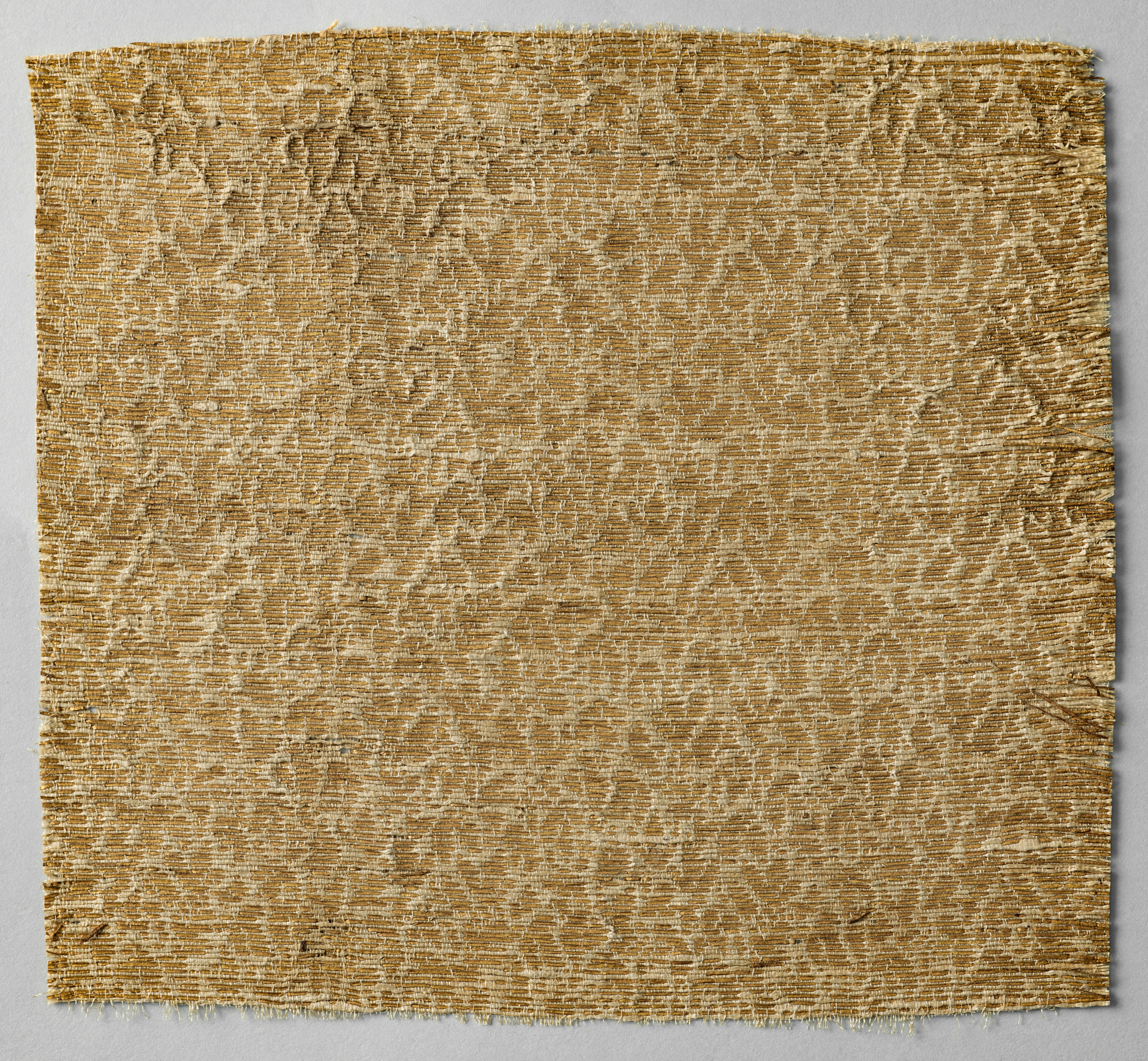
Technical Deconstruction & Historical Resonance: The Il-khanid "Tiny Leaves" Textile
The provided textile specimen presents a formidable and inspiring synthesis of material conquest and aesthetic dialogue. Originating from the Il-khanid period in Central Asia, it is a physical manifesto of the Mongol Empire's role as history's most formidable connector of disparate textile traditions. The base fabric is a silk tabby, a fundamental weave that speaks to the ancient, sophisticated sericulture of China. Upon this ground, the introduction of supplementary weft patterning in gold thread represents a tectonic shift. This technique is not merely decorative; it is a technological import, likely flowing westward from earlier Byzantine and Islamic traditions, now supercharged by Mongol patronage. The gold thread—often a strip of gilded leather or membrane wrapped around a silk core—transforms the fabric from a precious material into a literal embodiment of light, power, and celestial aspiration. The "tiny leaves" motif, likely a repetitive, all-over pattern, is more than a floral nod. In the Il-khanid context, it symbolizes a portable paradise, a Mongol elite appropriating and disseminating a settled, Persianate vision of the eternal garden across the steppes and into their opulent, mobile courts.
Core Reference: The New DNA Strand
The directive to reference a New DNA Strand is the critical catalyst for our avant-garde translation. We interpret this not as literal genetics, but as a conceptual framework for radical recombination and encoded potential. The original textile is itself a historical "DNA strand"—a hybrid of Chinese silk technology, Central Asian design, and Near Eastern metallic embellishment. Our task is to splice this ancient code with a contemporary one.
For Zoey Fashion Lab, the "New DNA Strand" represents the foundational building block of a completely reimagined garment system. We propose moving beyond the textile as a flat, decorative surface. Instead, we will deconstruct its physical and symbolic components into discrete "base pairs" to be recombined in a three-dimensional, structural fashion.
Avant-Garde Translation: A Manifesto for Zoey Fashion Lab
Our analysis yields not a reproduction, but a propagation. The avant-garde outcome for Zoey Fashion Lab will be a capsule collection titled "Il-khanid Sequence." It will manifest the following principles:
Material Re-coding
The silk tabby and gold thread are disassembled and reconstituted. The supplementary weft becomes a structural element. Imagine fine, rigid rods of anodized titanium (in gold, copper, and iron hues) or biodegradable polymers infused with mineral pigments, acting as the "gold thread." These are not woven but inserted as exoskeletal reinforcements along seam lines, dart edges, and hems. The "silk tabby" is translated into multiple expressions: a sheer, matte organic silk gauze representing the ground; a fused, non-woven silk felt for sculptural sections; and a technical, high-density weave of recycled polyester for durability, each representing a mutation of the original base.
Motif as Blueprint
The "tiny leaves" pattern is extracted from the surface and becomes a three-dimensional cutting and construction blueprint. Using algorithmic patterning software, the leaf shape informs every aspect of the garment architecture: Leaf-shaped gussets are inserted under arms and at joints, creating unexpected mobility and volume. Seam lines themselves trace the stem and vein paths of the leaf motif, making the construction diagram the primary visual aesthetic. The scale of the motif is violently altered—from tiny to gigantic—with a single leaf potentially forming the entire silhouette of a cape or dress, its veins created by our "gold thread" structural rods.
The Garment as Mobile Archive
Reflecting the Il-khanid textile's role in transmitting culture across geography, our garments will be modular and transformative. A coat can be disassembled at the titanium-thread seams into a gilet and separate sleeves; a dress can reconfigure its drape via adjustable structural elements. This speaks to the modern nomad and the dynamic, multi-context life. Furthermore, using NFC technology discreetly embedded behind a "leaf," the garment can tell its own story—scanning it reveals the history of the original textile, the sourcing of our materials, and care instructions, making the wearer a curator of a continuous cultural dialogue.
Color & Surface: Beyond Metallics
While honoring the original's luminous quality, we expand the palette. The gold is not just a color but a property of light interaction. We will develop surfaces using innovative coatings: a photo-chromic silk that reveals a leaf pattern under sunlight (UV "gold thread"), or a magnetic yarn woven into the base that allows the wearer to arrange metallic leaf motifs freely on the garment's surface. The concept of "supplementary" is key—everything is additive, modular, and mutable.
Conclusion: The Synthesized Strand
The Il-khanid "Tiny Leaves" textile offers Zoey Fashion Lab a profound starting point: a artifact of fusion, power, and transcendent craftsmanship. By treating it as a "DNA strand" for avant-garde design, we move beyond pastiche. We isolate its core genetic instructions—hybrid materiality, symbolic motif, portable opulence, and structural embellishment—and recombine them with the nucleotides of contemporary technology, sustainability, and modularity.
The resulting "Il-khanid Sequence" collection will not look like a historical costume. It will feel like its logical, futuristic evolution: garments that are architecturally bold, intellectually resonant, and personally configurable. They will carry the memory of Silk Road caravans in their conceptual code while speaking unequivocally to the forefront of modern design. This is deconstruction not as destruction, but as a method of uncovering deep, replicable patterns of beauty and meaning, allowing us to weave a new narrative thread for the future of fashion.