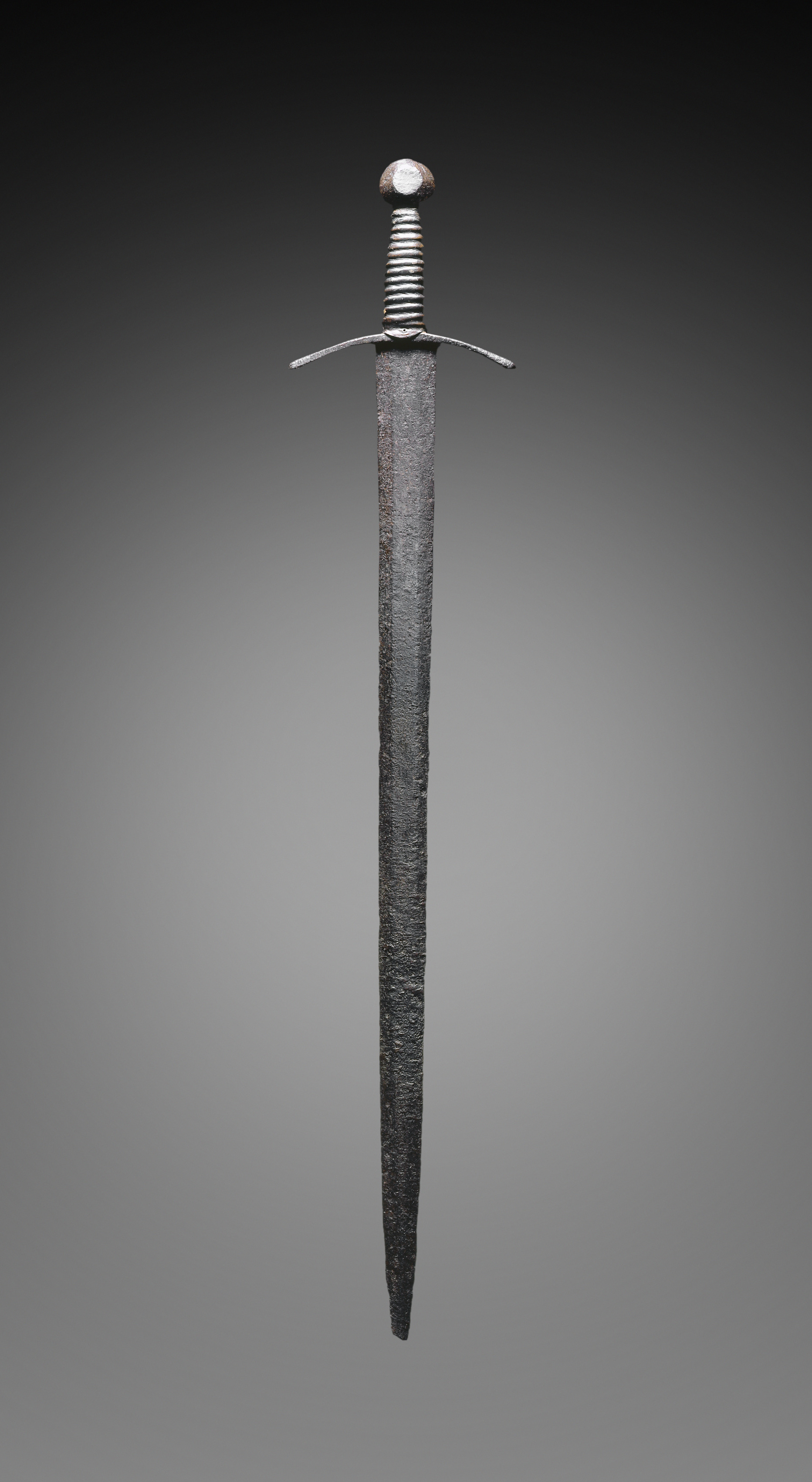
Deconstructing the Blade: An Avant-Garde Analysis of the Early 15th-Century European Sword
At Zoey Fashion Lab, our mandate is not merely to observe historical artifacts but to dissect their structural DNA, extracting the latent kinetic energy and symbolic grammar that can be re-sequenced into contemporary wearable form. The subject of this analysis—a European longsword from the early 15th century—presents a formidable paradox. It is an object of brutal function, yet its silhouette, material logic, and ergonomic tension offer a rich lexicon for avant-garde construction. By treating the sword not as a weapon but as a proto-futuristic exoskeleton, we can isolate three primary vectors of design innovation: the rigid spine (blade geometry), the connective tissue (leather and wire wrapping), and the gravitational pivot (pommel and crossguard). This deconstruction yields a "New DNA Strand" that redefines the relationship between the body, architecture, and movement.
I. The Steel Spine: Reinterpreting Rigidity as Silhouette Architecture
The blade of the 15th-century longsword is a study in dynamic taper—a broad, resilient base that narrows into a lethal point. In traditional tailoring, this would be translated as a simple A-line or a sharp lapel. However, for an avant-garde garment, we must consider the blade's distal taper as a blueprint for three-dimensional, load-bearing seams. The steel's fullered central groove, designed to lighten the blade without compromising strength, is a direct analogue to the modern concept of negative space in pattern cutting.
We propose a jacket silhouette where the central panel mimics the blade's cross-section. Instead of a flat front, the garment would feature a pronounced, sculpted keel—a rigid, boned structure running from the sternum to the hem, echoing the blade's ricasso. This is not a mere aesthetic reference; it is a functional re-engineering. The "steel" is replaced by a high-compression technical textile, such as carbon-fiber-infused nylon or a thermo-molded polyurethane, which can be shaped to replicate the blade's subtle convexity and concave fuller. The resulting garment does not drape; it stands. It creates an architectural carapace that alters the wearer's posture, forcing a deliberate, measured gait—a kinetic echo of the swordsman's stance.
Furthermore, the blade's point becomes the garment's terminus. Rather than a hem that falls horizontally, the avant-garde piece terminates in an asymmetric, sharply angled point that extends past the knee on one side. This "point" is not decorative; it is a structural counterweight, visually elongating the torso and creating a dynamic line of tension that pulls the eye downward, mimicking the sword's own gravitational intent.
II. The Grip and Wire: Textile Tensegrity and the Second Skin
The sword's handle, or grip, is where the object transitions from abstract weapon to intimate extension of the human hand. In the early 15th century, this was typically a wooden core wrapped in corded leather and twisted brass or iron wire. This is not merely a functional anti-slip measure; it is a sophisticated system of tensegrity—a network of compression and tension that creates a resilient, tactile membrane.
For Zoey Fashion Lab, this wrapping technique is the genesis of a new textile construction method. We reject the flat, woven fabric in favor of a structural lattice. Imagine a sleeve or a glove constructed from a base of supple, vegetable-tanned leather, over which we apply a spiraling, hand-wound layer of conductive metallic yarn—a modern reinterpretation of the iron wire. This is not embroidery; it is a functional exoskeleton that provides variable compression. The wire wrap can be tightened at the wrist and elbow to create articulated joints, while looser at the bicep to allow for fluid movement.
The visual effect is one of controlled chaos—the raw, tactile quality of the medieval grip translated into a high-fashion statement. The texture becomes a language: the ridges of the wire catch light and shadow, creating a moiré effect that shifts with every gesture. This "second skin" is not just worn; it is activated by the wearer's motion, functioning as an external muscular system. We can further this concept by using a bio-based, 3D-printed polymer that mimics the twisted wire's geometry but is flexible enough to be woven on a jacquard loom. The result is a fabric that has the visual density of metal but the hand-feel of silk—a true paradox of materiality.
III. The Crossguard and Pommel: The Shoulder Yoke and Counterweight
The crossguard (or quillons) and the pommel are the sword's most overtly sculptural elements. The crossguard, often straight or gently curved, acts as a horizontal stabilizer, protecting the hand and providing a fulcrum for leverage. The pommel, a heavy metal counterweight, balances the blade's length, allowing for rapid, agile movement. In the avant-garde context, these two elements become the shoulder yoke and the lower-back counterweight of a garment.
We propose a coat where the shoulders are not natural or padded but are extended into rigid, horizontal "quillons." These are not simple shoulder pads; they are cantilevered structures—perhaps made from milled aluminum or a high-density bio-resin—that project outward from the body, creating a dramatic, imposing profile. This silhouette directly references the knight's armored pauldron but is executed with a minimalist, futuristic precision. The crossguard's central boss, where it meets the blade, is translated into a high-necked, mandarin-style collar that is both protective and ceremonial.
Conversely, the pommel is re-imagined as a weighted tail or a sculptural peplum. In a dress or a long tunic, the back hem would be fitted with a heavy, polished metallic disc—a nod to the pommel's function. This is not mere ornament; it is a kinetic counterweight. When the wearer turns, the momentum of the disc creates a delayed, sweeping motion in the fabric, a dramatic "swing" that is both elegant and aggressive. This interplay of front rigidity (the blade) and rear counterweight (the pommel) creates a dynamic equilibrium that makes the garment feel alive, constantly adjusting to the wearer's center of gravity.
IV. Synthesis: The New DNA Strand
The "New DNA Strand" for this collection is not a literal replication of the sword. It is a genetic algorithm of conflict and elegance. The strand is composed of three base pairs: Rigidity/Fluidity, Weight/Levity, and Protection/Exposure. The blade gives us rigidity and protection; the leather and wire give us fluidity and tactile exposure; the pommel gives us weight and a sense of grounded levity.
In final form, the Zoey Fashion Lab garment is a hybrid: a tailored, avant-garde overcoat with a molded, asymmetrical front panel (the blade), a sleeve system wrapped in conductive metallic thread (the grip), and a cantilevered shoulder structure (the crossguard) that frames the face. The palette is stark—oxidized steel grey, deep charcoal, and a single accent of oxblood leather—reflecting the sword's austere beauty. This is not historical costume; it is speculative archaeology, unearthing the latent futurism within a medieval artifact. The wearer is not a knight, but a sentinel of a new age, moving through space with the calculated precision of a blade being drawn.