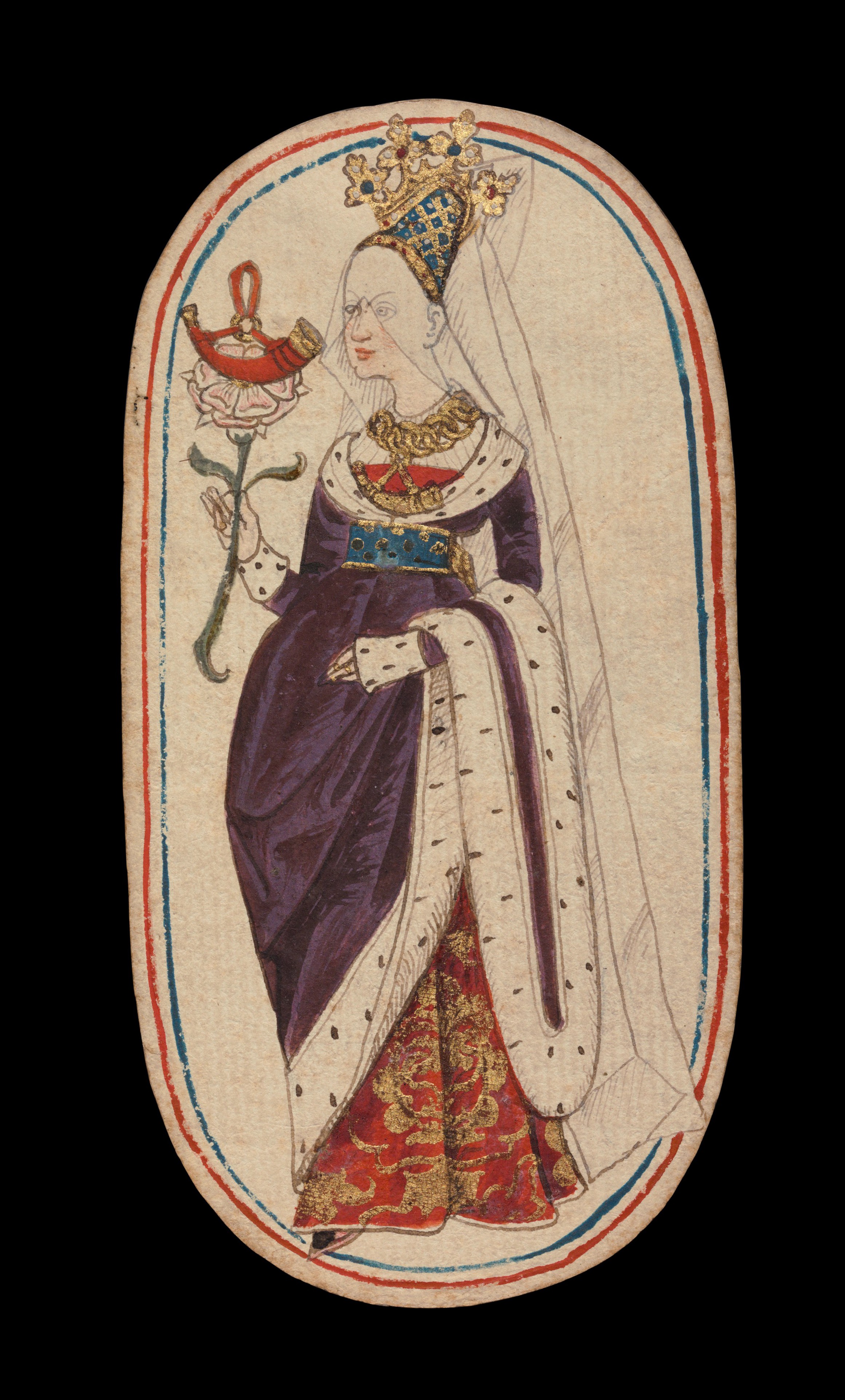
The Queen of Horns: A Cartomantic Blueprint for SS26 Deconstruction
The Zoey Fashion Laboratory’s SS26 directive is not to interpret history, but to dissect it, extract its skeletal geometry, and re-forge it into a speculative future. Our subject, the Queen of Horns from the fifteenth-century South Netherlandish Cloisters Playing Cards, presents a paradoxically fertile ground for such an operation. At first glance, this is a relic of pasteboard and pigment—four layers of laminated paper, hand-drawn with pen and ink, glazed, and gilded with silver and gold. Yet, within its rigid, courtly frame lies a blueprint for radical garment architecture. We are not looking at a portrait; we are looking at a schematic for power, asymmetry, and material transmutation. For SS26, we will extract three core principles from this card: the Hierarchy of the Horn, the Cartography of the Gaze, and the Alchemy of the Substrate.
I. The Hierarchy of the Horn: Asymmetric Exoskeletal Silhouettes
The Queen’s namesake attribute—the horn—is not a mere accessory but a structural extension of her form. In the original card, it rises as a curved, almost organic extrusion from her headdress, suggesting a fusion of body and object. For SS26, we reject the notion of the horn as a hat. Instead, we propose the Exo-Spinal Horn: a cantilevered, carbon-fiber-reinforced polymer spine that emerges from the nape of a sharply tailored, double-breasted jacket. This is not a decorative flourish; it is a load-bearing element that redirects the garment’s center of gravity. The silhouette shifts from a conventional vertical axis to a dynamic, forward-leaning parabola. The horn—here rendered in a matte, obsidian-black bio-resin—creates a deliberate asymmetry, echoing the card’s original hand-drawn irregularity. The opposite shoulder is left starkly bare, cut in a deep, surgical arc that exposes the clavicle, creating a visual dialogue between armored protection and raw vulnerability.
This principle extends to the lower body. We will introduce the Bifurcated Horn Culotte, a garment that is neither skirt nor trouser but a hybrid. One leg is constructed from a stiff, molded neoprene that tapers to a sharp point, while the other is a flowing, deconstructed panel of technical silk that catches air. The “horn” here is implied in the rigid, pointed extension of the left leg, which juts forward like a prow. The asymmetry is not merely visual; it is kinetic, forcing the wearer into a modified, powerful gait. The SS26 wearer does not walk; she advances, her silhouette a living contradiction of static courtly grace and futuristic propulsion.
II. The Cartography of the Gaze: Layered Transparency and Glazed Surfaces
The Cloisters Queen is defined by her materiality—the layering of opaque paint over glazes, the strategic application of silver and gold. We translate this into a study of temporal depth through fabric. The card’s painted surface suggests a skin that conceals and reveals simultaneously. Our SS26 approach employs a tripartite layering system. The base layer is a second-skin mesh of recycled metallic yarns, printed with a distorted, pixelated version of the card’s original floral background. Over this, we place a translucent, hand-painted organza panel, mimicking the card’s glazes. This panel is not static; it is treated with a thermochromic finish that shifts from deep burgundy to pale gold when exposed to body heat, echoing the alchemical transformation of the original pigments.
The final layer is the Applied Silver and Gold, but not as embroidery. We use laser-sintered, metallic flakes that are fused directly onto the fabric in a pattern that mimics the card’s cracked, aged surface. This is not ornamentation; it is a cartographic map of the wearer’s movement. The flakes are strategically placed at pivot points—the elbows, the shoulders, the hips—so that they catch light only during specific gestures. The gaze of the viewer is therefore not passive; it is an active participant in the garment’s narrative, tracing the same visual paths that an art historian would follow across the original card’s surface. The effect is a garment that appears to be in a constant state of becoming, its surface perpetually shifting between opaque history and translucent future.
III. The Alchemy of the Substrate: Re-Engineering the Pasteboard Core
The most radical innovation for SS26 is our response to the card’s foundational material: four layers of pasteboard. This humble, laminated core is the source of the card’s durability and its surprising weight. We propose a fashion equivalent: Structural Pasteboard Couture. This is not a nostalgic return to paper dresses but a high-tech reimagining. We will utilize a newly developed composite of cellulose nanofibers, derived from post-industrial textile waste, and a biodegradable polymer binder. This material can be molded, scored, and folded with the precision of the original cardstock, yet it possesses the tensile strength of leather.
We will construct a series of Fold-Form Gilets—vests that are not sewn but engineered through a series of precise, origami-like folds and interlocking tabs. The patterns are laser-cut from this composite, then hand-scored to create sharp, architectural creases that reference the pen-and-ink lines of the original drawing. The gilets are worn over bare skin or a sheer base layer, and their rigid, board-like quality creates a striking contrast with the fluidity of the body. This is a garment that stands on its own, quite literally. When removed, it retains its three-dimensional form, becoming an object of sculpture. This challenges the fundamental definition of clothing as something that conforms to the body. Instead, we propose a garment that the body conforms to—a wearable architecture that demands respect and postural discipline.
Conclusion: From Card to Code
The Queen of Horns is not a historical artifact to be faithfully reproduced; she is a code to be cracked. Her horn is a prompt for structural asymmetry. Her painted layers are a directive for material depth. Her pasteboard core is a challenge to our preconceptions of garment construction. For SS26, Zoey Fashion Laboratory will not present a collection; we will present a thesis. The garments will be functional prototypes, each one a test of a hypothesis about the relationship between power, material, and form. The wearer of this collection is not a consumer but a collaborator—a curator of her own body, using these exoskeletal forms to project a future that is as complex, as layered, and as defiantly artificial as the gilded surface of a fifteenth-century playing card. We do not look back; we look through, and what we see is a new silhouette, born from the horn of a queen who has waited five centuries for her true incarnation.