Deconstructing the Sovereign Canopy: The Royal Round Tent as Proto-Avant-Garde Architecture
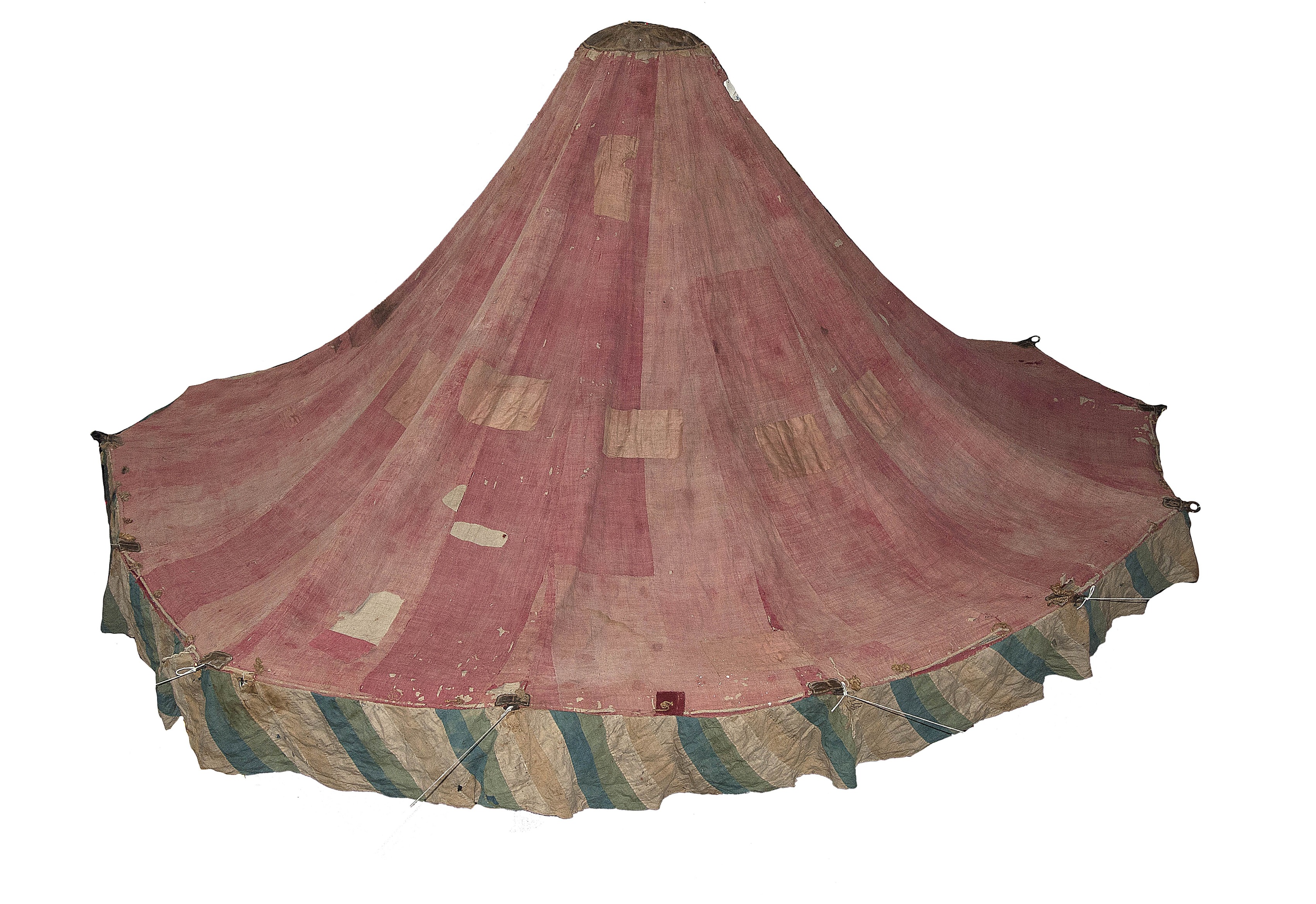
At Zoey Fashion Lab, we do not merely observe historical artifacts; we dissect them for their latent futurism. The Royal Round Tent made for Muhammad Shah, hailing from Rasht, Iran, during the Qajar period (1779-1925), is frequently misclassified as a relic of nomadic utility or royal pageantry. We reject this reductionist view. Through the lens of avant-garde deconstruction, this tent is not a shelter but a proto-architectural manifesto—a complex, tensile system that prefigures modern installation art and wearable architecture. Its material lexicon—wool, silk, leather, cotton, rope, and iron—forms a dialog between the ephemeral and the structural, a conversation that resonates profoundly with contemporary fashion’s obsession with deconstruction and re-assembly.
Material Dialectics: The Haptic Grammar of Power
The technical specification of this artifact is a study in oppositional forces. The interior, a realm of intimate reception, employs wool in a plain weave as its foundational ground. This is not a passive backdrop. The plain weave offers a grid—a rational, structural baseline against which the chaos of ornament can erupt. Upon this grid, the artisan has deployed silk embroidery in a chain stitch. In our lab, we interpret the chain stitch not as mere decoration but as a continuous, unbroken line of kinetic energy. It is a drawing in space, a calligraphic gesture that mimics the flow of courtly narrative. The juxtaposition of the coarse, utilitarian wool against the lustrous, delicate silk creates a haptic tension—a friction between the nomadic past and the sedentary, opulent present of the Qajar court.
This tension is the very essence of avant-garde practice: the deliberate collision of disparate materials to generate new semantic fields. The inclusion of tape and leather as binding agents further complicates the text. Leather, a material of animal origin, introduces a raw, organic temporality, while the tape—likely a manufactured textile—speaks to industrial precision. This is not a harmonious synthesis; it is a deliberate assemblage, a bricolage that anticipates the work of designers like Martin Margiela or Rei Kawakubo, who famously deconstruct garments to expose their constitutive parts and re-stitch them into new, unsettling wholes.
The Exterior: A Study in Structural Brutalism
Conversely, the exterior of the tent is a study in structural brutalism. Here, the material palette shifts to cotton and wool in plain weaves, materials chosen not for their tactile luxury but for their tensile strength and resistance to the elements. This is the public face of power—a facade that must withstand wind, rain, and the gaze of the multitude. The rope and iron ring are the critical junctures of this system. They are not hidden; they are exposed, celebrated as functional elements. This is a radical act of honesty, a refusal to conceal the mechanics of support.
In this, the tent aligns with the principles of early modernism and the high-tech movement, where structure is made visible and celebrated. The iron ring, a cold, industrial object, sits in stark contrast to the warm, hand-woven textiles. It is the pivot point, the zero-degree of the entire architectural composition. It anchors the tent to the earth, yet it also symbolizes the celestial dome—the cosmic axis around which the sovereign’s universe revolves. This duality—the mundane and the cosmic, the industrial and the artisanal—is precisely the kind of dialectical tension that fuels avant-garde innovation.
Archive Resonance: The Ghost of Global Aesthetics
The reference to "Archive Resonance" and the mention of the 16th to 17th centuries in the provided context is not an academic footnote; it is a critical clue. This period marks the height of the Safavid dynasty, a time of intense cultural exchange along the Silk Road. The Qajar tent, though later, is a direct descendant of this globalized aesthetic. It absorbs influences from Ottoman, Mughal, and even European sources, synthesizing them into a distinctly Persian idiom. For the avant-garde, this is a powerful reminder that purity is a myth.
All cultural production is hybrid, a palimpsest of borrowings and reinterpretations. The tent’s design is a testament to the fluidity of influence—the chain stitch, for instance, is a technique found across Central Asia and the Indian subcontinent, adapted here to serve a Persian royal aesthetic. This resonates with contemporary fashion’s post-modern condition, where designers freely sample from a global archive of styles, breaking down the barriers between "high" and "low," "East" and "West." The tent is not a static object; it is a node in a vast network of cultural transmission, a resonance chamber where distant aesthetics echo and merge.
The Tent as Wearable Architecture
From a Zoey Fashion Lab perspective, the most radical interpretation of this artifact is to view it as wearable architecture. The tent is not merely a space to inhabit; it is a garment on a monumental scale. The interior is the lining, the exterior is the shell, and the rope and iron ring are the fastenings. The structure is essentially a garment that has been inverted and scaled up to encompass a social body. This inversion—turning the inside out and the outside in—is a core strategy of avant-garde fashion design.
Consider the way the interior’s embroidery is meant to be seen by the select few who enter, while the exterior’s plain weave is for the public. This is a sartorial code of visibility and concealment, of intimacy and display. The sovereign, seated within, becomes the living heart of this textile organism. The tent is his second skin, his exoskeleton, projecting his authority through its materiality. This concept directly translates to contemporary design, where garments are increasingly conceived as micro-architectures, with seams acting as structural joints and fabric panels as load-bearing membranes.
Conclusion: A Blueprint for the Future
The Royal Round Tent of Muhammad Shah is far more than a historical curiosity. It is a blueprint for a deconstructive practice that challenges our contemporary notions of space, material, and power. Its synthesis of disparate materials—from the utilitarian rope to the luxurious silk—creates a complex text that speaks to the fragmented nature of modern identity. Its exposure of structural elements prefigures the high-tech aesthetic, while its cultural hybridity anticipates our current globalized condition.
At Zoey Fashion Lab, we extract from this artifact a set of principles: the valorization of structural honesty, the poetic potential of material friction, and the necessity of cultural synthesis. The tent is not an object of the past; it is a proposition for the future. It asks us to reconsider the boundaries between clothing and shelter, between ornament and structure, between the individual and the collective. In its silent, tensile strength, we find a resonance that challenges us to deconstruct our own assumptions and rebuild them into something more complex, more honest, and infinitely more avant-garde. It is not a roof; it is a philosophy made manifest in wool, silk, and iron.