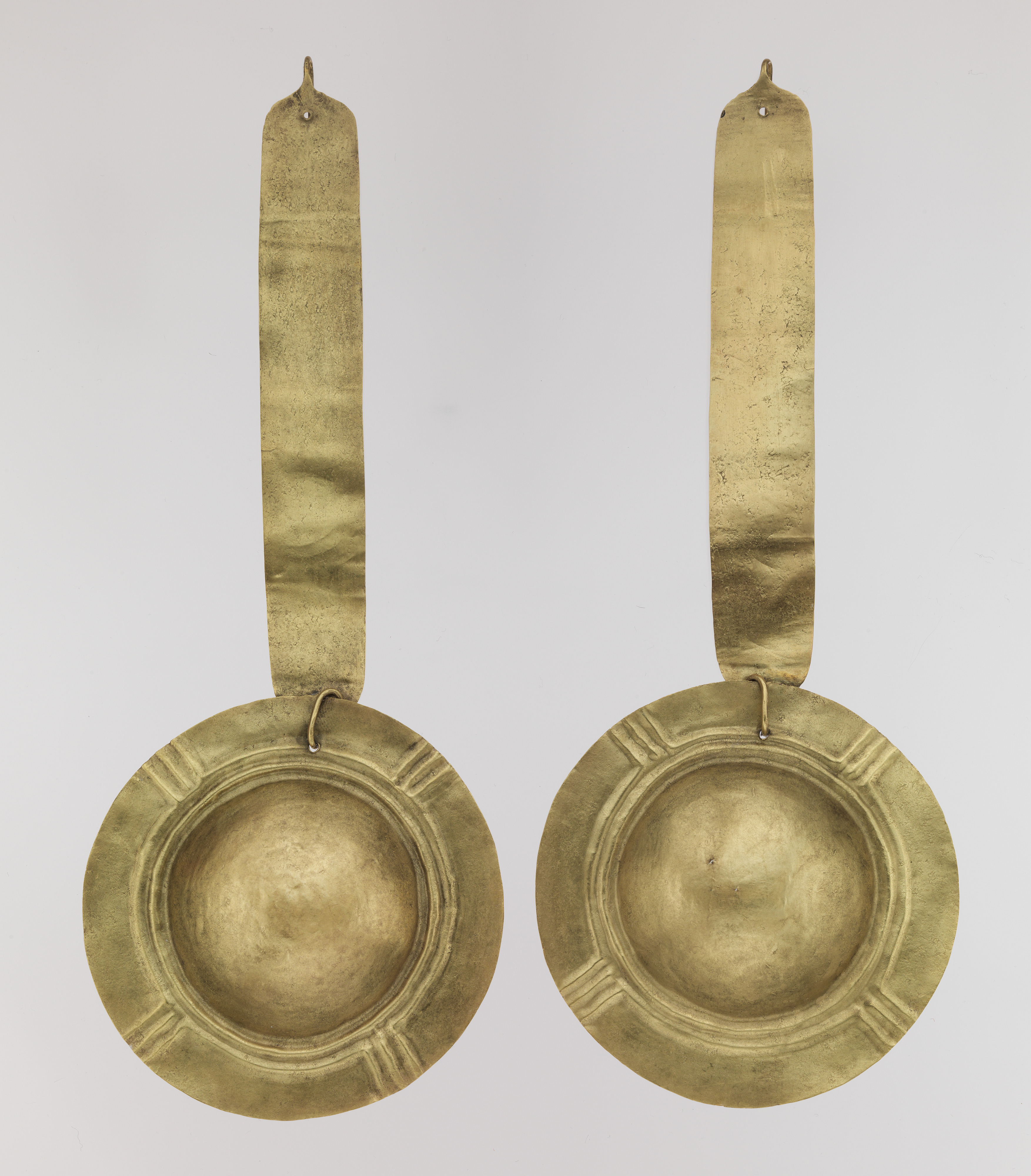
The Sonic Alchemy of Adornment: Deconstructing the Sonso Gold Ear Pendants
In the relentless pursuit of a post-human aesthetic, Zoey Fashion Laboratory’s SS26 archive interrogation forces a radical re-reading of ancestral artifacts. The subject of this analysis—a pair of gold ear pendants from the Sonso culture—is not merely a relic of metallurgical prowess but a proto-futuristic blueprint. These objects, weighing heavily with the patina of ritual, are deconstructed here not as jewelry, but as wearable acoustic architecture. They are the missing link between the organic chaos of the natural world and the sterile precision of cybernetic ornamentation. The aesthetic correlation to our archive node—the dichotomy of the gilded palm leaf on a mirror versus the relief narrative on a cold sarcophagus—is not coincidental; it is the very dialectic that defines SS26’s structural philosophy.
I. The Metallurgical Paradox: Weight as a Silhouette Strategy
The first point of departure is the materiality of gold itself. In contemporary couture, gold is often relegated to surface gilding, a veneer of wealth. However, the Sonso artisan understood gold as a structural load-bearing element. The sheer mass of these pendants dictates a specific ergonomic response from the wearer—a stiffening of the neck, a deliberate tilt of the skull. For SS26, we weaponize this constraint. The future silhouette is not about the garment's drape but about the negative space created by the body's forced posture. We are designing for the "cranio-cervical extension," a posture that transforms the human form into a plinth for the pendant. The ear lobe is no longer a biological feature; it is a load-bearing pier. The weight of the gold pulls the flesh downward, creating micro-folds and tension lines that are as integral to the design as the metal itself. This challenges the modernist obsession with featherweight comfort, proposing instead a kinetic heaviness where gravity becomes a collaborator in the sculptural narrative.
II. The Mirror-Sarcophagus Dialectic: Translating Relief into Motion
Our archive node presents a binary: the reflective, planar surface of the mirror with its intricate leaf inlay versus the deep, narrative relief of the sarcophagus. The Sonso pendants inhabit a third space—they are mobile reliefs. Unlike the static sarcophagus, these gold forms are in constant flux, catching light and casting shadows that shift with every micro-movement. For SS26, we propose a structural innovation termed "Kinetic Chiaroscuro." The pendant’s surface is not polished to a high mirror finish; instead, it retains a granular, hammered texture. This is a deliberate rejection of the "silver mirror" aesthetic. The matte, pitted surface diffuses light, creating a soft, volumetric glow that mimics the organic irregularity of the palm leaf. Conversely, the edges of the pendant are sharp, faceted, and precise, echoing the cold, carved lines of the sarcophagus. This juxtaposition—volumetric core, linear edge—is the foundational principle for our new ear architecture. We are not creating jewelry; we are creating portable light modulators that define the wearer's aura before the garment is even visible.
III. Futuristic Silhouettes: The Ear as a Structural Fulcrum
Moving beyond traditional earring design, which treats the ear as a hook point, the Sonso artifact suggests the ear is a fulcrum for the entire upper-body silhouette. In SS26, we introduce the "Aural Spine"—a rigid, gold-alloy framework that extends from the ear pendant, curving along the temporal bone and integrating with a high-necked, structural collar. This is not a necklace; it is a continuation of the pendant's mass. The silhouette is no longer defined by the shoulders or the waist, but by this diagonal axis of tension running from the ear to the clavicle. This creates a futuristic, asymmetrical profile that is both archaic and cybernetic. The pendant’s weight is redistributed across this framework, allowing for larger, more aggressive forms without physical discomfort. We are effectively engineering a new skeletal system for adornment, where the jewelry dictates the architecture of the garment, not the other way around. The collar becomes a minimalist canvas, a stark contrast to the ornate pendant, allowing the gold to perform as the sole protagonist.
IV. The Palm Leaf and the Code: Biomorphic Data Storage
The palm leaf motif is not mere decoration; it is a biomorphic data system. In the Sonso context, the leaf’s intricate veins likely encoded social status, lineage, or spiritual protection. In our SS26 translation, we re-code these veins as conductive circuitry. The gold is not just metal; it is a conductive substrate. We propose embedding micro-engraved, non-reflective channels within the gold surface that mimic the leaf’s venation. These channels are not visible to the naked eye but are readable via haptic feedback or thermal variance. The pendant becomes a wearable memory chip, carrying the wearer’s biometric data or a personalized digital signature. This is the ultimate fusion of the sarcophagus’s narrative relief and the mirror’s reflective surface. The pendant tells a story, but it is a story written in machine-readable code, a silent narrative that is only deciphered through technological mediation. This elevates the artifact from a passive ornament to an active participant in the wearer’s digital identity.
V. Conclusion: The Ear as an Interface
Ultimately, the Sonso gold ear pendants are not about the ear at all. They are about the interface between the biological and the constructed. They are the primordial ancestors of the Bluetooth headset, the hearing aid, and the neural implant. For Zoey Fashion Laboratory, this analysis is a manifesto for Adornment 2.0. We are discarding the notion of jewelry as a secondary accessory. Instead, we position it as the primary driver of silhouette, posture, and even data transmission. The future of couture lies not in fabric innovation alone, but in the structural and semantic integration of metallic artifacts. The Sonso pendant, with its brutal weight and organic complexity, is the perfect primitive prototype for a future where our ornaments are not merely worn, but are integral to how we exist, move, and communicate. The mirror and the sarcophagus are unified—not as opposites, but as two sides of the same golden coin, spinning in the ear of a cyborg goddess.