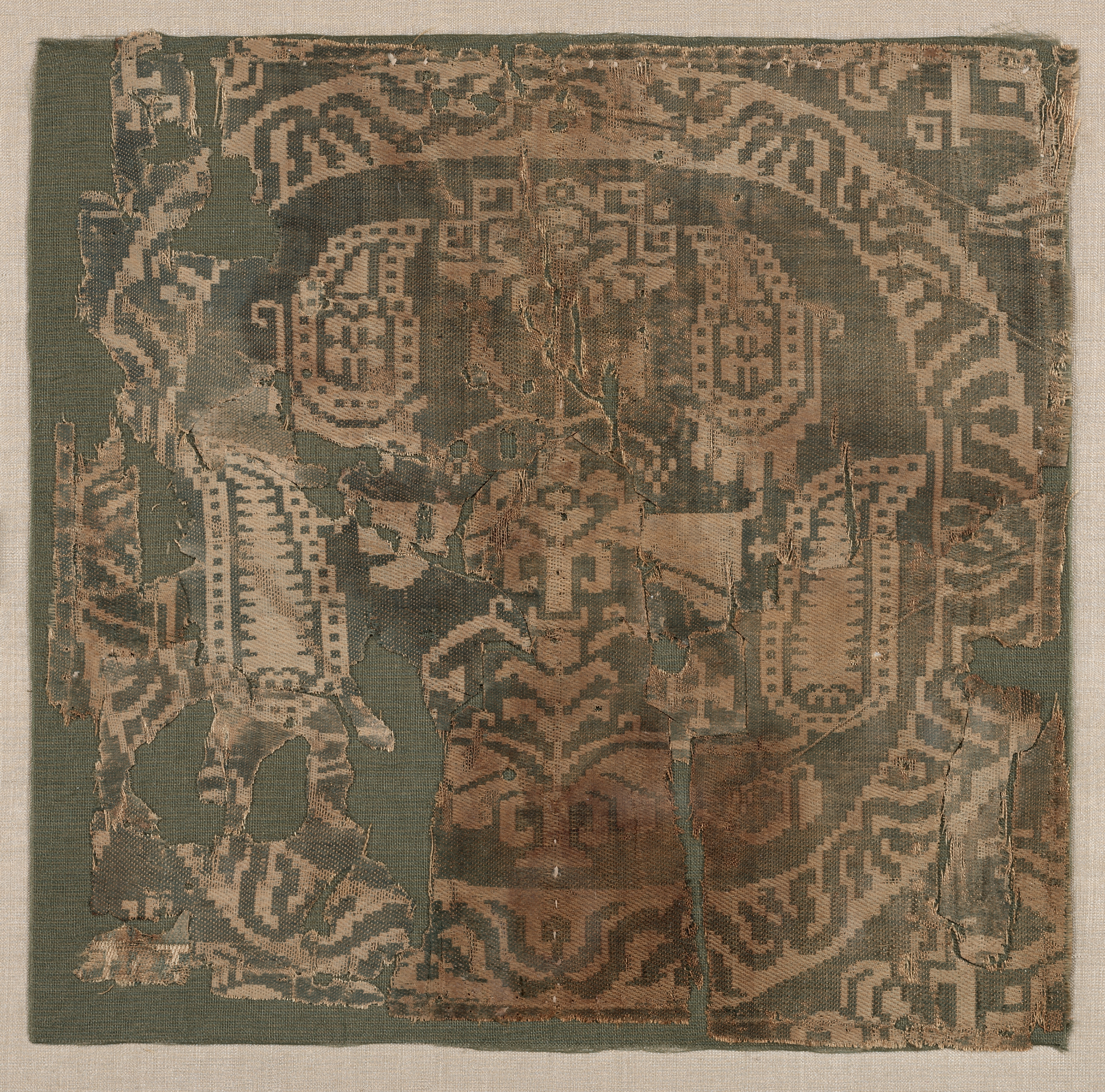
Deconstructing the Sacred Orchard: A Technical and Philosophical Analysis of the Samite Roundel
At Zoey Fashion Lab, our mandate extends beyond the mere cataloging of historical textiles. We engage in a process of fabric deconstruction, wherein we dissect not only the physical warp and weft but also the cultural DNA embedded within each thread. The subject of today's analysis—a Roundel from a Tunic with Palmette Tree, originating from Egypt or Syria and executed in a luxurious complementary weft-faced twill weave with inner warps (samite)—presents a profound paradox. It is a relic of a bygone era of trade and faith, yet its structural logic and visual rhythm resonate with startling clarity in the context of contemporary avant-garde design.
This artifact, dated to the medieval Islamic period, is not merely a decorative patch. It is a microcosm of a cosmopolitan world, a silent testament to the Silk Road's intellectual and aesthetic exchanges. For the avant-garde designer, this roundel is not a museum piece to be replicated, but a blueprint for subversion. It challenges us to rethink ornamentation, structure, and the very concept of 'preciousness' in a digital age.
I. The Structural Paradox: Weft-Faced Twill and the Logic of Excess
The technical specification of complementary weft-faced twill weave with inner warps is the first point of departure. In conventional weaving, the warp (the longitudinal threads) often dictates the ground structure, while the weft (transverse threads) provides color and pattern. Samite inverts this hierarchy. Here, the weft threads are the protagonists, completely covering the warp to create a dense, patterned surface. The inner warps act as a hidden skeleton, adding weight and stability without interfering with the visual field.
From a deconstructionist perspective, this is a radical act. It is a deliberate denial of the loom's default logic. The artist-weaver chose excess over economy, layering weft floats to build a surface that is almost sculptural in its relief. For the avant-garde, this translates into a design philosophy of material opulence—not in the sense of gaudy decoration, but in the strategic use of texture and density. Imagine a modern garment where the 'print' is not applied but woven into existence, where the pattern is a topographic map of thread tension and release. The samite technique teaches us that pattern and structure are not separate entities; they are a single, cohesive system of force and form.
Furthermore, the use of silk is critical. Silk's natural luster and high tensile strength allow for these long, floating wefts without breakage. In the avant-garde context, silk is often associated with softness and drape. However, in samite, the silk is forced into a rigid, almost architectural state. This contradiction—soft material, hard structure—is a powerful conceptual tool. It suggests a fashion that is both luxurious and armored, delicate yet unyielding.
II. The Iconographic Code: The Palmette Tree as a Hybrid Signifier
The central motif—the Palmette Tree—is a botanical impossibility. It is a stylized, composite form that merges the lotus (Egyptian), the acanthus (Greek), and the palm (Persian). This is not a representation of nature, but a synthesis of civilizations. The roundel format, a perfect circle, contains this organic growth, forcing it into a geometric discipline. This tension between the organic (the tree) and the geometric (the circle) is the core of its visual power.
For the avant-garde designer, the Palmette Tree is a precursor to the concept of hybridity. It is a pre-modern example of cultural appropriation done with respect and intelligence. It does not borrow a single motif; it creates a new species from multiple roots. In our design practice, this translates to a rejection of 'pure' aesthetics. We are not interested in minimalist reduction or single-source inspiration. Instead, we look to this roundel as a mandate to cross-pollinate—to take the structure of a tailored suit, the drape of a Japanese kimono, and the digital glitch of a computer error, and fuse them into a new, coherent whole.
The circular composition is equally significant. The roundel is a closed system, a self-contained universe. Yet, within that boundary, the palmette tree grows outward, its branches and leaves spiraling in a continuous, non-hierarchical flow. This is a direct challenge to Western linear perspective and its focus on a single vanishing point. The Islamic aesthetic, as seen here, is rhizomatic—it grows in multiple directions simultaneously. For our avant-garde collections, this suggests a move away from garments that have a single 'front' or 'back' and towards designs that are omnidirectional, where every angle reveals a new configuration of the pattern.
III. Archive Resonance: Bridging the 16th-17th Century and the Digital Now
As noted in the Archive Resonance, the period of the 16th to 17th centuries was one of intense cultural collision. The roundel we analyze may predate this, but its influence persisted. During that later period, the exchange between the Ottoman Empire, Safavid Persia, and Renaissance Europe created a fertile ground for textile innovation. The roundel's design language—its use of negative space, its rhythmic repetition, and its abstracted botanicals—would later influence European damasks and velvets.
In our contemporary context, this roundel speaks to the digital glitch. The repeating, interlocking nature of the palmette tree, when viewed through a pixelated lens, resembles a complex algorithm. The weft-faced twill, with its dense surface, can be seen as a precursor to high-resolution digital printing. The avant-garde designer today is not weaving with silk but with data. We are composing in code, layering pixels, and creating 'threads' of light. The roundel's lesson is that pattern must have a structural integrity—it must be able to withstand the stress of being stretched, draped, and worn. A digital print that merely sits on the surface is a ghost; a pattern that is woven into the structure, or coded into the garment's silhouette, is a presence.
The deconstruction of this roundel reveals that the most radical act in fashion is not the destruction of form, but the re-engineering of its logic. The samite weaver did not invent a new fiber; they reinvented the relationship between warp and weft. Similarly, the avant-garde designer does not need to invent a new material; they must reinvent the relationship between body, garment, and environment.
In conclusion, the Roundel from a Tunic with Palmette Tree is not a relic. It is a working document. Its dense, weft-faced structure challenges our modern preference for lightweight, disposable fashion. Its hybrid iconography challenges our notions of cultural purity. And its circular, non-linear composition challenges our reliance on conventional garment geometry. For Zoey Fashion Lab, this artifact is a catalyst for a new design language—one that values depth over surface, synthesis over purity, and structure over decoration. We do not look back to copy; we look back to decode the underlying algorithms of beauty and re-purpose them for the future of fashion. The palmette tree, once a symbol of eternal life, now stands as a symbol of eternal reinvention.