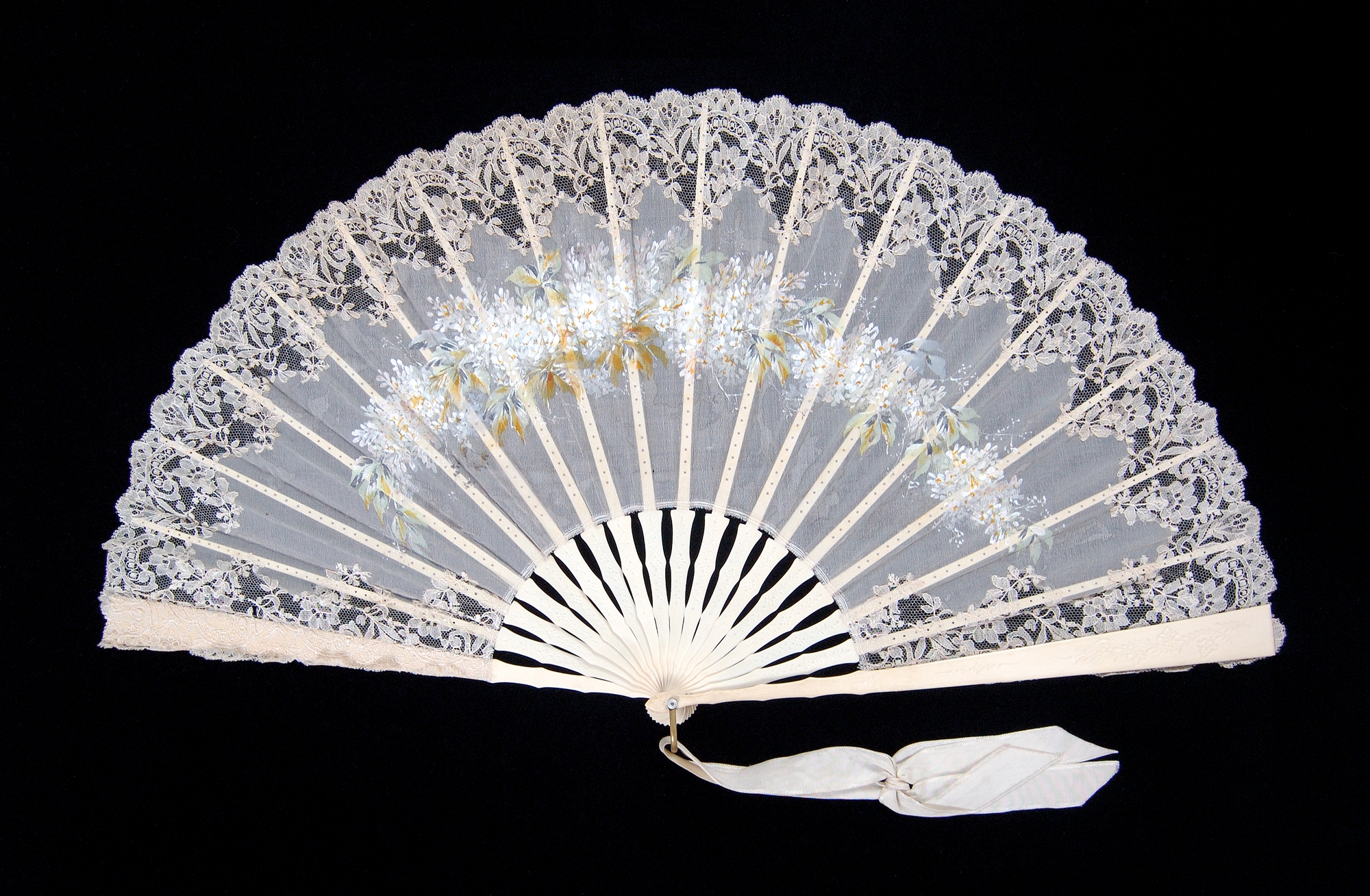
The Fan Reconfigured: An Avant-Garde Autopsy for SS26
The fan—that relic of aristocratic gesture, of whispered intrigue and calculated breeze—has long been consigned to the dusty vitrine of historical costume. For Zoey Fashion Laboratory, however, the fan is not an artifact; it is a structural manifesto. Deconstructed from its ivory stays, stripped of its silk membrane, and reimagined through the lens of post-humanist garment architecture, the fan becomes the blueprint for a new corporeal syntax. This is not nostalgia. This is a surgical extraction of kinetic principles from a 17th-century French object, then re-engineered for the augmented body of SS26.
I. The Skeletal System: Ivory as Exoskeletal Armature
The original fan’s ivory sticks—delicate, carved, and rigid—are here liberated from their decorative function. In our SS26 proposition, ivory is not a material but a logic of segmentation. We replace the organic ivory with a bio-ceramic composite that mimics its tensile strength while allowing for thermo-reactive flexion. The resulting exoskeletal panels do not hang on the body; they articulate it. A jacket becomes a series of overlapping, fan-folded lamellae that open and close with the wearer’s respiratory rhythm. The shoulder line, traditionally a fixed point, dissolves into a cascade of pivoting struts that can flare to a 180-degree wingspan or collapse into a razor-sharp silhouette. This is not a garment that you put on; it is a kinetic habitat that negotiates space in real time.
The structural innovation lies in the pivot joint. The fan’s rivet—the single point of convergence—is reimagined as a modular, magnetic hub placed at the acromion, the hip, and the cervical spine. These hubs allow for the attachment of interchangeable "fan-blade" appendages: some translucent, some opaque, some composed of photovoltaic silk that harvests solar energy to power embedded micro-LEDs. The body becomes a switchboard of potential forms, each configuration a new architectural statement. The wearer is no longer a passive mannequin but a choreographer of their own silhouette, adjusting their exoskeleton in response to environment, mood, or social aggression.
II. The Membrane: Silk as a Fluid Topology
Traditional fan silk—painted with pastoral scenes or gilded fleur-de-lis—is a surface of fixed narrative. Our SS26 membrane is a liquid interface. We employ a bio-engineered silk, grown in a lab, that is embedded with microfluidic channels. These channels can be inflated or deflated via a wrist-worn pressure pump, causing the fabric to billow, pleat, or flatten on command. The result is a dress that is not cut but grown, its volume shifting from a clinging second skin to a voluminous, air-filled sphere in under three seconds. This is the fan’s gesture—the snap of the wrist, the flutter of the hand—amplified to a full-body event.
The mother-of-pearl inlays of the original fan are translated not as decoration but as optical sensors. These iridescent discs, embedded in the silk, refract light in response to the fabric’s tension. When the membrane is taut, they produce a sharp, spectral glint; when relaxed, they diffuse into a soft, opalescent haze. This creates a living, chromatic feedback loop between the garment and its environment. The wearer’s movement becomes a painterly act, leaving trails of refracted light in the air. The fan is no longer a tool for cooling; it is a tool for perception, altering how the body is seen and how the body sees itself.
III. The Metal Frame: A Grammar of Collapse and Expansion
Metal, in the original fan, was the quiet servant—the hinge, the pin, the discreet reinforcement. In our reconfiguration, metal becomes the dominant voice. We utilize a shape-memory alloy, nitinol, which is trained to "remember" two distinct geometries: a fully collapsed, linear state and a fully expanded, fan-shaped arc. When an electric current passes through the alloy, it snaps from one state to the other with a sharp, metallic click—an audible punctuation to the visual transformation. This allows for garments that self-assemble and self-dissolve.
Consider a full-length coat. In its dormant state, it is a slim, columnar sheath. Upon activation, the nitinol ribs embedded in the fabric splay outward, creating a dramatic, bell-shaped skirt that flares twelve inches beyond the body. The metal is not hidden; it is deliberately exposed, a gleaming exoskeleton that traces the garment’s internal logic. This is structural honesty pushed to a fetishistic extreme. The seams are not sewn but riveted; the hems are not finished but clamped. The garment is a piece of precision machinery, and the wearer is its operator. This is couture as mechanical theater.
IV. The Futuristic Silhouette: The Body as a Variable
The cumulative effect of these innovations is a radical redefinition of the silhouette. The static, hourglass or columnar forms of traditional fashion are replaced by a topology of potential. The body is no longer a fixed volume to be draped or tailored; it is a node of energy from which forms radiate and retract. The SS26 Zoey silhouette is defined by its asymmetry of motion—one shoulder may be encased in a rigid, fan-shaped shield while the opposite hip dissolves into a flowing, silk-trailing train. The waist is not cinched but articulated, with a series of pivoting metal plates that allow for torsion and flexion. The overall effect is one of controlled chaos, a baroque minimalism where every element has a mechanical purpose.
This is not a collection for the passive consumer. It is a provocation, a call to reconsider the garment as a responsive, intelligent system. The fan, once a symbol of feminine artifice, is reborn as a tool of empowerment and structural agency. It is a testament to the power of historical objects to seed futuristic visions—provided one is willing to break them apart first. The ivory may be gone, but its logic of segmentation remains. The silk may be synthetic, but its capacity for fluid transformation is amplified. The metal may be alloyed, but its voice is louder than ever. This is the fan, deconstructed and rebuilt, as a weapon of style for the 21st century.