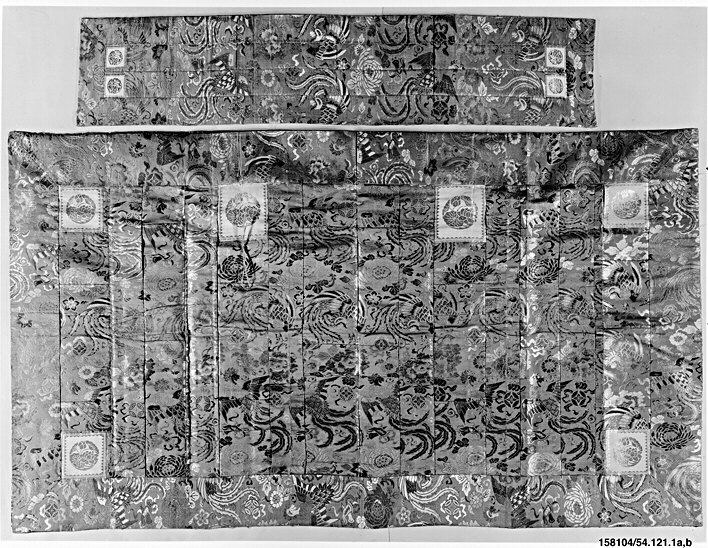
Deconstructing the Divine: A Structural Exegesis of Ecclesiastical Form
The ecclesiastical vestment, particularly the priest's robe and stole, represents one of fashion's most potent and untouched archives of symbolic architecture. For the SS26 collection, Zoey Fashion Laboratory initiates not a mere reinterpretation, but a rigorous structural exegesis. We dissect the canon of sanctity to rebuild it upon a new, future-facing armature. The Japanese origin of our source material is critical; it provides a lens of spatial reverence, intentional asymmetry (fukinsei), and the philosophical concept of Ma (negative space)—prerequisites for moving beyond Western-centric deconstruction. This is not fashion as rebellion, but fashion as a profound, respectful, and forward-propagating inquiry into form, function, and aura.
Silk as Skin, Metal as Nervous System: A Material Dialectic
The foundational dialectic of SS26 is established through a radical re-engineering of materiality. Traditional silk, a symbol of purity and luxury, is subjected to advanced bio-pleating and enzyme-washing techniques to create a “memory-fabric” with variable states of opacity and rigidity. It can appear fluid as liquid, then, through body heat or embedded micro-currents, contract into a sculptural, exoskeletal form. The metallic thread is liberated from its role as mere embellishment. Woven in dense, neural-net-like patterns and connected to micro-capacitors, it becomes a conductive, reactive nervous system within the garment. This system can emit a low-frequency glow, respond to ambient sound with visual pulses, or map the wearer's biometrics—heartbeat, breath—as a shimmering, corporeal halo. The material ceases to be a covering and becomes a symbiotic interface.
The Silhouette of Sanctuary: From Volume to Volumetric Space
The sweeping volume of the priestly robe is deconstructed into a philosophy of “wearable architecture” and “dynamic containment.” We abandon the monolithic bell shape for a silhouette built on articulated, geometric panels. Inspired by the folding logic of origami and the expansive joints of samurai armor (yoroi), the robe transforms into a kinetic structure. It employs lightweight, rigid alloys sheathed in our engineered silk, creating articulated “spine” and “rib” systems that extend, contract, and reconfigure around the body. The silhouette is not static; it is performative. In a resting state, it may hug the torso. With movement, it can deploy into a sweeping trapezoid or an asymmetrical, wing-like projection, creating a personal sanctuary of space—a modern, mobile sacristy.
The stole, that symbolic yoke of office, undergoes the most radical transfiguration. It is reimagined as a “data-stream” or “information harness.” No longer a simple strip of cloth, it is a modular assembly of flexible OLED strips, laser-cut silk-georgette, and linked titanium segments. It can be worn in multiple configurations: as a traditional diagonal sash, as a fragmented collar, or as a trailing, algorithmic scroll that displays abstract data or light patterns. It functions as the central command nexus for the garment’s reactive systems, a literal and figurative conduit of meaning for the digital age.
Structural Innovation: The Exoskeletal Chasuble and Kinetic Drape
Our technical focus for SS26 is on kinetic drape and exoskeletal support. The traditional chasuble’s oval form is analyzed as a problem of suspended geometry. We develop an internal “ghost armature”—a web of shape-memory alloy wires and tensioned silk cables—that allows large swathes of fabric to appear to float away from the body at key points (shoulders, back), defying gravity. This creates pockets of “Ma,” negative space that is as integral to the design as the material itself. Seam construction is revolutionized using ultrasonic welding and biomimetic adhesion, creating seamless, fluid joins that can also serve as conductive pathways for the metallic thread network.
Furthermore, we introduce the concept of “programmable pleating.” Using heat-sensitive shape-memory polymers laminated between silk layers, specific sections of the garment can change their pleat density and direction on command, altering texture, transparency, and thermal regulation. A sleeve can transform from a smooth cylinder to a densely folded, textured bell, echoing the sudden, profound quiet of a stone garden (karesansui).
SS26: The Avatar of Ambiguous Ritual
The final manifestation for SS26 is a collection entitled “The Ambiguous Ritual.” Each ensemble is a standalone study for a new kind of secular cleric—a curator of data, an architect of experience, a guardian of meaning in a fragmented world. The palette is drawn from the sacred and the technological: oxidized silver, bio-luminescent white, deep void black, and the sudden, shocking vermilion of a temple seal (inkan). The wearer becomes an avatar, their garment a responsive environment that mediates between the self and the world.
This analysis posits that the future of avant-garde couture lies not in arbitrary shock, but in deep structural intelligence and philosophical materiality. By deconstructing the priest's robe and stole through the precise, spatial sensibility of Japanese aesthetics and cutting-edge textile science, Zoey Fashion Laboratory forges a new sartorial language. It is a language that speaks of protection and exposure, tradition and erasure, the solid and the ephemeral—a definitive step towards the sentient silhouette of tomorrow.