Deconstructing the Archive: Robert Shurlock as Proto-Futurist
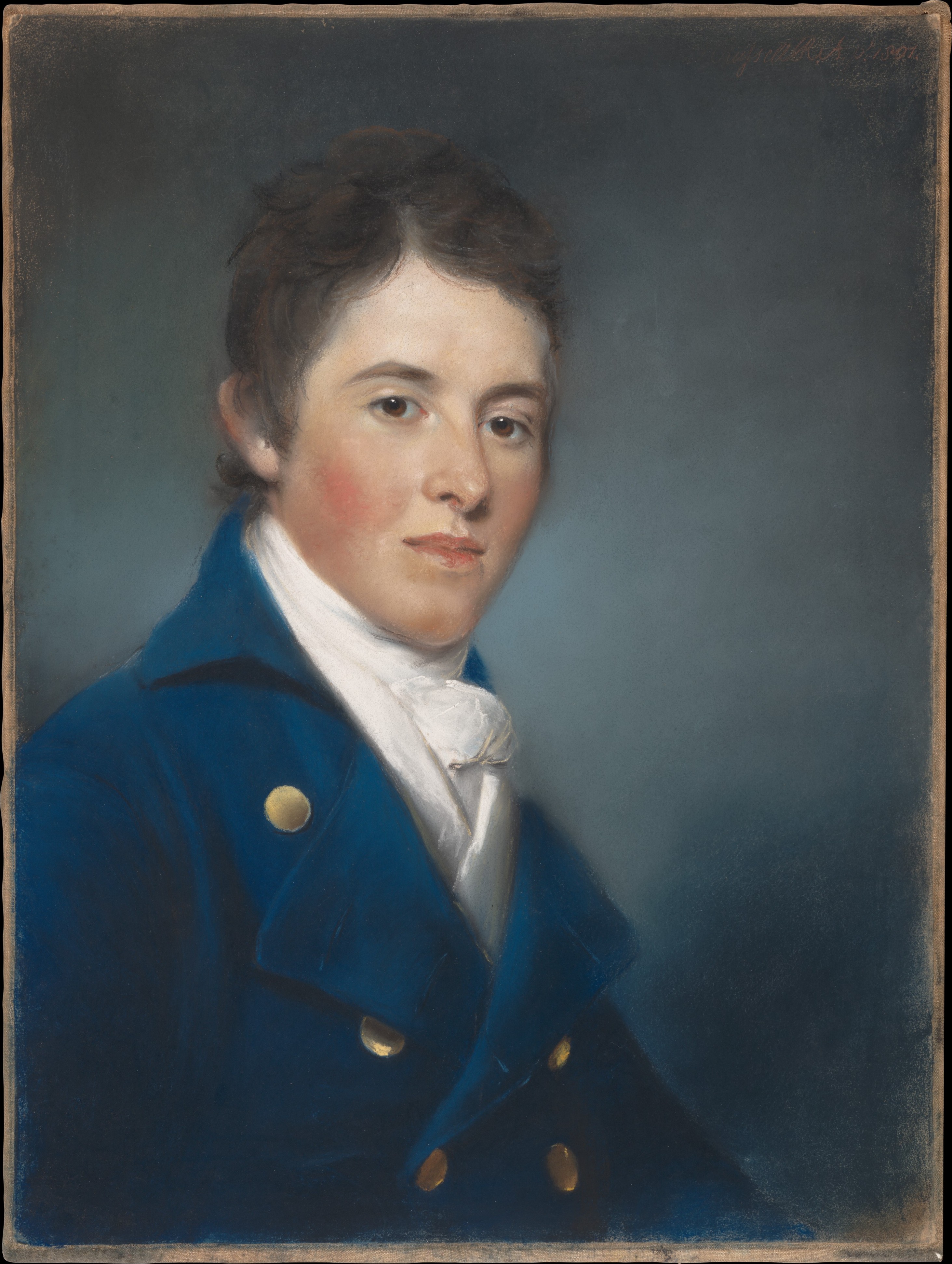
In the relentless pursuit of the next frontier, the fashion laboratory often turns to the most unexpected sources of innovation. For the SS26 cycle, we excavate the oeuvre of Robert Shurlock (1772–1847), a figure whose 'Global Frontier' pastel studies, laid down on canvas, transcend their historical context to function as a prescient blueprint for deconstructive aesthetics. To the uninitiated, Shurlock is a relic of the Romantic era; to the avant-garde curator, he is a structural anarchist. His work, characterized by a radical flattening of perspective and an almost violent juxtaposition of ephemeral pastel against the rigid permanence of canvas, offers a masterclass in tension architecture. This is not a nostalgic retrospective; it is a surgical extraction of principles that will define the SS26 silhouette—a study in controlled chaos, where the fragility of the medium becomes the source of its formidable strength.
The Erosion of Surface: Materiality as a Weapon
Shurlock’s technical choice—pastel on paper, laid down on canvas—is the first point of departure for our design ethos. The pastel, inherently fugitive and soft, is violently subjugated by the canvas’s weave. This creates a frictional interface, a literal battle between the ephemeral and the structural. For SS26, we translate this into garment architecture through the manipulation of high-tenacity organza and laser-cut bonded neoprene. We are not merely layering fabrics; we are creating geological strata of tension. The outer shell, mimicking the canvas, is rigid, architectural, and imposing. The underlayer, representing the pastel, is fluid, pigment-infused, and designed to bleed through strategic perforations. This is not print; it is chromatic seepage. We engineer garments where the surface is deliberately distressed, not for a grunge effect, but to expose the internal structural lattice—a nod to Shurlock’s technique of allowing the paper’s tooth to disrupt the pigment’s flow. The result is a silhouette that appears to be perpetually in a state of becoming, its final form contingent on the viewer’s perspective and the wearer’s movement.
Silhouette Displacement: The Anti-Gravitational Line
Shurlock’s 'Global Frontier' studies are notable for their distorted sense of scale and the displacement of focal points. He removes the central subject from the composition, forcing the eye to traverse the negative space. We apply this principle directly to the SS26 silhouette via asymmetric cantilevered panels. The traditional shoulder line is abolished. In its place, we construct a single-sleeve architecture that extends into a rigid, wing-like structure, while the opposing side is stripped to the bare minimum of a high-cut armhole. This generates a powerful visual torque, a sense of the garment rotating around the body’s axis. The waist is no longer cinched; it is displaced. We utilize molded, bio-resin corsetry that sits off-center, creating a diagonal structural seam that bisects the torso. This is not about fitting the body; it is about creating a new spatial dimension around it. The garments are designed to be inhabited, not worn, with internal armatures that hold the fabric away from the skin, creating an aero-dynamic negative space. This is the futuristic silhouette—not sleek and minimal, but fractured, volumetric, and intellectually demanding.
Chromatic Anomalies: The Palette of Decay and Renewal
The materiality of pastel dictates a specific, luminous palette that Shurlock exploits with scientific precision. He layers complementary hues—acidic yellows against deep violets, pallid pinks against industrial greys—to create a surface that vibrates with optical tension. For SS26, we move beyond simple color blocking into chromatic erosion. Our dyeing process involves a selective solvent wash that removes pigment from the apex of the garment’s folds, leaving the recessed areas saturated. This mimics Shurlock’s technique where the pastel clings to the paper’s valleys but is wiped clean from the peaks. The effect is a three-dimensional color map, where light and shadow are not just illuminating the fabric but are intrinsic to its color construction. We employ thermochromic micro-encapsulated inks that shift hue with body heat, so the garment’s palette is in constant flux, echoing the ephemeral nature of the artist’s medium. The dominant tones are not colors but transitions—the moment where one pigment surrenders to another. This is the palette of the frontier: raw, unrefined, and charged with the energy of the unknown.
Structural Innovation: The Exoskeletal Frame
The most radical departure lies in our interpretation of construction. Shurlock’s canvases are not merely paintings; they are objects, physical presences that assert their weight. We honor this by introducing an external skeletal structure to our garments. This is not a crinoline or a cage in the historical sense, but a carbon-fiber and recycled aluminum articulation that snaps onto the primary garment via magnetic connectors. This exoskeleton defines the garment’s ultimate shape, creating hard geometric lines that contrast with the fluidity of the textile. The wearer becomes a co-architect, choosing which structural elements to attach, thereby altering the garment’s profile from a compact column to a sprawling, geometric landscape. This modularity is the ultimate expression of deconstructive aesthetics—the garment is never a fixed entity but a kit of parts, a manifesto of infinite possibility. It is a direct challenge to the notion of the finished piece, positioning the garment as a perpetual work-in-progress, much like Shurlock’s studies, which are sketches of a larger, unseen vision.
Conclusion: The Legacy of the Frontier
Robert Shurlock is not a historical footnote; he is a collaborator from the past, providing the theoretical framework for a future that has yet to be worn. His work teaches us that true innovation lies not in the creation of new shapes, but in the re-contextualization of material and structure. For SS26, Zoey Fashion Laboratory presents a collection that is less about clothing and more about inhabitable architecture. We are building garments that challenge the wearer to consider their own physicality in relation to the space they occupy. The pastel’s fragility becomes our strength; the canvas’s rigidity becomes our fluidity. This is the new frontier—a space where the past is not preserved but shattered and reassembled into a vision of radical, structural beauty. The future is not a smooth, seamless line; it is a fractured, pastel-dusted, exoskeletal silhouette, ready to be inhabited by those who dare to lead. This is the definitive avant-garde analysis; this is the blueprint for the next generation of fashion.