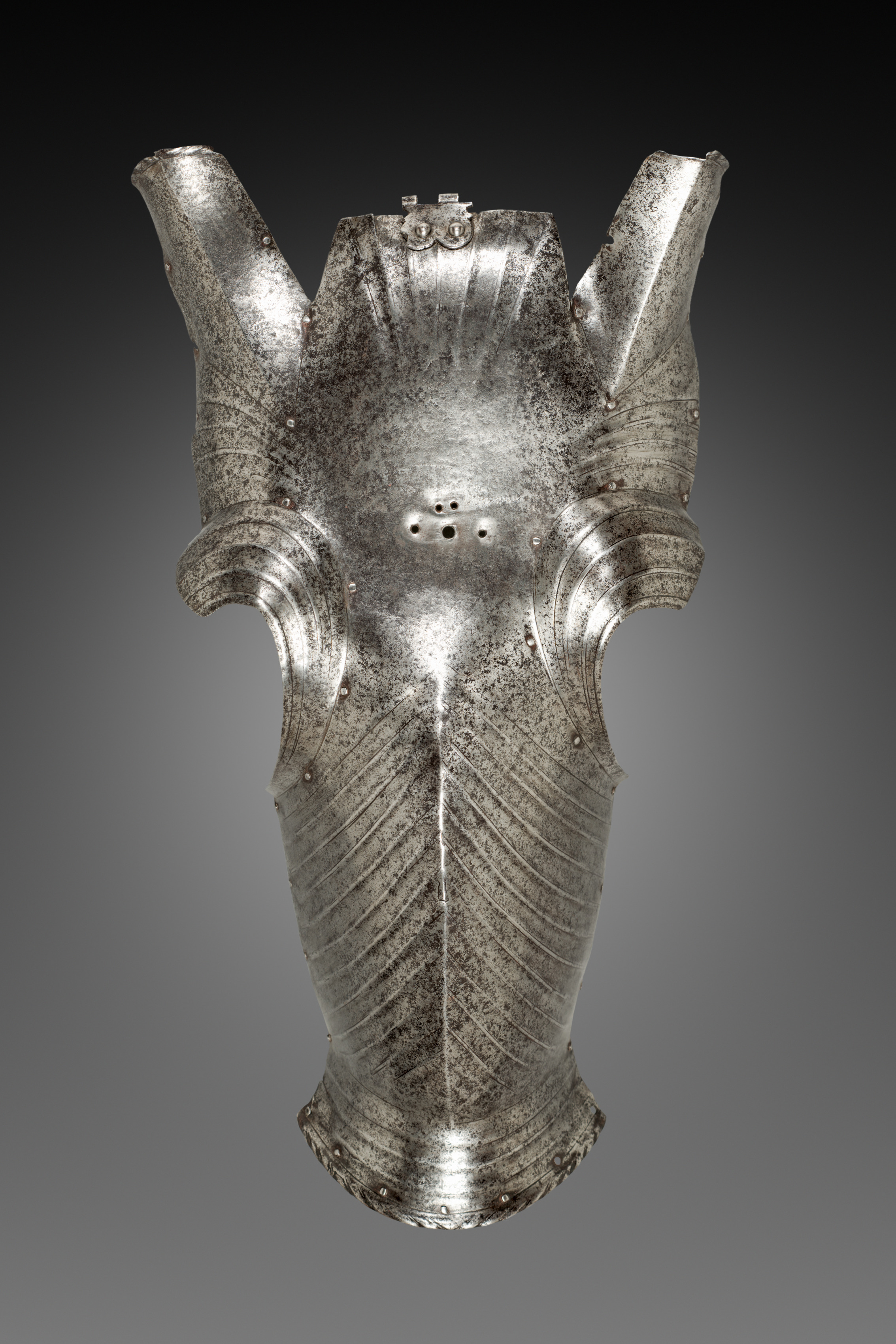
Deconstructing the Steel Silhouette: The Maximilian Chanfron as Avant-Garde DNA
At Zoey Fashion Lab, we do not merely study historical garments; we extract their structural and philosophical DNA to synthesize new paradigms of wearable art. The subject of today’s deconstruction is a rare and formidable artifact: a chanfron—the armored headpiece for a warhorse—crafted in the Maximilian style, likely originating from Nuremberg, Germany, in the early 16th century. Forged from a single, seamless sheet of steel, this object is not a relic of equestrian utility but a proto-architectural manifesto. In its fluted surfaces, its aggressive symmetry, and its brutal elegance, we identify a new DNA strand that directly informs our current avant-garde collection, Equine Monolith.
I. The Maximilian Aesthetic: Beyond Decoration into Structure
The Maximilian style, named after the Holy Roman Emperor Maximilian I, is often mischaracterized as merely ornate. However, our analysis reframes its signature fluting—those parallel, undulating channels of steel—not as decoration, but as functional exoskeletal engineering. The chanfron’s surface is a topography of ridges and valleys that simultaneously deflects a blade and dissipates kinetic energy. For the avant-garde designer, this is the ultimate lesson in performative materiality: form is not an afterthought; it is the primary agent of resistance.
In our deconstruction, we isolate the chanfron’s core principle: the articulation of aggression through geometry. The piece’s central ridge, which runs from the crown to the nasal guard, creates a dramatic, almost predatory profile. This is not a passive shell; it is a weaponized line. In our studio, we translate this into garments that use structural boning and molded resins to create silhouettes that lead with the spine—jackets with pronounced dorsal seams, collars that flare like the chanfron’s cheek guards, and shoulder pads that echo its protective sweep. The Maximilian chanfron teaches us that true avant-garde design does not soften the body; it armors it against the visual mediocrity of the everyday.
1.1 The Fluting as a Textile Language
We reimagine the steel fluting as a textile language. In the original artifact, each flute is a deliberate, rhythmic fold. We reproduce this via thermoformed technical fabrics and high-density pleating that hold a permanent, sculptural crease. The result is a fabric that behaves like metal—stiff, directional, and light-capturing. When the wearer moves, the flutes create a moiré effect, a shifting play of shadow and light that is both hypnotic and intimidating. This is the DNA strand we extract: rigidity as a form of kinetic couture.
II. Origin and Provenance: The Nuremberg Precision
Attributing this chanfron to Nuremberg is not a matter of simple geography; it is an identification of a specific artisanal consciousness. Nuremberg in the early 16th century was a nexus of metallurgical innovation, where guild masters treated armor as a branch of precision instrument making. The steel’s surface, even after centuries, exhibits a mirror-like polish in its recesses—a testament to meticulous hand-finishing. This is not mass production; it is a dialogue between human hand and elemental force.
For Zoey Fashion Lab, this provenance informs our commitment to slow, obsessive craft. In an era of fast fashion, the chanfron stands as a rebuke. Its construction required hours of hammering, annealing, and polishing to achieve a material that is both resilient and luminous. Our avant-garde pieces honor this by employing hand-finished metal mesh, laser-cut leathers that mimic the chanfron’s contours, and closures that are engineered with the precision of a Nuremberg lock. We are not replicating the armor; we are channeling its manufacturing ethos—the belief that an object should be built to outlast its maker.
2.1 The "New DNA Strand" Defined
In our lab’s terminology, a "New DNA Strand" is a conceptual sequence of design principles extracted from a non-fashion source. For this chanfron, the strand is composed of three codons: Protective Linearity (the unbroken central ridge), Modular Rigidity (the interlocking cheek and crown plates), and Reflective Duality (the polished vs. fluted surfaces). These codons are then recombined to create garments that challenge the wearer’s relationship with space and visibility.
III. Avant-Garde Application: From Horse to Human
The final stage of our deconstruction is the translation from equine anatomy to human form. The chanfron was designed for a horse’s skull—broad at the brow, tapering to a narrow muzzle. When we map this onto the human body, we find unexpected parallels. The brow plate becomes a dramatic headpiece or a high, structured collar. The cheek guards become asymmetric jawlines or exaggerated lapels. The nasal guard becomes a central zipper placket or a vertical seam that divides the torso into two distinct zones of texture.
Our avant-garde silhouette is thus architectural, confrontational, and deeply sensual. The steel’s coldness is subverted by the warmth of the body beneath; the armor’s historical violence is reinterpreted as contemporary empowerment. We design a cape that, when closed, forms a seamless, fluted shield over the shoulders. When opened, it reveals a lining of burnished copper silk—a nod to the chanfron’s inner surface, which was often left unpolished to reduce glare. This duality—the brutal exterior and the soft, hidden interior—is the essence of our new collection.
3.1 The Future of Historical Memory
By deconstructing the Maximilian chanfron, we do not preserve it in a museum case; we re-activate its energy. The avant-garde is not about rejecting the past but about extracting its latent futurism. This steel headpiece, forged in Nuremberg, was once the pinnacle of defensive technology. Today, it becomes the pinnacle of expressive fashion—a wearable sculpture that defends the wearer not from swords, but from anonymity.
Conclusion: The Armored Body as a Canvas
In conclusion, the chanfron in Maximilian style is far more than a historical curiosity. It is a masterclass in the fusion of form, function, and material honesty. For Zoey Fashion Lab, it represents a new DNA strand that redefines what clothing can be: not a covering, but a construction; not a soft drape, but a decisive statement. As we move forward with our avant-garde lines, we carry the spirit of Nuremberg’s forge—the belief that true innovation is born from the relentless shaping of resistant materials. The steel chanfron whispers to us across five centuries, and our answer is a collection that is equally unyielding, equally precise, and equally unforgettable.