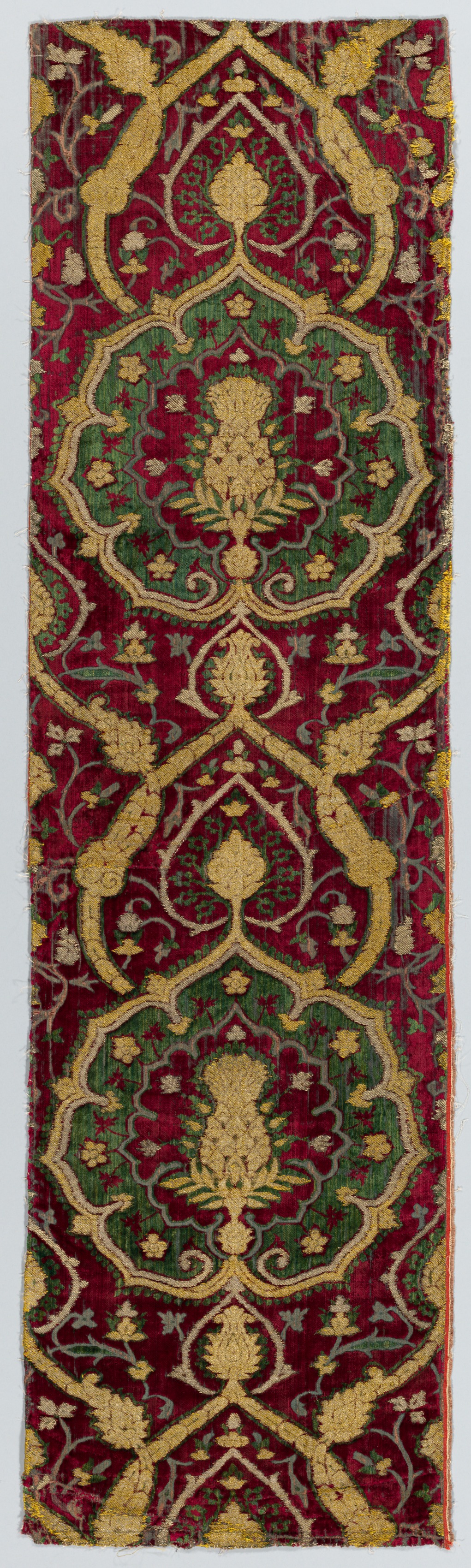
Deconstructing the Ottoman Opulence: Brocaded Velvet as an Avant-Garde DNA Strand
At Zoey Fashion Lab, we do not merely observe historical textiles; we dissect their genetic code, extracting the structural and philosophical imperatives that can inform the future of fashion. This week’s subject—a fragment of brocaded velvet from early 16th-century Turkey—presents a paradox of immense creative potential. On the surface, it is the epitome of imperial luxury: a silk ground, plush and deep, overlaid with shimmering gold and silver threads. Yet, beneath this veneer of Ottoman opulence lies a radical architectural blueprint that resonates profoundly with contemporary avant-garde design. Our analysis treats this artifact not as a museum piece, but as a New DNA Strand—a sequence of material, technique, and cultural tension that we are prepared to splice, mutate, and re-sequence for the modern runway.
I. The Material Genome: Deconstructing Silk, Gold, and Silver
The primary nucleotides of this genetic strand are its raw materials. The velvet base is pure silk, a protein fiber renowned for its tensile strength, lustrous surface, and remarkable drape. In the 16th century, silk was not merely a textile; it was a geopolitical statement, a currency of power flowing along the Silk Road from China through Persia and into the Ottoman ateliers of Bursa and Istanbul. For our lab, silk represents structural memory—a material that holds its shape under tension yet yields fluidly to movement. It is the foundational helix of our design, offering a neutral, luminous canvas.
However, the true mutation occurs with the introduction of the metal threads. The brocading technique—a supplementary weft technique—introduces gold and silver filaments into the velvet pile. These are not simple metallic wires; they are typically silver-gilt, meaning a silver core wrapped in a thin layer of gold leaf. This composite creates a material with a dualistic identity: the cool, reflective brilliance of silver and the warm, imperial glow of gold. In an avant-garde context, we view this not as decoration but as a form of light architecture. The metallic threads are not passive surfaces; they are active agents that manipulate ambient light, creating a kinetic, shifting topography across the garment. This is our first point of extraction: the deliberate use of contrasting material densities to create visual and tactile dissonance.
II. The Technical Weave: Brocading as a Structural Provocation
Technically, the brocaded velvet is a marvel of complex loom engineering. The ground weave is a cut velvet, where loops of silk pile are sheared to create a dense, soft surface. The brocading weft, however, is discontinuous. The gold and silver threads are woven only where the pattern requires them, floating on the reverse side. This creates a fabric with a variable thickness and weight—areas of plush velvet contrast sharply with rigid, metallic plateaus.
For Zoey Fashion Lab, this technical irregularity is a provocation. Traditional tailoring seeks uniformity; our avant-garde approach celebrates disruption. We propose to invert the hierarchy of this weave. Instead of hiding the discontinuous floats on the inside, we will expose them on the exterior, creating a fringed, deconstructed edge that reveals the garment’s internal skeleton. The brocading becomes a form of exoskeleton, a metallic armor that is simultaneously fragile and imposing. Furthermore, the weight differential between the silk pile and the metal threads offers a unique opportunity for gravity-play. A garment can be engineered to fall asymmetrically, with the heavier metallic sections pulling the silhouette into unexpected, sculptural forms. This is not a nostalgic reproduction; it is a re-engineering of the weave's physical properties to generate new silhouettes.
III. Cultural Tension: The Ottoman Code as a Subversive Language
The cultural origin of this textile is as significant as its materiality. Early 16th-century Ottoman velvet was designed to signify absolute authority—the divine right of the Sultan, the wealth of an empire, and the rigid hierarchy of courtly life. The patterns, often featuring stylized floral motifs, arabesques, and celestial forms, were codified symbols of paradise and power. To wear this fabric was to embody the state.
Our avant-garde reinterpretation must therefore engage in a subversive dialogue with this history. We are not interested in recreating imperial grandeur; we are interested in dismantling it. By cutting the velvet against the grain, fragmenting the traditional motifs, and re-contextualizing the fabric in a deconstructed, asymmetrical silhouette, we challenge the original message of order and control. The gold becomes ironic—a symbol of excess and decadence that is now used to critique contemporary consumerism and political spectacle. This is the core of our New DNA Strand: taking a signifier of absolute power and re-coding it as a symbol of individual freedom, chaos, and subversion. The garment becomes a wearable manifesto, a conversation between the 16th century and the present moment.
IV. Avant-Garde Synthesis: The Zoey Fashion Lab Design Proposal
Our design proposal is a three-piece ensemble that functions as a living sculpture. The primary garment is a long, asymmetric coat. The body is constructed from the velvet, but we have chemically and mechanically distressed the pile to create varying heights of texture, from a smooth, polished surface to a raw, almost felted finish. The gold and silver brocading is not used in its original continuous pattern. Instead, we have cut the metallic threads into narrow strips and re-applied them using a laser-fusion technique, creating a fractured, lightning-like pattern that runs diagonally across the torso. This disrupts the traditional verticality of the Ottoman design, introducing a sense of dynamic instability.
Beneath the coat, we propose a second skin: a form-fitting bodysuit made from a biotech-derived silk filament, printed with a digital scan of the original velvet’s reverse side. This exposes the hidden structure—the floating threads and the chaotic underside of the weave—as a visible, graphic pattern. The juxtaposition of the heavy, textured coat and the sleek, digital-printed bodysuit creates a dialectic between the physical and the virtual.
Finally, the ensemble is completed by a headpiece—a sculptural collar constructed from the silver-gilt threads, but woven into a rigid, geometric form that resembles a futuristic exoskeleton. It is both a crown and a cage, referencing the original imperial authority while simultaneously imprisoning the wearer in a new, self-imposed identity. This is the ultimate expression of our analysis: the brocaded velvet is not a relic but a catalyst—a material that, when deconstructed, reveals the tensions between power, beauty, and the individual. At Zoey Fashion Lab, we do not preserve history; we weaponize it for the future.