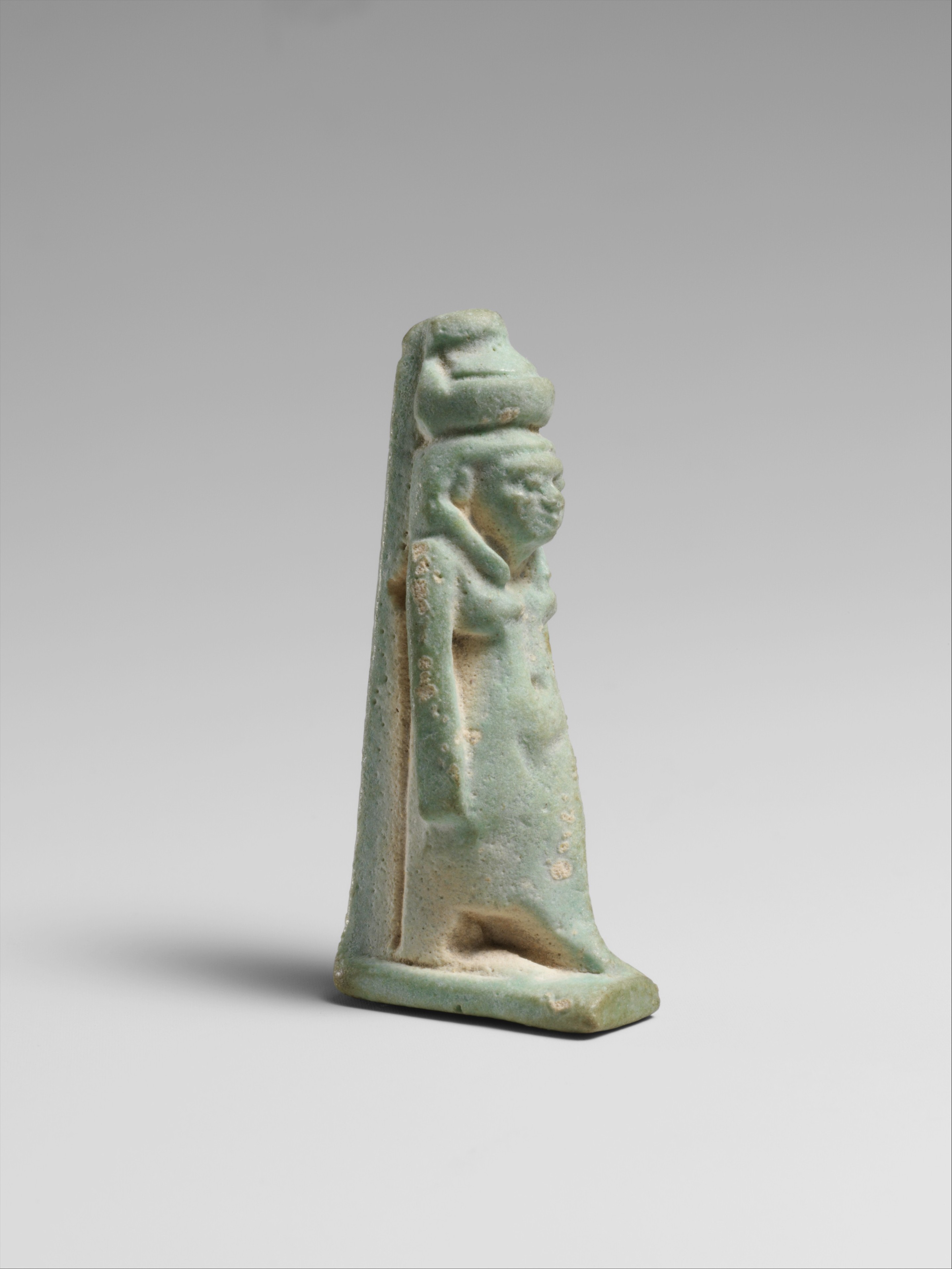
The Techno-Sacral Amulet: Deconstructing Ptolemaic Divinity for SS26
The faience amulet of Mut, rendered in her double crown, is not merely an artifact of Ptolemaic piety; it is a proto-architectural blueprint. For Zoey Fashion Laboratory’s SS26 directive, this object—small, glazed, and intensely symbolic—becomes the catalyst for a radical reimagining of the female silhouette. We are not interested in historical reproduction. Instead, we extract the amulet’s core principles: its material paradox, its vertical tension, and its protective enclosure. The result is a collection that treats the body as a sacred plinth, and the garment as a modular, load-bearing system of spiritual and structural defiance.
Material Paradox: The Glaze of the Future
Faience is a lie that becomes a truth. It is a composite of crushed quartz, alkaline salts, and colorants, fired to a vitreous sheen that mimics lapis lazuli or turquoise. The Ptolemaic artisan was not fooling anyone; they were creating a new reality through technological alchemy. For SS26, we translate this deception into fabric innovation. Our primary textile is a bio-ceramic bonded neoprene, which we have developed with a micro-encapsulated glaze that shifts from a matte, sand-like texture to a high-gloss, reflective surface upon body heat. This is not a print. It is a living surface that reacts to the wearer’s thermal signature, echoing the amulet’s uncanny luminosity.
Further, the structural integrity of faience—its surprising hardness beneath a delicate exterior—informs our tailoring. We introduce a new category of “compressed couture”: garments that appear soft and pliable from a distance but lock into rigid, architectural forms when stressed. Think of a sleeveless column dress in this ceramic neoprene, cut with a razor-sharp neckline that mirrors the amulet’s flat, frontal presentation. The fabric is pleated using a laser-etched technique that creates a permanent, structural corrugation, reminiscent of the amulet’s incised details. The result is a garment that holds its shape like a sculpted artifact, yet moves with the fluidity of a second skin. This is the paradox of the future: strength that feels like silk, and history that looks like tomorrow.
The Double Crown: A Silhouette of Dual Sovereignty
Mut’s double crown—the combination of the White Crown of Upper Egypt and the Red Crown of Lower Egypt—is the collection’s primary silhouette driver. This is not a literal hat. Instead, we deconstruct the crown’s verticality and bifurcation into the garment’s core geometry. The SS26 silhouette is defined by an asymmetric, elongated shoulder that rises on one side like the White Crown, while the opposite side falls into a sweeping, red-based train that evokes the Red Crown’s curvature. This creates a dynamic, diagonal line that disrupts the conventional horizontal balance of the body, forcing the eye upward and outward—a form of wearable hieratic scale.
We further interpret the crown’s dual nature through modular construction. A signature piece is a two-in-one bodice: the left half is a high-necked, corseted shell in white ceramic leather, while the right half is a draped, hooded mantle in crimson liquid silk. The two are joined by a single, visible titanium clasp—an homage to the amulet’s suspension loop—allowing the wearer to separate the halves into two distinct garments. This is not just a design feature; it is a philosophical statement. The crown is not a unified symbol of domination, but a negotiation between two powers. Our garments, likewise, are negotiations between structure and drape, past and future, protection and exposure.
Protective Enclosure: The Amulet as Armor
Amulets were worn for apotropaic protection, not mere decoration. They were placed on the body to guard the wearer against specific threats. In the context of SS26, this translates into a new language of “psychic armor.” We are designing garments that protect not from physical harm, but from the visual and social noise of contemporary life. The amulet’s compact, self-contained form inspires a series of high-collared, enveloping jackets and capes that cocoon the wearer. These are not bulky; they are precisely engineered. The collars are constructed from a shape-memory alloy that can be bent into a rigid, protective frame around the face, then flattened when not in use. The sleeves are cut in a single, seamless piece with the torso, creating a bat-like, encompassing wing that can be closed with hidden magnetic closures.
The faience’s iconic turquoise color—often associated with rebirth and the Nile’s life-giving waters—is reimagined as a “digital Nile” palette. We move beyond simple cyan. Our color story includes a phosphorescent aqua that glows in low light, a deep, oxidized copper green, and a bone-white with a subtle, iridescent pearl finish. These colors are not applied as mere surface treatments; they are integral to the material’s structure. We use a technique of in-situ pigment infusion, where the color is embedded within the fabric’s fibers during the spinning process, ensuring that the garment’s hue is as permanent as the faience’s glaze.
Structural Innovation: The Loop and the Lattice
The amulet’s suspension loop is a crucial, often-overlooked detail. It is the point of connection, the interface between the sacred object and the mortal body. We elevate this humble loop into a major structural device. All mainline garments for SS26 feature an integrated “load-bearing loop”—a reinforced, metallic eyelet or a braided cord channel—at key stress points: the shoulder blades, the hip bones, and the sternum. These loops are not decorative; they are functional anchors for a series of detachable panels, trains, and capes. This allows for a single base garment to be reconfigured into multiple silhouettes, echoing the amulet’s portability and adaptability.
Finally, we look to the amulet’s incised surface details—the fine lines that delineate the crown’s feathers and the goddess’s features—as a basis for a new textile lattice. We have developed a “hieroglyphic mesh”: a laser-cut, three-dimensional latticework that is both structural and decorative. This mesh is used as an overlay on sheer bases, creating a play of light and shadow that mimics the play of light across the amulet’s glazed surface. It is also used as a standalone material, shaped into sculptural, cage-like skirts and bodices that hover over the body, never quite touching. This creates a sense of suspension, of the garment existing in a state of levitation, just as the amulet was meant to hover between the earthly and the divine.
In conclusion, the Ptolemaic amulet of Mut is not a relic of a dead past, but a blueprint for a living future. For SS26, Zoey Fashion Laboratory transforms this small, sacred object into a comprehensive system of design—from reactive materials to modular silhouettes—that challenges the very notion of what a garment can be. It is a collection that is simultaneously a prayer, a weapon, and a prophecy, dressed in the iridescent colors of the Nile’s eternal dawn.