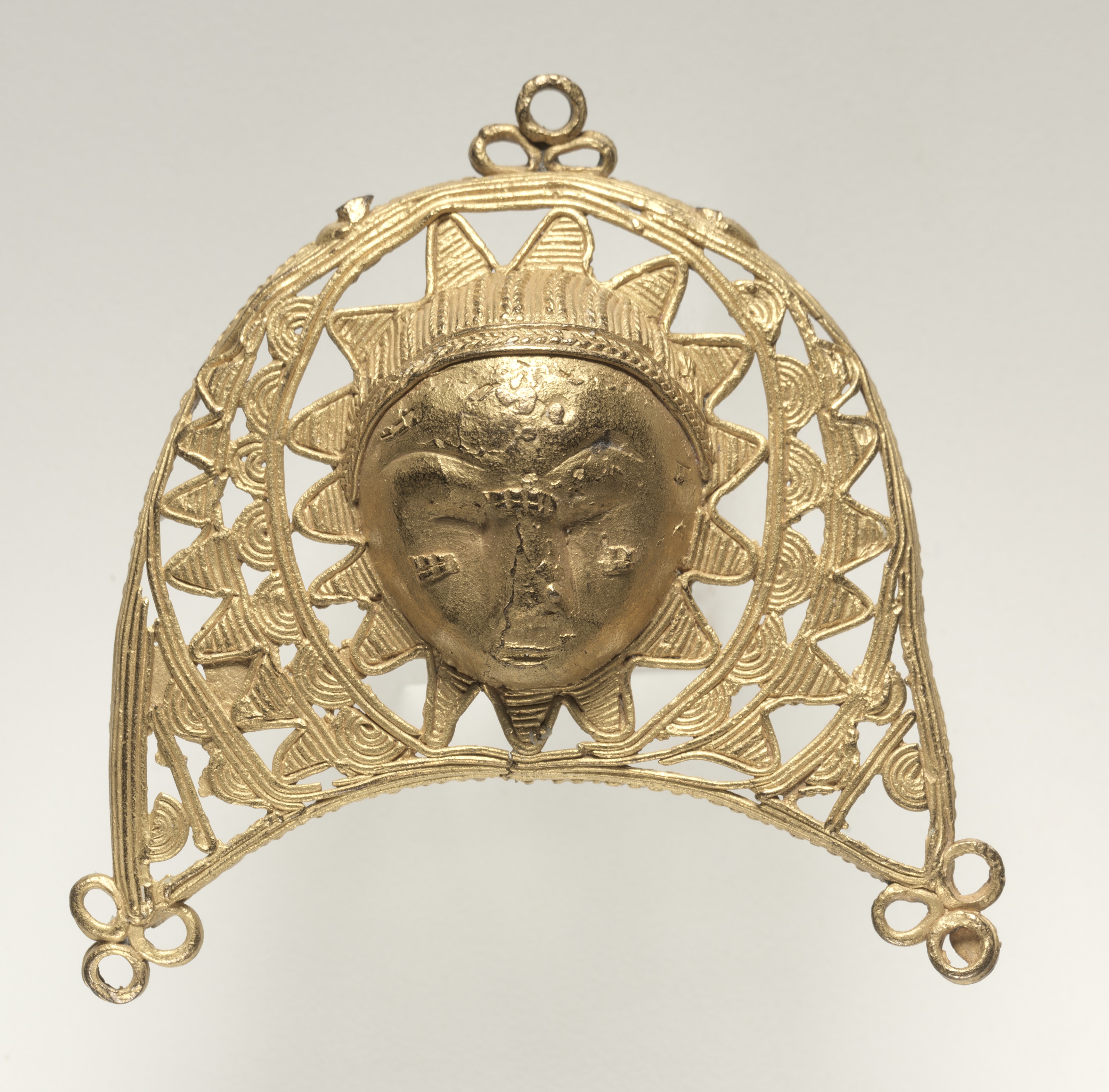
Deconstructing the Crescent: An Avant-Garde Analysis of the Baule-Inspired Pendant
At Zoey Fashion Lab, our mandate extends beyond the mere cataloging of adornment. We dissect the object, stripping away layers of historical context, technical execution, and cultural resonance to reveal the raw aesthetic potential that lies beneath. In this installment of Archive Resonance, we turn our analytical gaze to a singular artifact: a gold pendant depicting a face within a crescent, originating from West Africa, specifically Côte d'Ivoire, and attributed to the Baule goldsmithing tradition. Our objective is not to authenticate or appraise, but to re-contextualize this piece within a framework of avant-garde fashion theory, exploring how its formal qualities and symbolic weight can inform a radical, contemporary design language.
Formal Dissection: The Geometry of Duality
The pendant’s primary formal gesture is the crescent—a shape that is neither complete nor void. It exists in a state of perpetual becoming, a sliver of a whole that suggests both the waxing and waning of celestial bodies. In the context of avant-garde design, this is not a passive ornament but a deliberate act of negative space manipulation. The crescent frames the face, yet it does not contain it. The visage, rendered in gold, appears to emerge from or recede into the lunar curve, creating a dynamic tension between the solid mass of the face and the hollow arc of the crescent. This is a study in counterbalance: the heavy, sculptural quality of the face is offset by the ethereal, almost architectural lightness of the crescent’s curve.
The Baule goldsmith’s technique is paramount here. The use of the lost-wax casting method—a process of meticulous wax modeling, clay investment, and molten metal replacement—imbues the piece with a tactile, hand-wrought quality that mass-produced fashion accessories wholly lack. The surface is not perfectly smooth; it retains the micro-textures of the artist’s hand, the subtle undulations of the original wax model. In an era of sterile, 3D-printed precision, this pendant champions artisanal imperfection as a luxury. The gold itself, often alloyed with copper or silver in Baule work to achieve a range of hues from reddish to pale yellow, catches light differently across its facets, creating a living, breathing surface that changes with the viewer’s angle.
Symbolic Cartography: The Face and the Lunar Arc
To truly deconstruct this pendant for avant-garde application, one must engage with its symbolic architecture. The face is not a portrait; it is an archetype. In Baule culture, such representations often relate to blolo bla or blolo bian—spirit spouses from the other world who guide and inspire. The face, therefore, is not a depiction of a physical individual but a conduit to a parallel reality. This aligns seamlessly with the avant-garde fashion ethos of transcending the mundane, of using clothing and accessories as portals to alter ego and speculative identity.
The crescent, in this context, is a potent symbol of cyclical time, transformation, and the feminine principle. It is the moon in its most dynamic phase, not the static full orb. Pairing the human face with the lunar arc creates a cosmological dialogue: the microcosm (human) meeting the macrocosm (celestial). The avant-garde interpretation is not about wearing a piece of jewelry; it is about wearing a philosophical statement. The pendant becomes a wearable manifesto on the relationship between individual identity and universal forces, between the fleeting moment of human life and the eternal recurrence of cosmic cycles.
Archive Resonance: The Mirror and the Relief
Our internal reference for this piece draws a striking parallel: “一面是光洁银镜上以黄金镶嵌的纷繁棕叶纹,另一面是冰冷石棺板上以浮雕诉说的生命叙事”—"On one side, a polished silver mirror with intricate palm-leaf patterns inlaid in gold; on the other, a cold sarcophagus slab whose relief narrates a story of life." This poetic duality is the key to unlocking the pendant’s avant-garde potential. The mirror represents surface, reflection, and the ephemeral present. The sarcophagus represents depth, memory, and the enduring past.
The pendant, like this mirror-and-sarcophagus composite, is a binary object. It holds the tension between the immediate visual impact (the gold’s luster, the face’s direct gaze) and the deeper, latent narrative (the spiritual significance, the cultural history). For the avant-garde designer, this suggests a design strategy of layered opacity. The garment or accessory must first seduce with its surface—its texture, its color, its silhouette—but upon closer inspection, it must reveal hidden depths, whether through concealed construction, unexpected material juxtapositions, or embedded symbolic motifs.
Avant-Garde Translation: From Artifact to Aesthetic System
How does this Baule pendant inform a forward-thinking fashion collection? We propose a three-pronged translation:
1. Silhouette as Crescent. The crescent form can be abstracted into garment architecture. Imagine a cape whose asymmetric hem traces a lunar arc, or a sculptural collar that frames the neck and lower face, echoing the pendant’s framing of the visage. The silhouette would not be symmetrical; it would be dynamically unbalanced, suggesting movement and transition. The use of rigid, metallic-infused fabrics (like organza with metal thread) could replicate the structural integrity of the gold, while softer, flowing materials could represent the void of the crescent, allowing the body to become the negative space.
2. Surface as Narrative. The lost-wax technique’s textural residue should be translated into fabric treatments. We advocate for irregular pleating, hand-applied sequins in varying densities, and burnout velvet that reveals a secondary layer beneath—a nod to the mirror-sarcophagus duality. The gold color should not be used as a flat metallic; it must be achieved through tonal variation, mixing antique gold, bright yellow gold, and rose gold threads or beads to mimic the natural alloy variations of Baule goldwork. The face motif itself could be abstracted into a digital print, but distorted, blurred, or repeated at varying scales to strip it of literal representation and elevate it to a pure graphic pattern.
3. Accessory as Philosophy. The pendant itself, reimagined, becomes a central accessory—but not as a simple necklace. It could be scaled up into a face-covering visor or a shoulder armor piece, transforming the wearer into a living avatar of the Baule spirit spouse. The crescent would be rendered in polished metal or resin, while the face would be suggested through cutouts and shadows, not explicit depiction. The wearer’s own face becomes the third element, completing the composition. This is not costume; it is wearable ritual, a deliberate act of self-mythologizing.
Conclusion: The Pendant as a Living Thesis
The Face in Crescent pendant is far more than a historical artifact. It is a comprehensive design thesis on duality, materiality, and narrative depth. For Zoey Fashion Lab, it serves as a masterclass in how to embed profound cultural and philosophical meaning within a compact, wearable form. The avant-garde is not about novelty for its own sake; it is about radical re-contextualization. By taking this Baule goldsmith’s creation and translating its core principles—the dynamic crescent, the archetypal face, the textural honesty of lost-wax casting, and the binary of mirror and relief—into a modern fashion system, we honor its origin while propelling it into a future it could never have imagined. The result is not a collection of clothes and accessories, but a curated experience of identity, where each piece carries the weight of a cosmogram and the lightness of a fleeting lunar shadow.