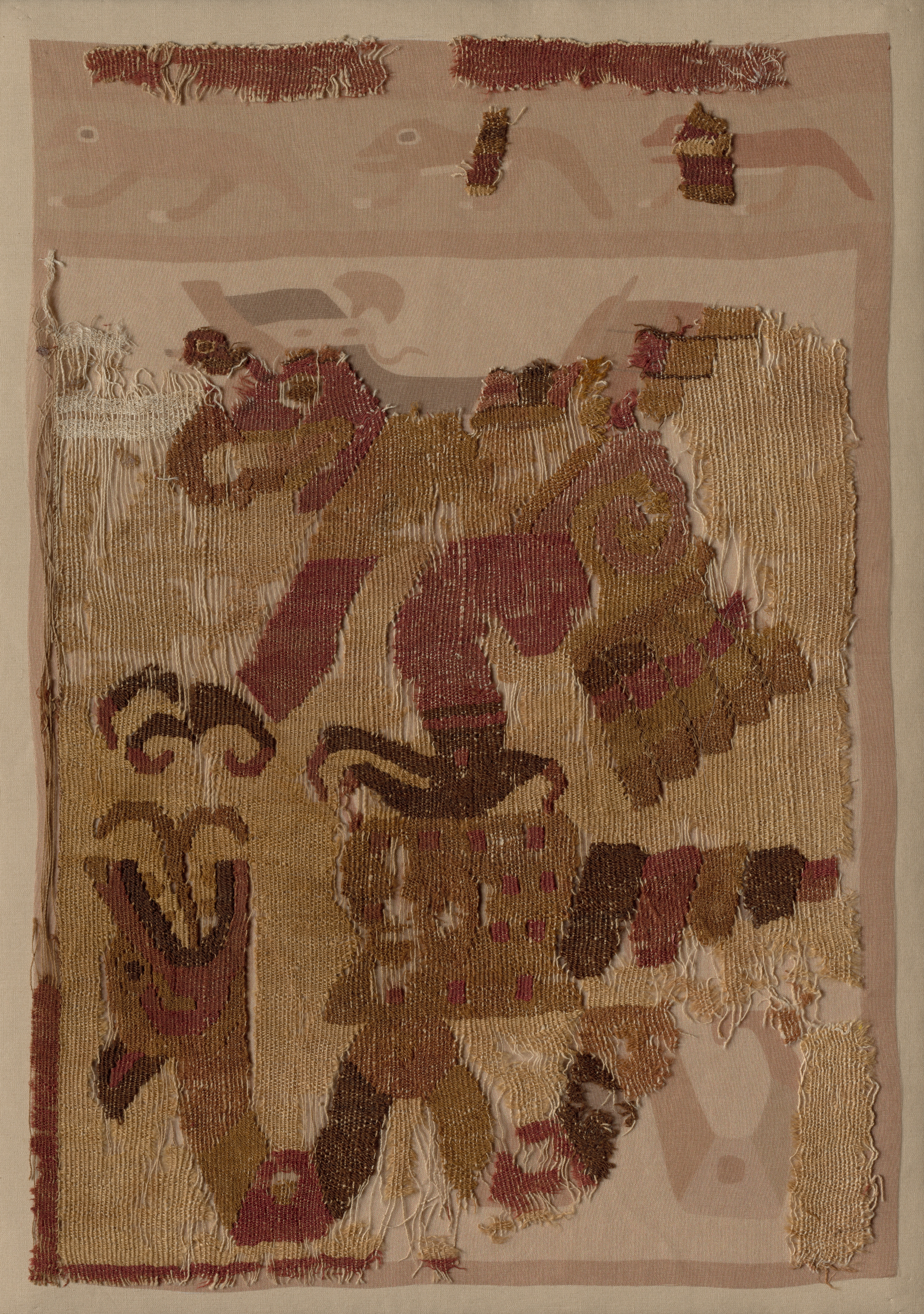
Deconstructing the Andean Echo: A Textile Fragment’s Avant-Garde Resonance
At Zoey Fashion Lab, our mandate extends beyond the mere cataloging of fabric; we engage in the archaeological excavation of narrative, the forensic analysis of cultural memory, and the radical recontextualization of historical artifacts within a contemporary, avant-garde framework. The textile fragment under examination—a Moche-era composite of cotton and camelid fiber from Peru’s north coast—presents a profound paradox. It is at once a utilitarian remnant of a pre-Columbian civilization and a startlingly prescient precursor to modern abstract expressionism. This analysis will dissect the fragment’s technical, material, and cultural layers, positioning it not as a static relic but as a dynamic source code for future fashion innovation.
Technical Autopsy: The Interlacing of Two Worlds
The fragment’s construction is a testament to the Moche’s sophisticated understanding of material properties. The warp, predominantly of cotton, provides a stable, absorbent, and inherently flexible base. Native to the coastal valleys, this cotton was cultivated in a spectrum of natural hues—from creamy ivory to deep chocolate brown—negating the need for initial dyeing. In stark contrast, the weft introduces camelid fiber (likely from alpaca or vicuña), a protein-based filament prized for its thermal insulation, tensile strength, and remarkable luster. This deliberate pairing is not merely functional; it is a philosophical statement. The cellulose (cotton) grounds the textile in the terrestrial, while the protein (camelid) elevates it toward the celestial. The resulting fabric possesses a dual tactility—the crisp, dry hand of the cotton against the soft, warm halo of the wool—creating a dynamic surface tension that is both physically and conceptually compelling.
Furthermore, the weave structure itself, likely a warp-faced or complementary warp pattern, demonstrates a mastery of tension and rhythm. The irregular, slightly uneven thread counts suggest a hand-loomed process, where the human touch is indelibly imprinted in every millimeter. This imperfection is not a flaw but a signature. In our lab, we refer to this as “algorithmic irregularity”—a pattern that repeats with deliberate variance, defying the sterile uniformity of industrial production. This technical choice yields a fabric that behaves as a living membrane, shifting its drape and texture in response to light and movement.
Material Semiotics: Cotton as Canvas, Fiber as Code
Beyond its physical properties, the materiality of this fragment functions as a semiotic system. The cotton base, often bleached by the sun or dyed with indigo from coastal plants, served as a ground for narrative expression. The camelid fiber, frequently dyed with vibrant pigments derived from insects (cochineal), minerals (cinnabar), and plants (chilca), was used to articulate iconographic details. While the fragment’s specific imagery is partially eroded, the remnants of geometric patterns and stylized zoomorphic forms—likely felines, serpents, or birds—speak to a cosmological order. These are not mere decorations; they are mnemonic devices, encoding agricultural calendars, ritual practices, and social hierarchies.
In the context of Zoey Fashion Lab’s avant-garde lens, we interpret this as an early form of “wearable data.” The Moche did not simply wear cloth; they wore their worldview. The juxtaposition of materials—the humble cotton and the precious camelid—mirrors the social stratification of their society, yet their co-existence within a single weave suggests an inherent interdependence. This challenges the contemporary fashion industry’s obsession with singular, luxury fibers. The fragment proposes a radical alternative: value through hybridity, not purity. It suggests that true opulence lies in the intelligent fusion of disparate elements to create a new, synergistic whole.
Chrono-Cultural Collision: The Archive Resonance
Our reference to the “Archive Resonance” of 16th-17th century colonial encounters is crucial here. That later period was marked by violent cultural collision, where Andean textile traditions were systematically dismantled and repurposed by European colonizers. Yet, the Moche fragment predates this rupture by nearly a millennium. It represents a time of autonomous aesthetic evolution, before the imposition of foreign iconography. Viewing this fragment through the lens of that later colonial trauma, we recognize its pre-lapsarian purity—a visual language that is entirely self-referential and untainted by external influence. This makes it an incredibly potent source of inspiration for the avant-garde designer seeking to break free from the hegemonic, Eurocentric design canon.
The fragment’s resonance lies in its silent defiance. It survived the Spanish conquest, the ravages of time, and the arid climate of the north coast, emerging as a testament to indigenous ingenuity. For our lab, this is not merely historical data; it is a call to action. It challenges us to deconstruct the Western binary of “art” versus “craft,” and to recognize the profound intellectual labor embedded in textile production. The fragment’s abstract, almost modernist geometry—the interplay of negative and positive space, the rhythmic repetition of motifs—resonates with the works of mid-century abstract painters, yet it was created centuries earlier. This temporal disjunction collapses linear time, positioning the Moche as proto-avant-gardists.
Avant-Garde Application: From Fragment to Future
For Zoey Fashion Lab, this fragment is not a museum piece to be preserved under glass. It is a generative algorithm for new design. Our avant-garde methodology involves a process of “reverse-engineering” the artifact’s core principles and re-embedding them in a contemporary context. We propose the following applications:
1. Deconstructed Weave Architecture: We will develop a new fabric system that replicates the cotton-camelid warp/weft dichotomy using modern, sustainable equivalents—perhaps a bio-based cellulose (like Tencel) paired with a regenerated protein fiber (like Qmilch or recycled wool). The goal is to recreate that dynamic surface tension and thermal duality, but with a lower environmental footprint.
2. The “Irregularity” Aesthetic: We will employ digital jacquard looms programmed with algorithms that introduce controlled “errors” into the weave, mimicking the hand-loomed irregularities of the Moche fragment. This will produce a fabric that feels organic and alive, rejecting the sterile perfection of mass production. This is a direct challenge to the current industry’s obsession with flawlessness.
3. Wearable Cosmology: We will abstract the fragment’s iconography—the felines, serpents, and geometric motifs—into a new visual language of “digital camouflage.” These forms will be pixelated, distorted, and recombined to create a pattern that is both ancestral and futuristic, functioning as a conversation starter about cultural continuity and appropriation versus appreciation.
4. Tactile Narrative: The garment constructed from this new fabric will be designed to reveal its internal logic through movement. The differential shrinkage rates of the two fiber types can be exploited to create a self-folding, sculptural garment that shifts its silhouette when worn. This embodies the Moche concept of the textile as a living, dynamic entity.
In conclusion, this Moche textile fragment is a masterclass in material intelligence and cultural expression. Its technical sophistication and aesthetic power are undeniable. For Zoey Fashion Lab, it serves as a critical reminder that innovation does not occur in a vacuum. The future of fashion lies not in the relentless pursuit of the new, but in the deep, respectful, and creative excavation of the past. By deconstructing the threads of this ancient fabric, we weave a new narrative for the future—one that honors the ingenuity of our ancestors while pushing the boundaries of what clothing can be. This is the true essence of the avant-garde: not to break with tradition, but to break it down and rebuild it with a more profound understanding.