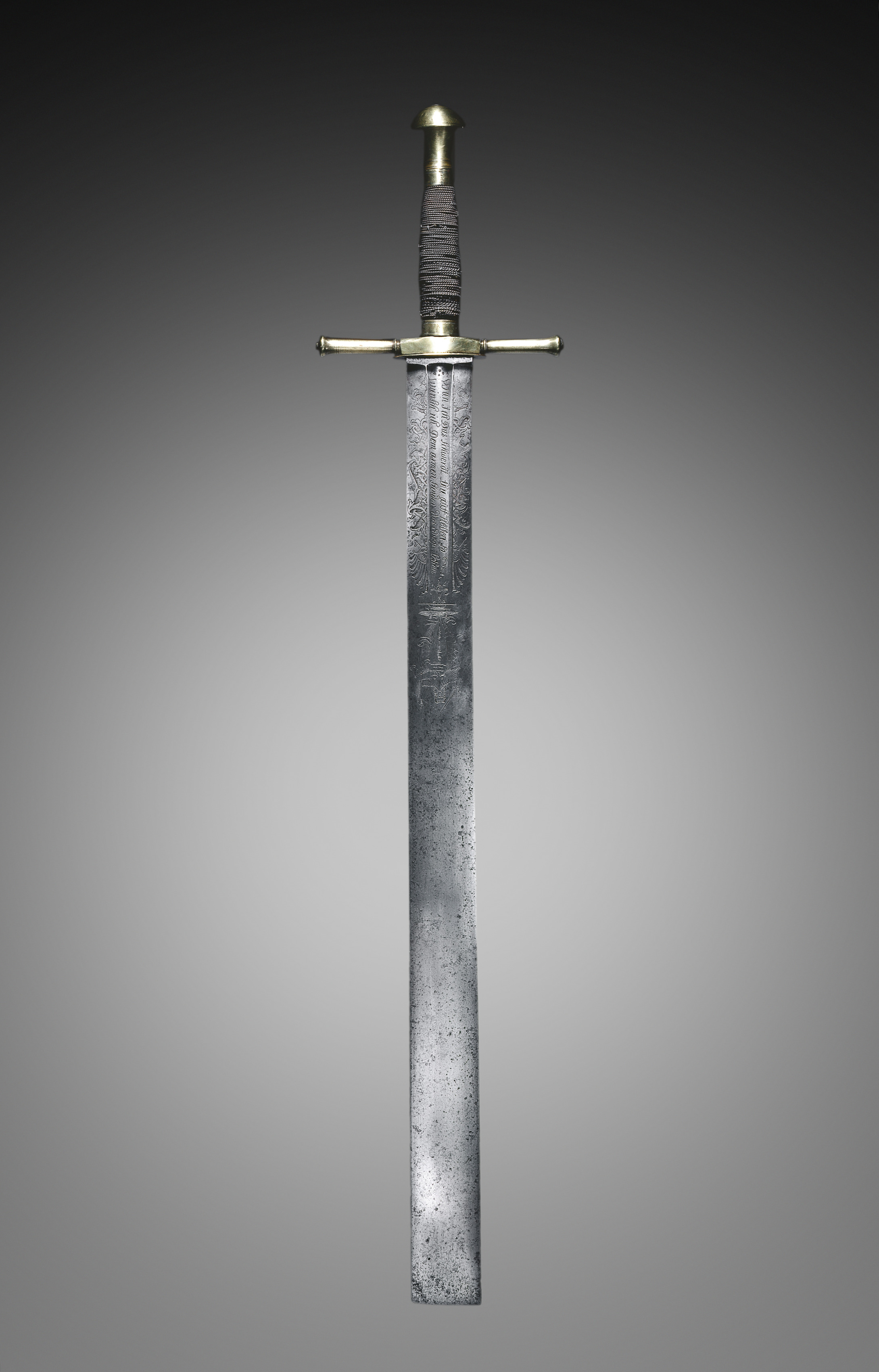
Deconstructing the Executioner's Sword: A Study in Finality for Zoey Fashion Lab
At Zoey Fashion Lab, our mandate extends beyond the mere examination of textile and form. We engage in the forensic analysis of historical objects, extracting their latent conceptual DNA to inform the future of avant-garde design. Our latest subject, the late 17th-century German Executioner's Sword, presents a paradox of immense creative potential. On the surface, it is an instrument of blunt finality, a tool of judicial violence. Yet, beneath its cold steel and utilitarian grip lies a rich tapestry of symbolism—authority, precision, ritual, and the irreversible nature of a single, decisive act. This analysis will deconstruct the sword’s physical and metaphysical components, translating them into a new design lexicon for our forthcoming collection, "New DNA Strand."
I. The Steel: A Study in Negative Space and Finality
The blade itself is the primary locus of meaning. Unlike the rapier's elegant thrust or the saber's sweeping arc, the executioner's sword is defined by its massive, blunt tip and its sheer weight. It is not designed to slash or parry; it is engineered to fall. The geometry is one of absolute commitment. In our design language, this translates to a radical departure from fluid, organic silhouettes. We propose sharp, architectural shoulders and elongated, columnar panels that create a visual "fall" from the model's frame. The fabric should mimic the blade's polished, unyielding surface—using high-density wools, bonded technical nylons, and liquid-like silks that catch light with a cold, metallic sheen.
The sword's defining characteristic, however, is its blunted point. In a traditional fashion context, points are used for direction and dynamism. Here, we invert this principle. We introduce the concept of the "truncated apex"—garments that end abruptly, with raw, cut edges or heavy, weighted hems that suggest an action halted mid-swing. This is not a design of aggression, but of suspended consequence. A jacket that falls straight from the shoulder without a waist suppression; a skirt that ends in a severe, horizontal line just below the knee, eschewing any taper. This creates a powerful, monolithic presence, a silhouette that commands space through sheer gravity rather than movement.
II. The Grip and Pommel: Ritual and Human Interface
Moving from the blade to the hilt, we find the point of human interaction. The grip, typically wrapped in leather or wood and bound with copper and brass wire, is a study in functional texture. It is the only part of the weapon that is warm to the touch, the interface between the cold instrument and the executioner's will. This juxtaposition of the brutal and the tactile is a critical component of our new strand.
In our collection, this translates to a focus on strategic textural contrast. We will juxtapose the cold, sleek surfaces of the primary fabrics with intricate, hand-woven elements at points of articulation—the cuffs, the collar, the waist. We envision metallic-threaded jacquards that mimic the tight, helical wrap of the wire, or 3D-printed polymer structures that replicate the geometric pattern of the grip. These elements are not merely decorative; they are functional anchors, visually and physically grounding the garment. They represent the human element within the machine, the point where the wearer's agency meets the garment's predetermined structure.
The pommel, often a simple wooden sphere or a faceted metal weight, serves as the counterbalance. It is the fulcrum upon which the entire weapon's efficacy depends. Conceptually, this is the point of equilibrium. In our garments, we will introduce this as a design principle of "weighted counterpoints." A heavy, sculptural collar that balances a voluminous train; a massive, structured belt that offsets the severe minimalism of a dress. These elements are not afterthoughts; they are integral to the garment's balance, ensuring that the visual weight is perfectly distributed, creating a sense of poised, deliberate tension.
III. The German Iconography: A Narrative of Law and Order
Many executioner's swords of this era were engraved with symbols of justice—scales, swords, and sometimes the visage of a saint. This iconography was not mere ornamentation; it was a legal and moral declaration. It transformed a simple tool into an emblem of societal order. For the "New DNA Strand," this concept of "embedded narrative" is paramount. We are moving away from surface-level prints and towards structural storytelling.
This will manifest in laser-cut leather appliqués that are not sewn on, but rather interlocked into the weave of the fabric, creating a seamless integration of form and symbol. We will use abstracted, geometric representations of these historical motifs—a scale becomes a series of balanced, asymmetric panels; a sword becomes a sharp, vertical seam. The goal is not to reproduce the iconography, but to abstract its underlying principles of balance, judgment, and finality into a modern, wearable language. The garment itself becomes a statement of intent, a piece of wearable law that dictates its own terms of engagement with the body and the space around it.
IV. Synthesis: The New DNA Strand
The "New DNA Strand" is not about recreating a historical costume. It is about isolating the fundamental genetic markers of an object—its materiality, its geometry, its ritualistic function, and its cultural resonance—and re-sequencing them into a new, avant-garde form. The Executioner's Sword offers a uniquely potent genetic code. It provides a lexicon of severe geometry, weighted tension, tactile contrast, and narrative depth.
Our collection will feature a series of "ceremonial outerwear" pieces—long, dramatic coats and capes that embody the sword's monolithic presence. These will be paired with "interventionist" underlayers, constructed from the wire-wrap-inspired textiles, which speak to the human interface. The color palette will be stark and unforgiving: metallic greys, deep anthracite, oxidized copper tones, and the stark white of polished bone. The final effect is one of austere, powerful beauty—garments that do not merely clothe the wearer but imbue them with a sense of authority and finality. This is fashion as a decisive act, a statement that is as powerful and irreversible as the swing of the blade itself. This is the new strand, woven from the steel of history.