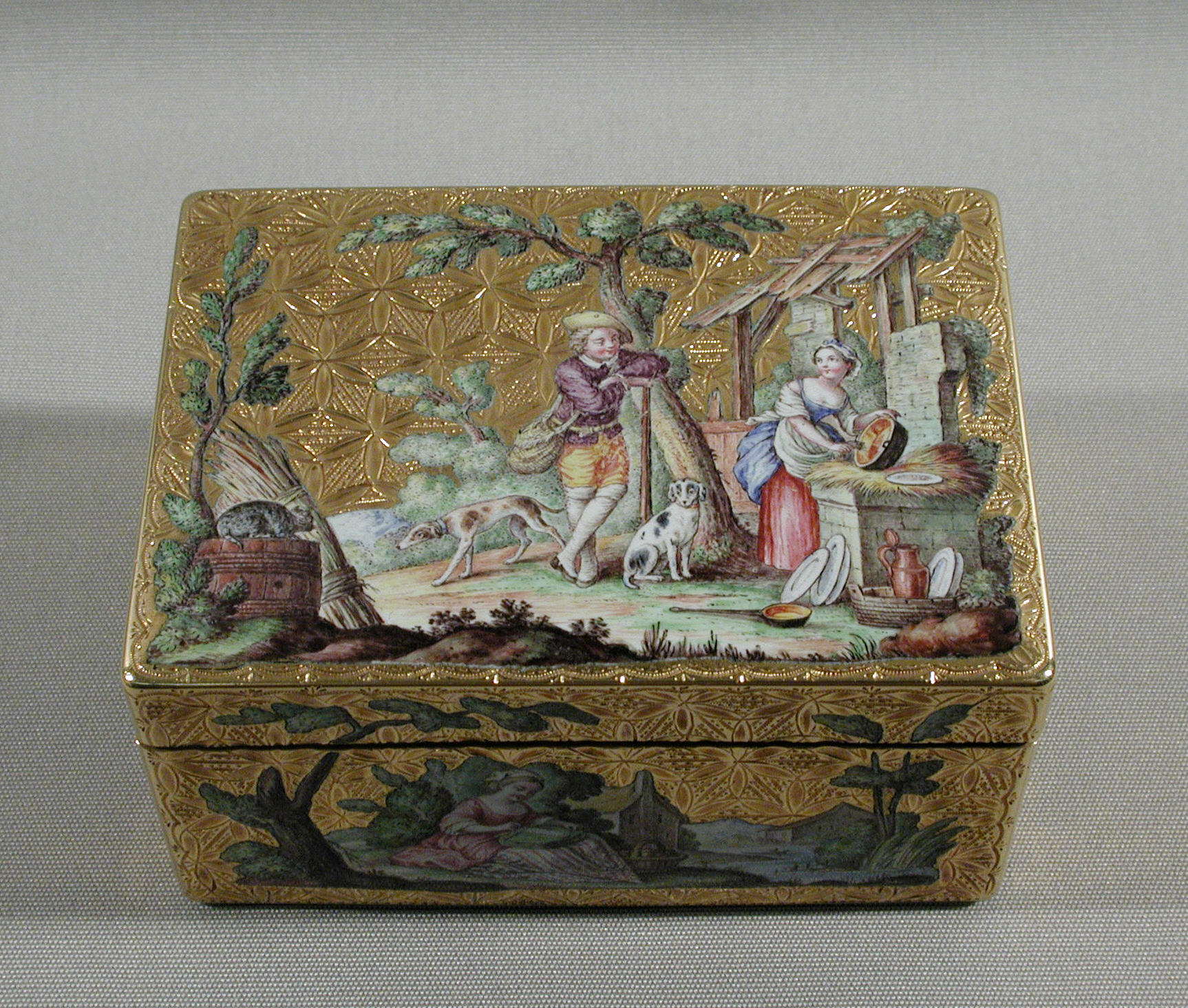
The Snuffbox Reconfigured: A Structural Autopsy for SS26
The snuffbox, historically a vessel of powdered indulgence and aristocratic ritual, is an object of profound architectural paradox. It is diminutive yet monumental, intimate yet ceremonial, ornate yet functional. For Zoey Fashion Laboratory’s SS26 avant-garde study, we deconstruct this micro-monument not as a nostalgic relic, but as a generative blueprint for a new corporeal topology. The gold and enamel origin—a Global Frontier artifact—demands a radical re-reading: not as surface decoration, but as a load-bearing system for futuristic silhouettes. We interrogate its hinged geometry, its rigid enamel cladding, and its pocket-sized scale to engineer garments that are less about draping the body and more about *housing* it within a precision-tooled exoskeleton.
I. The Hinge as Articulated Spine
The defining mechanical feature of the snuffbox—the hinge—transcends its utilitarian role to become a conceptual joint for the SS26 collection. In traditional couture, movement is achieved through fabric fluidity or bias cutting. Here, we invert that paradigm. The hinge becomes a literal, articulated structural node, embedded within the garment’s chassis. Imagine a tailored jacket whose shoulder seam is not sewn but *pivoted*, using a custom-milled, gold-plated alloy joint that allows for a 180-degree rotation of the sleeve cap. This is not costume; this is wearable kinetic architecture. The silhouette shifts from static to dynamic, where each gesture of the arm opens and closes a spatial volume, revealing an enameled under-layer that mimics the box’s interior cache.
Furthermore, the hinge informs the lumbar region. A high-waisted, corseted cuirass is segmented into three rigid panels—front, side, and back—connected by exposed, industrial-grade hinges. This allows the wearer to flex and twist with surprising freedom, while the exterior maintains a severe, unyielding line. The future silhouette here is not soft or organic; it is a series of interlocking planes that reconfigure in real-time. The body becomes the hand that opens the snuffbox, and the garment is the lid, perpetually in a state of controlled unveiling.
II. Enamel Cladding and the Glazed Carapace
Enamel, in its fired, vitreous state, offers a unique material philosophy: it is simultaneously hard and luminous, opaque yet reflective. For SS26, we translate this into a new generation of surface treatments that reject traditional textile softness. We propose a ceramic-infused technical mesh, where micro-scale enamel tiles are laser-welded onto a flexible Kevlar base. The result is a carapace that bends with the body but maintains the uncompromising, glossy rigidity of a snuffbox lid. This is not armor in the medieval sense; it is a glazed exoskeleton that catches light like a precious object, yet performs as a high-functioning, breathable membrane.
The color palette is dictated by the enamel’s historical lexicon: deep oxblood, midnight sapphire, and a poisonous chartreuse. But we distort the scale. A full-length coat, resembling a lab coat dissected and rebuilt, features oversized, domed shoulder panels that echo the box’s curved lid. These panels are not merely decorative; they are structural counterweights, balancing the silhouette’s forward momentum. The enamel finish is applied in a gradient, from high-gloss at the shoulder to a matte, sandblasted texture at the hem, creating a visual and tactile narrative of erosion—a nod to the Global Frontier’s harsh, unyielding terrains.
III. The Pocket Dimension: Scaling and Proportion
The snuffbox’s most radical contribution is its scale. It is an object designed to be held, concealed, and withdrawn. In our SS26 proposition, we magnify this "pocket dimension" to architectural extremes. The traditional silhouette—shoulder-to-hem—is disrupted by the insertion of negative-space compartments. A voluminous, sculptural skirt is not constructed from yards of fabric, but from a series of rigid, enameled panels that fold inward, creating a series of recessed niches. These are not pockets in the functional sense; they are voids that define the form’s positive space. The eye reads the absence as much as the presence, creating a silhouette that is both monumental and hollow.
Conversely, we miniaturize the box’s proportions for intimate accessories that function as structural anchors. A golden, hinge-locked choker acts as the collection’s keystone, its clasp mechanism echoing the snuffbox’s latch. This is not jewelry; it is a tension point that pulls the entire garment’s line taut. The choker connects to thin, enamel-coated steel cables that run beneath the outer shell, adjusting the drape of the sleeves or the flare of a skirt with a simple twist of a hidden dial. The wearer becomes the curator of their own silhouette, manipulating the architecture in a ritualistic, almost ceremonial manner.
IV. Global Frontier: A Synthesis of the Nomadic and the Fixed
The Global Frontier origin is not a geographical location but a conceptual state—a liminal space between known territories. The snuffbox, carried across borders and through changing regimes, embodies this nomadic permanence. Our SS26 garments reflect this dialectic. They are designed for extreme mobility, yet their construction is anchored in permanence. The gold, typically a symbol of wealth, is here used as a structural alloy—not for ostentation, but for its tensile strength and resistance to corrosion. We envision a modular overcoat that can be disassembled into three distinct components: a hinged breastplate, a skirt of enameled scales, and a pair of articulated gauntlets. Each component is self-sufficient, capable of being worn alone as a statement of deconstructed couture, or combined into a formidable, full-body enclosure.
This modularity is the ultimate avant-garde gesture: it challenges the notion of a fixed garment, proposing instead a system of wearable architecture that adapts to the wearer’s environment and intent. The snuffbox, once a container for a fleeting pleasure, becomes a metaphor for the body itself—a vessel of potential, its structure perpetually opening and closing, revealing and concealing. The SS26 silhouette is thus not a shape but a process, a series of hinged moments in gold and enamel that redefine the future of couture as a discipline of precision, paradox, and perpetual motion.