Deconstructing the Halberd: A Materialist Reading for the Avant-Garde
At Zoey Fashion Lab, our mandate is not merely to clothe the body but to interrogate the very grammar of objecthood. The Halberd, a Swiss polearm of formidable historical pedigree, presents a unique challenge. It is not a textile, nor a drape, nor a silhouette. It is a weapon of war, a tool of ceremonial guard, and a relic of a pre-industrial metallurgical age. Yet, within its rigid, functionalist anatomy lies a profound lexicon for avant-garde construction. This analysis deconstructs the halberd not as a historical artifact, but as a material proposition—a DNA strand of aggressive linearity, brutalist geometry, and paradoxical fragility. Our reference point, the New DNA Strand, forces us to read this object not as a static form, but as a sequence of coded instructions for a new, disruptive sartorial syntax.
I. The Steel Blade: A Study in Negative Space and Aggressive Line
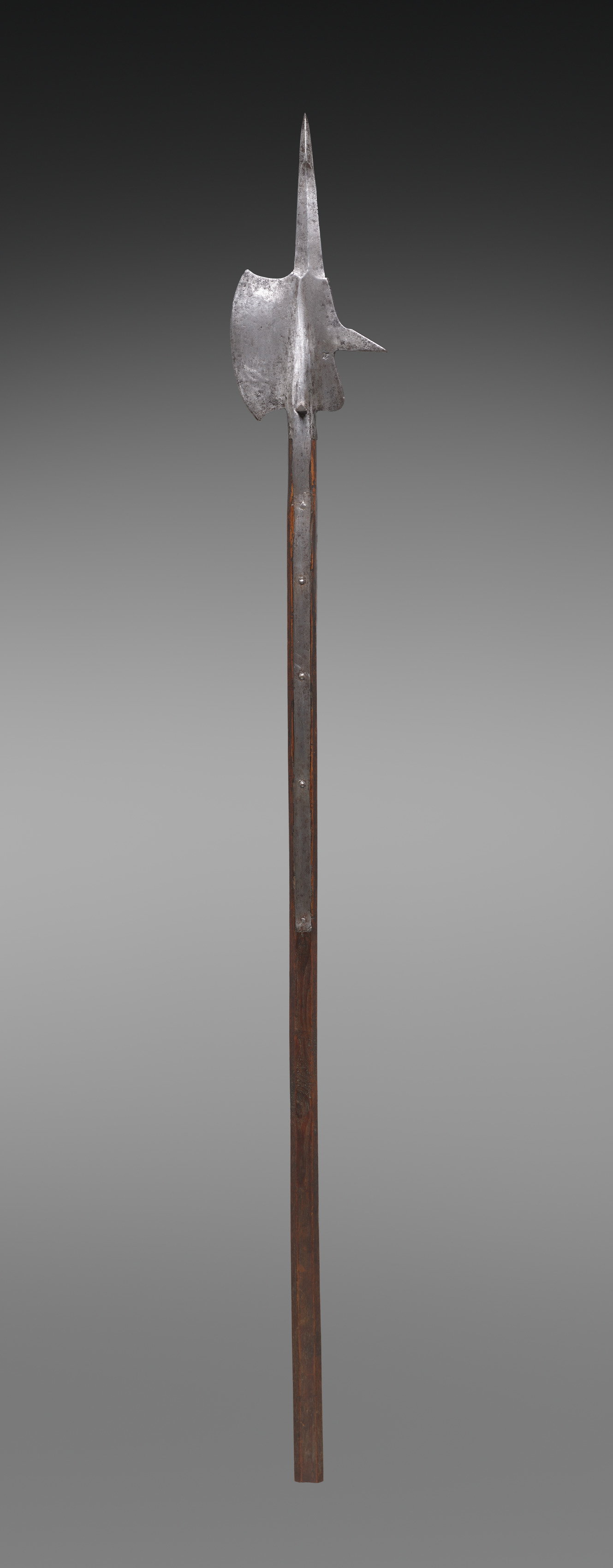
The halberd's defining feature is its forged steel head—a composite of a thrusting spike, an axe blade, and a trailing hook. In traditional analysis, this is a tool for piercing, cleaving, and pulling a rider from a horse. In our deconstruction, this tripartite steel configuration becomes a study in negative space and directional tension. The spike represents pure verticality, an unyielding line that disrupts the horizontal plane of the shoulder. The axe blade introduces a crescent of mass, a convex curve that suggests both protection and violation. The hook, often overlooked, is the most avant-garde element: it is a gesture of capture, a deliberate reversal of the garment's typical function of releasing the body.
For Zoey Fashion Lab, the steel head translates into a series of architectural shoulder pads that are not soft or rounded, but faceted and asymmetrical. The spike informs a high, rigid collar that extends beyond the nape, creating a silhouette of aggressive elongation. The axe blade is reimagined as a single, oversized lapel that folds across the torso, its edge sharpened with a metallic thread or a bonded, non-woven polymer. The hook, in a radical move, becomes a functional clasp that wraps from the back to the front, visually "capturing" the wearer's own arm. This is not decoration; it is a structural reinterpretation of the garment's ability to direct movement and attention.
II. The Haft: The New Rectangular Wood and the Grammar of Planed Corners
The technical specification of a new rectangular wood haft with planed corners is where our analysis deepens. Unlike the traditional round haft, which offers a continuous, cylindrical flow, the rectangular form is a study in discontinuity and planar faceting. The planed corners are not merely functional (preventing the weapon from rolling on the ground); they are a deliberate aesthetic choice that introduces a play of light and shadow across a longitudinal axis. This is the New DNA Strand made manifest: a linear sequence of flat, unyielding surfaces that refuse organic curvature.
In our translation, the haft becomes the spine of a garment. We propose a long, structured overcoat where the central seam is not a seam but a raised, rectangular ridge—a literal "haft" running down the back. This ridge is constructed from a high-density foam core, wrapped in a stiffened technical canvas, and then "planed" at the edges with a laser-cut finish to ensure a crisp, architectural corner. The garment's side seams are similarly treated, creating a series of vertical planes that mimic the haft's faceted geometry. The result is a silhouette that stands away from the body, creating a hollow volume—a negative space that is as significant as the fabric itself. The wearer does not fill the garment; they inhabit a structural corridor defined by these planed corners.
III. Material Alchemy: Steel as Textile and Wood as Structure
Our deconstruction refuses the binary of hard and soft. The steel is not to be worn as metal; it is to be translated into a textile behavior. We propose a jacquard weave that incorporates a stainless-steel filament, not for armor, but for its ability to hold a crease and its inherent thermal conductivity. This fabric will have a memory—it will fold and remain folded, creating permanent, sculptural pleats that echo the blade's edge. The wood, conversely, is not used as a structural stay but as a source of tonal and textural contrast. A fine, wood-pulp-based viscose, blended with a matte black cotton, will mimic the haft's grain. The "planed corners" are replicated through a technique of origami-style folding at the hems and cuffs, where the fabric is folded back on itself and fused, creating a stiff, paper-like edge that catches light with the same precision as a sanded wooden edge.
This material alchemy is central to the New DNA Strand reference. The strand is not a literal biological sequence but a code of material relationships. Steel's tensile strength is recoded as a fabric's ability to hold a silhouette. Wood's rigidity is recoded as a fabric's ability to create a planar surface. The halberd's DNA is thus not copied but transcribed into a new medium, preserving its structural logic while abandoning its lethal function.
IV. The Avant-Garde Silhouette: Wearing the Weapon
The final synthesis is a garment that is both a critique and an homage. We envision a unisex, asymmetric tunic that is worn over a base layer of liquid silver jersey. The tunic's left shoulder is built up with the faceted "blade" structure, while the right side is flat and minimal, creating a deliberate imbalance. The hem is not straight but cut on a severe diagonal, echoing the hook's curve. The entire piece is fastened not with buttons but with a series of magnetic, rectangular blocks that snap together with a satisfying, percussive click—a nod to the haft's planed corners and the weapon's functionalist hardware.
This is not a costume. It is a wearable manifesto. It argues that the avant-garde is not about novelty for its own sake, but about the radical re-contextualization of known forms. The halberd, a symbol of Swiss precision and martial discipline, is reborn as a symbol of sartorial autonomy and structural defiance. The wearer is not a soldier, but a sentinel of a new aesthetic order—one that values the line, the plane, and the deliberate, planed corner over the organic, the fluid, and the merely comfortable.
In conclusion, the Halberd, when read through the lens of the New DNA Strand, ceases to be a weapon and becomes a blueprint for a new form of dress. Its steel head provides the grammar of aggressive line and negative space; its rectangular haft provides the syntax of planar construction and architectural rigidity. Zoey Fashion Lab's rendition is not a reproduction but a mutation—a deliberate, genetic splice of martial history and futuristic textile technology. The result is a garment that stands as a monument to the power of deconstruction, proving that even the most brutal object can be re-coded into a poetic, avant-garde statement.