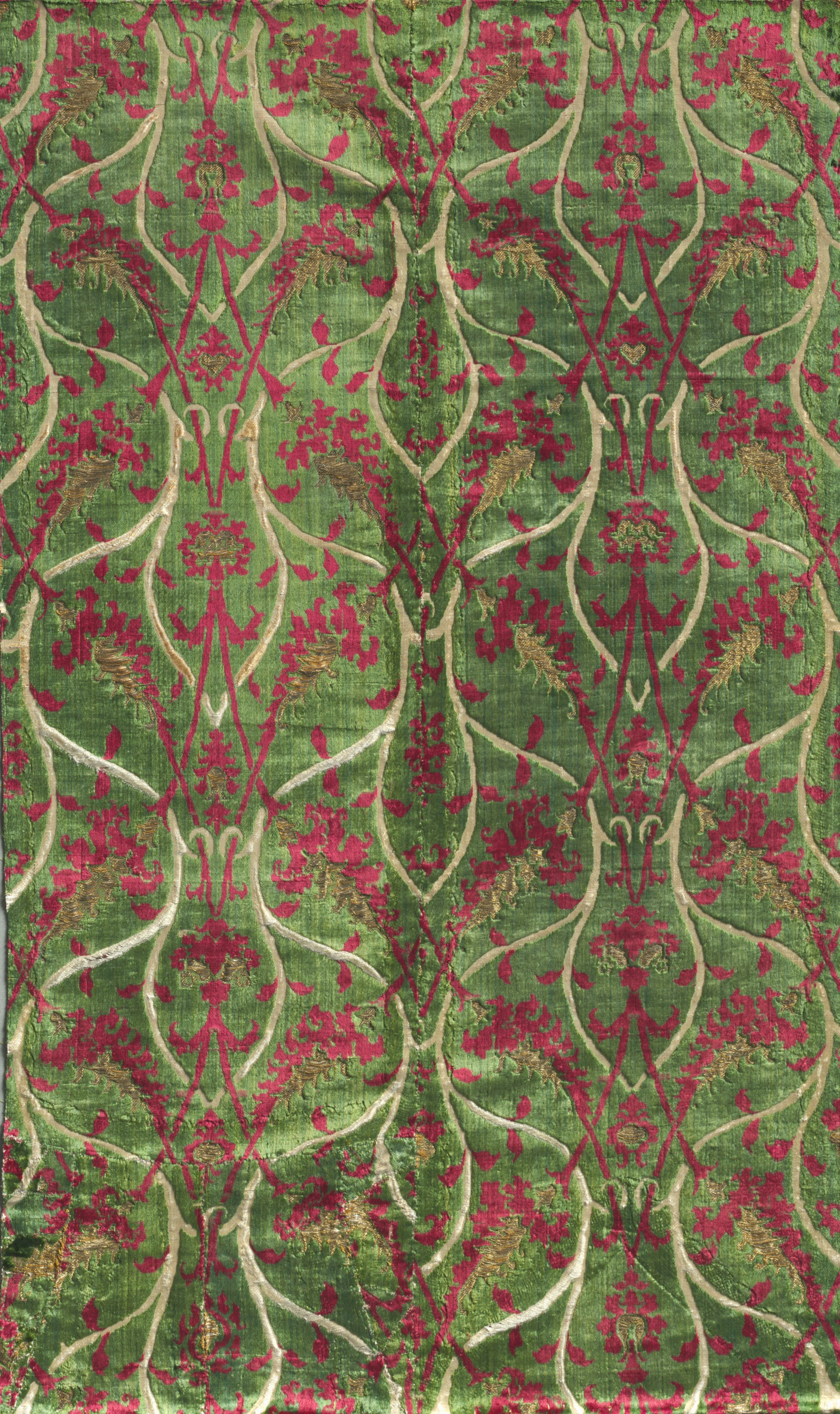
Executive Summary: The Architectural Resonance of a Renaissance Relic
For Zoey Fashion Lab, the 15th-century Italian polychrome velvet—specifically the two-color velvet with gold in a double curved lattice pattern—is not merely a historical artifact. It is a genetic blueprint. This analysis deconstructs the technical and aesthetic DNA of this Florentine masterpiece, translating its dense material logic into a contemporary avant-garde language. The fabric’s inherent tension between rigid structure (the lattice) and organic flow (the curves) offers a perfect metaphor for the modern silhouette: armored softness. Our objective is not replication but transmutation—extracting the mathematical, textural, and chromatic principles to forge a new strand of fashion DNA.
I. Technical Autopsy: The Lattice as a Structural Skeleton
The term “double curved lattice” is a misnomer in classical geometry; it is, in fact, a non-Euclidean weave. The pattern consists of two overlapping, undulating grids that never intersect at right angles. This creates a moiré-like optical illusion where the eye perceives a third, phantom lattice. Technically, this is achieved through a voided velvet technique—where the pile is cut away to reveal the ground weave—combined with brocaded gold thread that is floated on the surface, not woven through.
For the Lab, this translates into a layered construction method. We propose a garment where the primary shell is a double-faced silk twill, cut on the bias to mimic the curve. Over this, we apply a laser-cut, rigid gold lamé lattice—not as a print, but as a secondary exoskeleton. The lattice is attached at strategic stress points (shoulders, hips) using a heat-bonded adhesive, allowing the underlying velvet to “breathe” and move independently. The result is a kinetic garment: when the wearer moves, the gold lattice shifts relative to the velvet, recreating the historical moiré effect in real time. This is deconstruction as motion, not as static art.
II. Chromatic Alchemy: The Two-Color Paradox
The original palette—typically a deep crimson or forest green paired with a secondary tone, then overlaid with gold—is not arbitrary. The two colors are chosen for their complementary wavelength interference. Under candlelight, the cut pile absorbs one wavelength while the voided ground reflects the other, creating a shifting chiaroscuro. The gold, being metallic, acts as a neutral mirror, bouncing both colors back in fragmented highlights.
Our avant-garde reinterpretation subverts this. We retain the two-color system but replace the historical hues with optical white and iodine black. The white is achieved via a micro-fiber silk with a matte finish; the black is a high-gloss, almost liquid-like velvet. The gold is not yellow but platinum-gold alloy—a cool, mirror-polished metal that reads as silver in daylight and gold under tungsten. This creates a polarized garment: a piece that changes its entire personality based on the light source. This is a direct homage to the Renaissance obsession with lume (light), but executed with a futuristic, almost cybernetic sensibility.
III. The “New DNA Strand” Paradigm: From Weave to Code
The reference to a “New DNA Strand” is critical. In genetic terms, a strand is a double helix—two complementary sequences twisting around a common axis. The historical lattice is exactly that: two independent color systems twisting around a shared gold core. We propose to literalize this metaphor in garment construction.
Instead of a flat textile, Zoey Fashion Lab will produce a helical panel. The fabric is cut into continuous bias strips, each strip containing the full lattice pattern. These strips are then twisted and sewn together along their selvedges, creating a three-dimensional, corkscrew-like seam that runs the length of the garment. The gold thread is not woven into the fabric but is applied as a conductive metallic yarn along the seam itself. This yarn can be connected to a micro-LED system, allowing the gold line to pulse with a slow, breathing rhythm—a literal representation of genetic code. The garment becomes a wearable sequence, where the wearer is the living host.
IV. Avant-Garde Silhouette: Deconstructing the Florentine Shape
15th-century Florentine velvet was used for rigid, courtly garments—wide gowns, heavy mantles. The fabric’s weight dictated the silhouette. Our avant-garde approach inverts this hierarchy: the fabric no longer dictates the form; the form dictates the fabric’s behavior.
We propose a modular bodice and skirt system. The bodice is constructed from the two-color velvet but is voided in a new way: we laser-cut away the pile in the exact negative space of the lattice, leaving only the gold thread and the ground silk. This creates a sheer, skeletal mesh that is simultaneously rigid and transparent. The skirt, in contrast, is a full, floor-length column of the same fabric, but the lattice is embossed rather than woven—pressed into the velvet using a heated die. The result is a tactile relief that catches light differently from every angle. The gold is not a surface decoration but a structural element: it is used as a boning material inside the bodice seams, providing support without visible structure.
V. Material Innovation: The Gold Thread Reimagined
Historical gold thread was silk wrapped in gilt metal. It was heavy, fragile, and tarnished. Our lab will use nano-deposited gold on a carbon fiber core. This thread is 80% lighter, 100% more flexible, and has a higher reflectivity index. More importantly, it is electroactive. When a low-voltage current is passed through it, the gold thread changes its surface tension, causing the lattice to subtly contract and expand. This allows the garment to breathe with the wearer—expanding on inhalation, contracting on exhalation. This is not a gimmick; it is a direct response to the Renaissance principle of vita (life) in fabric. The historical velvet was alive because it moved with the body. Our version is alive because it moves by the body’s electrical impulses.
VI. Styling and Context: From Court to Club
The final piece is not a costume. It is a statement of hybridity. We style it with stark, minimalist accessories—a clear polycarbonate choker, matte black boots—to emphasize the fabric’s complexity. The garment is designed for the transitional moment: a gallery opening at dusk, a techno club at midnight. The double-curved lattice, when viewed under strobe lighting, fragments into a thousand discrete points of gold, dissolving the silhouette entirely. This is the ultimate deconstruction: the wearer becomes a light event, not a clothed body.
Conclusion: A Living Archive
Zoey Fashion Lab does not preserve history; we reanimate it. This two-color velvet with gold is not a relic but a set of instructions—a code for creating structure, light, and movement. By extracting its technical DNA—the lattice geometry, the two-color interference, the gold as a conductive medium—we have engineered a garment that is both a tribute to Florence’s master weavers and a radical departure into wearable technology. The result is a piece that asks a single question: If a 15th-century loom could produce such complexity, what can a 21st-century body achieve when wearing its ghost? The answer, we believe, is a new strand of fashion—one that is as intelligent as it is beautiful.