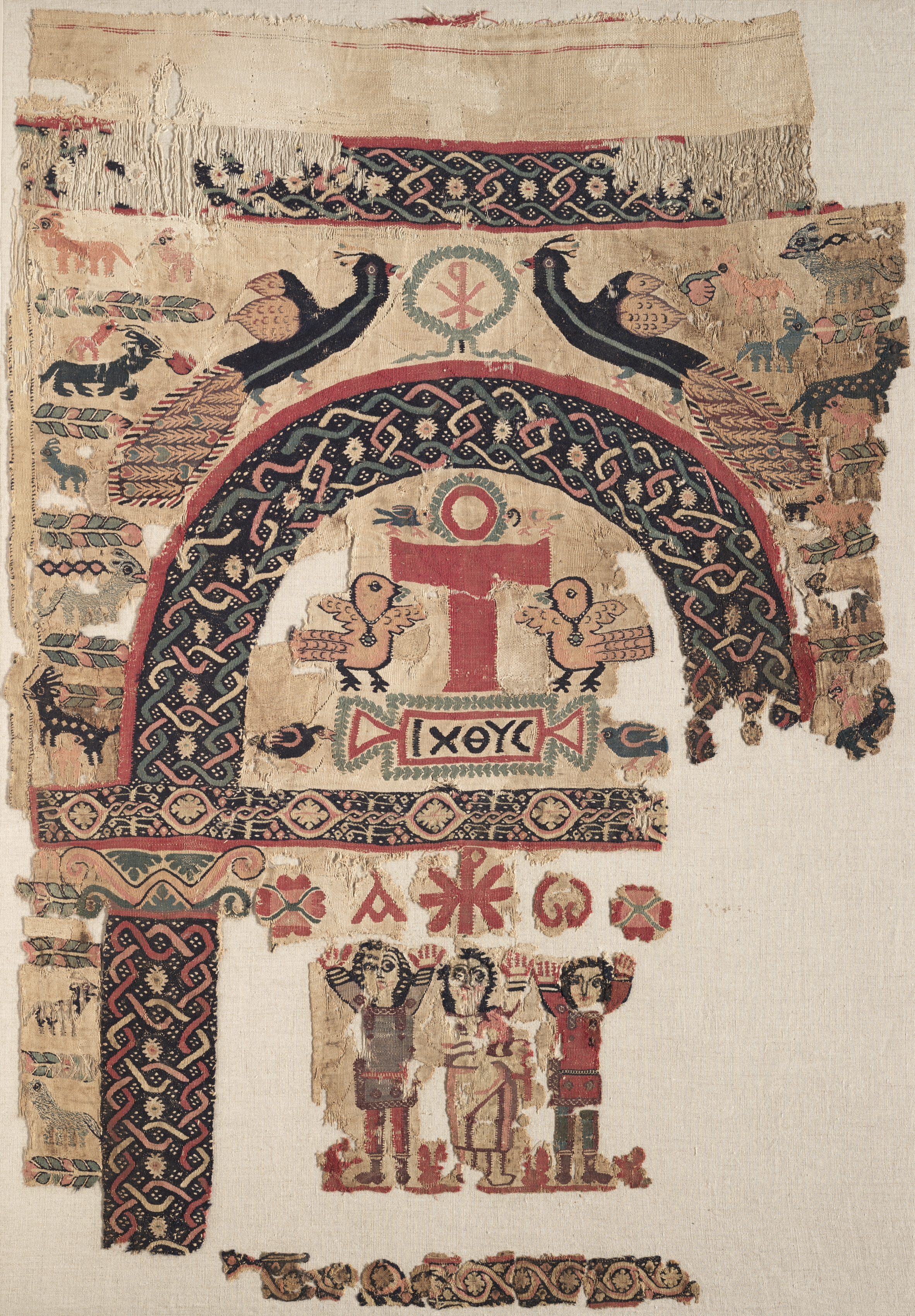
Deconstructing the Sacred: An Avant-Garde Analysis of a Byzantine Textile
At Zoey Fashion Lab, our mandate transcends the conventional boundaries of garment analysis. We do not merely observe fabric; we interrogate its very ontology. Today, we turn our deconstructive lens upon a singular artifact: a hanging adorned with Christian imagery, originating from Byzantine Egypt. This piece, a testament to a pivotal era of cultural synthesis, is not a relic to be preserved under glass but a living text to be read, ripped, and rewoven into the lexicon of contemporary avant-garde design. Its technical foundation—dyed wool and undyed linen in a plain weave (tabby) with inwoven tapestry weave—serves as the archaeological stratum upon which we will build a radical new aesthetic thesis.
I. Material Dialectics: The Humility of Linen and the Opulence of Wool
The primary material dialogue begins at the fiber level. Undyed linen, the ground warp, speaks in a language of austere functionality. It is the earthy, terrestrial base—the desert sand, the peasant's tunic, the raw, unadorned truth of Egypt. Conversely, dyed wool introduces a chromatic and textural dissonance. Wool, a fiber of nomadic and pastoral traditions, carries with it a sense of warmth, mobility, and imperial luxury. In the Byzantine context, this was not a mere choice of materials but a political and theological statement. The linen is the humanity, the wool is the divine light that illuminates it.
For the avant-garde designer, this binary is a call to arms. We reject the homogenization of modern textiles. Our directive is to amplify this contrast. Imagine a garment where raw, unbleached linen is slashed to reveal a lining of vibrant, high-pile wool, dyed in madder reds or indigo blues. The seam becomes a scar, a visible junction between the mundane and the sacred. The structural integrity of the tabby weave—a simple over-under interlacement—is a metaphor for the foundational order we must disrupt. Our deconstruction will not be destructive but revelatory, exposing the warp and weft of cultural identity itself.
II. The Tapestry Technique: Weaving Iconography into the Avant-Garde Silhouette
The most compelling technical feature is the inwoven tapestry weave. This is not a printed image or an embroidery applied to the surface; it is a structural intervention. The weft threads of wool are manipulated to create discontinuous areas of color, effectively "painting" with thread directly into the fabric's matrix. The Christian images—likely a figure of Christ, the Virgin, or a saint—are not decorations but integral components of the textile's physical body. They are woven into the very fabric of existence, not superimposed upon it.
This technique offers a profound paradigm for the avant-garde. We propose a methodology of "Structural Iconography." Instead of applying graphics or prints, we will weave our narratives directly into the garment's construction. A jacket's lapel could be a tapestry zone depicting a fragmented halo; a skirt's yoke could feature an abstracted, geometricized saint. The image becomes a tactile relief, a topographic map of belief. As the garment moves, the light catches the raised woolen wefts, creating a kinetic, shifting icon. The sacred image is no longer static; it is a living, breathing entity that moves with the wearer, challenging the fixed, monumental nature of traditional Byzantine art.
III. Contextual Resonance: The Archive as a Springboard for Dissonance
The reference note, “Archive Resonance,” speaks of cultural collision and aesthetic fusion in the 16th and 17th centuries. However, our artifact predates this by a millennium, emerging from the Byzantine period (circa 4th to 7th century CE). This is a crucial distinction. This hanging was created in the crucible of Coptic Egypt, a society where Pharaonic, Greco-Roman, and nascent Christian traditions were in constant flux. The use of wool—a nomadic fiber—in a predominantly linen-based Egyptian weaving tradition is itself a marker of cultural synthesis. It is a testament to the cosmopolitan nature of the Byzantine world, a world where the Nile Delta met the silk roads.
Our avant-garde interpretation must therefore embrace this anachronistic resonance. We are not recreating a Byzantine hanging; we are channeling its disruptive energy. The 16th-17th century reference serves as a second harmonic, reminding us that cultural appropriation and synthesis are cyclical, powerful forces. We will create pieces that feel simultaneously ancient and futuristic. A deconstructed tunic, for instance, might feature the tapestry-woven image of a Coptic saint, but the silhouette will be aggressively asymmetric, with raw edges and visible, unpicked seams. The garment will be a palimpsest, layering the memory of the Byzantine loom with the brutalist geometry of contemporary design. It is a dialogue across millennia, a conversation about faith, power, and the human form.
IV. Synthesis and Application: The Zoey Fashion Lab Manifesto
The analysis of this Egyptian hanging yields a clear, actionable manifesto for Zoey Fashion Lab. The principles are as follows:
Principle One: Material Honesty. We will champion the raw, unvarnished truth of fibers. Linen will remain unbleached to honor its terrestrial roots, while wool will be dyed in saturated, liturgical hues to represent the divine. The contrast is not to be softened but celebrated.
Principle Two: Structural Narrative. Our storytelling will be embedded in the weave, not printed on the surface. We will utilize jacquard and hand-looming techniques to create garments where the image is the structure, and the structure is the image. The iconography will be abstracted, fragmented, and recontextualized for a secular, post-modern audience.
Principle Three: Temporal Disruption. We will reject the tyranny of the present. Our designs will be time-travelers, pulling threads from the Byzantine past and the speculative future to weave a garment that exists in a state of eternal now. The garment will be a vessel for memory, a physical manifestation of cultural DNA.
In conclusion, this unassuming hanging is a radical blueprint. It teaches us that the sacred can be found in the structural, that the divine can be woven from the mundane, and that true avant-garde innovation lies not in novelty, but in the profound re-reading of history. At Zoey Fashion Lab, we will not simply hang this artifact; we will wear its philosophy. We will deconstruct its weave, dissect its dyes, and re-embody its iconography in forms that challenge, provoke, and ultimately, transcend. The future of fashion is, paradoxically, woven into its past.