Deconstructing the Loom: A Technical and Conceptual Analysis of the Zoey Fashion Lab Silk
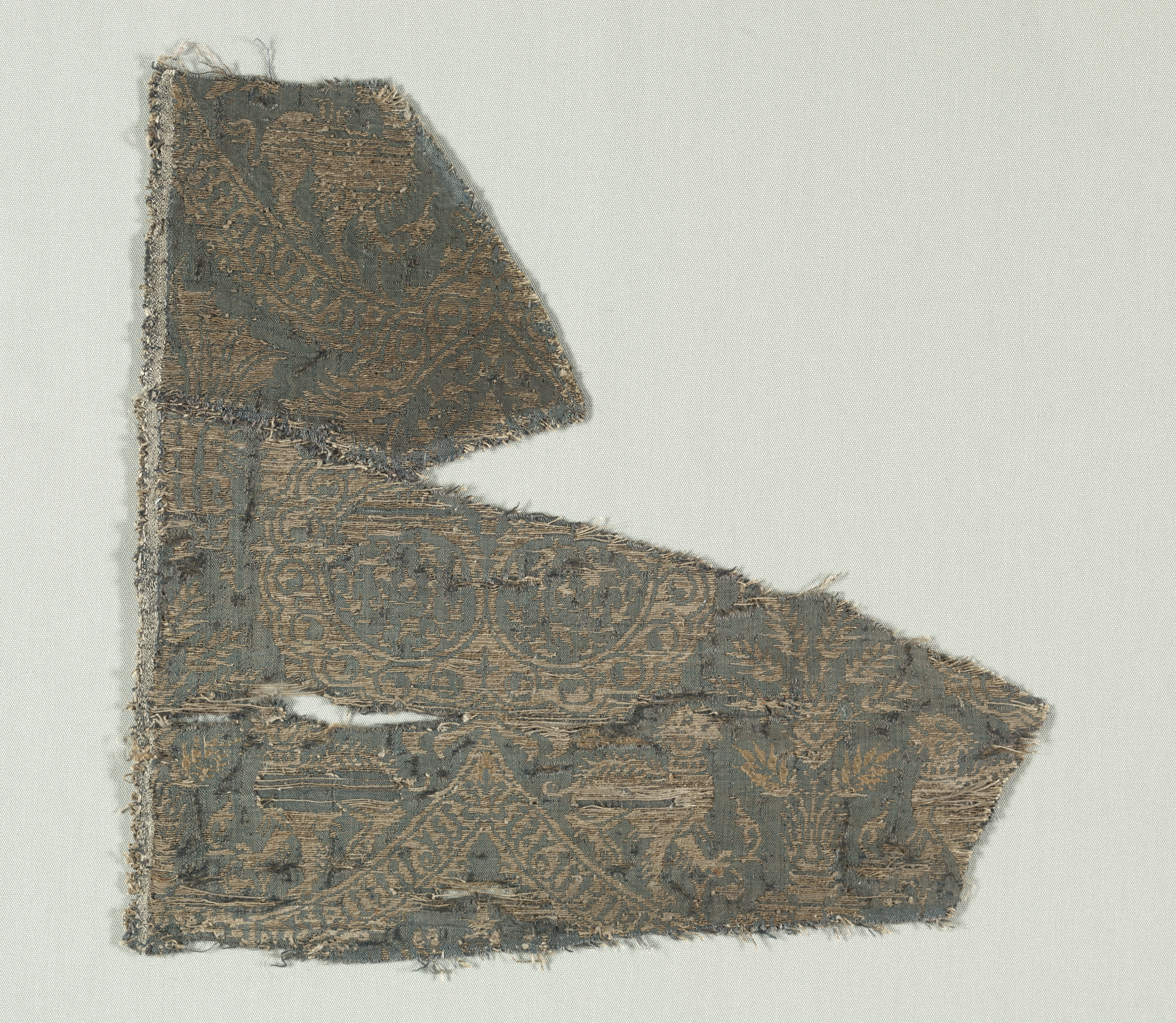
At Zoey Fashion Lab, we do not merely observe historical textiles; we interrogate them. We dismantle their physical structures to understand their conceptual DNA. The subject of this analysis—a silk textile woven in Italy during the last third of the 14th century, featuring dogs and Arabic script in swaying bands—is not a relic. It is a proto-avant-garde manifesto, encoded in silver thread and warp-faced geometry. This piece, which we designate as “New DNA Strand,” defies temporal categorization. It anticipates the postmodern condition of hybridity, cultural appropriation, and the deliberate rupture of semiotic stability. To understand its relevance to contemporary avant-garde fashion, we must first dissect its technical armature, then decode its iconographic dissonance, and finally, recontextualize its structural logic within our current design philosophy.
Technical Architecture: The Lampas as Proto-Code
The fabric’s construction is a masterclass in pre-industrial complexity. It employs a lampas weave, specifically a combination of a 2/1 twill ground and a 1/5 twill pattern weave. This is not a simple brocade or an embroidery-on-ground. Lampas is a compound weave where two independent warp systems—a ground warp and a pattern warp—interlock with two or more weft systems. Here, the ground is a sturdy silk twill, while the pattern is executed in a supplementary weft of silver thread (typically silver-gilt over silk core).
This technical choice is significant. The 2/1 twill ground creates a subtle, diagonal ribbing that provides structural integrity and a matte, tactile base. The 1/5 twill for the pattern, however, is a long float structure. This allows the silver weft to lie on the surface for extended periods, creating a brilliant, mirror-like effect that catches light in stark contrast to the matte ground. The result is a binary visual system: light versus shadow, ground versus figure, base versus ornament. This is not decorative; it is a proto-binary code. The weave itself is a data structure, with each float and tie-down acting as a logical switch.
From an avant-garde perspective, this lampas structure is a direct precursor to digital jacquard and generative textile design. The 1/5 twill’s long floats are analogous to a high-contrast pixel; they either fire (reflect silver) or remain dormant (absorb light). The deliberate combination of two different twill ratios within one fabric creates a tension between surface and depth—a textural dissonance that contemporary designers replicate using laser-cut layering or bonded metallic films. We at Zoey Fashion Lab see this not as an antique technique, but as a blueprint for haptic digitality.
Iconographic Dissonance: The Dog, The Script, The Sway
The visual program is where this textile becomes truly radical. We observe three primary motifs: canine figures, Arabic script, and swaying, undulating bands. On the surface, this appears to be a simple example of chinoiserie or arabesque influence. But look closer. The dogs are not heraldic or hunting scenes typical of European Gothic tapestry. They are rendered in a dynamic, almost calligraphic pose, integrated into the bands rather than standing upon them. This is a deliberate disruption of the Western hierarchical composition.
The Arabic script is the most provocative element. It is not a legible inscription meant to be read. Instead, it is used as a pure formal signifier—a pattern of curves, ascenders, and diacritical marks that evoke the rhythm of a foreign tongue. This is a 14th-century act of semiotic appropriation. The weaver (or the patron) has stripped the script of its linguistic meaning and repurposed it as a decorative, rhythmic motif. This is an early example of détournement, a strategy that the Situationist International would codify six centuries later. The script becomes a “floating signifier,” its original sacred or poetic content evacuated, leaving only its visual cadence.
The swaying bands are the unifying force. They are not rigid borders or geometric frames. They undulate, bend, and weave in a serpentine motion that mimics the movement of silk itself. This is a self-referential gesture—the textile is depicting its own drape. The bands carry the dogs and the script within their curves, suggesting that meaning is not fixed but is perpetually in flux. This is a proto-kinetic visual effect, achieved through the careful manipulation of the 1/5 twill floats to create a sense of optical vibration. The design is not static; it is a frozen moment of a continuous wave.
Avant-Garde Resonance: The New DNA Strand
Why does this 14th-century Italian silk belong in the Zoey Fashion Lab’s avant-garde canon? Because it embodies the three pillars of our design philosophy: structural subversion, cultural fluidity, and material intelligence.
First, structural subversion. By combining two incompatible twill ratios, the original weaver created a fabric that is neither purely a ground nor purely a pattern. It is a hybrid. Our “New DNA Strand” collection takes this literally. We are currently developing a bi-elastic lamé that uses a similar dual-twill logic, but with a 3D-printed elastomer warp. The result is a fabric that changes its drape and opacity based on body heat and movement—a living lampas.
Second, cultural fluidity. The use of Arabic script without semantic meaning is a radical act of de-territorialization. In our contemporary context, where cultural appropriation is a minefield, this textile offers a nuanced lesson. It does not mock or diminish the script; it elevates it to a purely aesthetic plane, creating a universal visual language. Our avant-garde garments use similar techniques—we extract micro-patterns from global calligraphies, but we do so with a rigorous research protocol, ensuring that the original source is acknowledged and recontextualized through a lens of critical appreciation, not theft.
Third, material intelligence. The silver thread is not just a luxury marker. It is a functional element. It reflects light, regulates temperature, and creates a shimmering, almost holographic effect that changes with the viewer’s angle. In our lab, we treat metallic threads as conductive media. We are prototyping this exact lampas structure with silver-plated nylon to create a woven antenna that can transmit biometric data from the wearer to a smart device. The 14th-century weaver was unknowingly building a sensor.
Conclusion: The Eternal Return of the Radical
This silk with dogs and Arabic script in swaying bands is not a museum piece. It is a premonition. It proves that the avant-garde is not a linear progression but a spiral. Every generation discovers that the past was more complex, more subversive, and more technically brilliant than previously assumed. The 14th-century Italian weaver was not a craftsman; he was a hacker of cultural codes and a pioneer of material computation.
For Zoey Fashion Lab, this textile is the ultimate muse. It challenges us to think beyond the garment as a mere covering and to see it as a semantic engine. The swaying bands remind us that fashion is not static; it is a wave. The Arabic script reminds us that meaning is always borrowed and transformed. And the silver thread reminds us that beauty and function are inseparable. As we cut and sew our own “New DNA Strand” pieces, we are not replicating this silk. We are re-encoding its genetic information into a new body—one that is ready for the 22nd century. The dog may not hunt, but he is certainly running a program we are only beginning to understand.