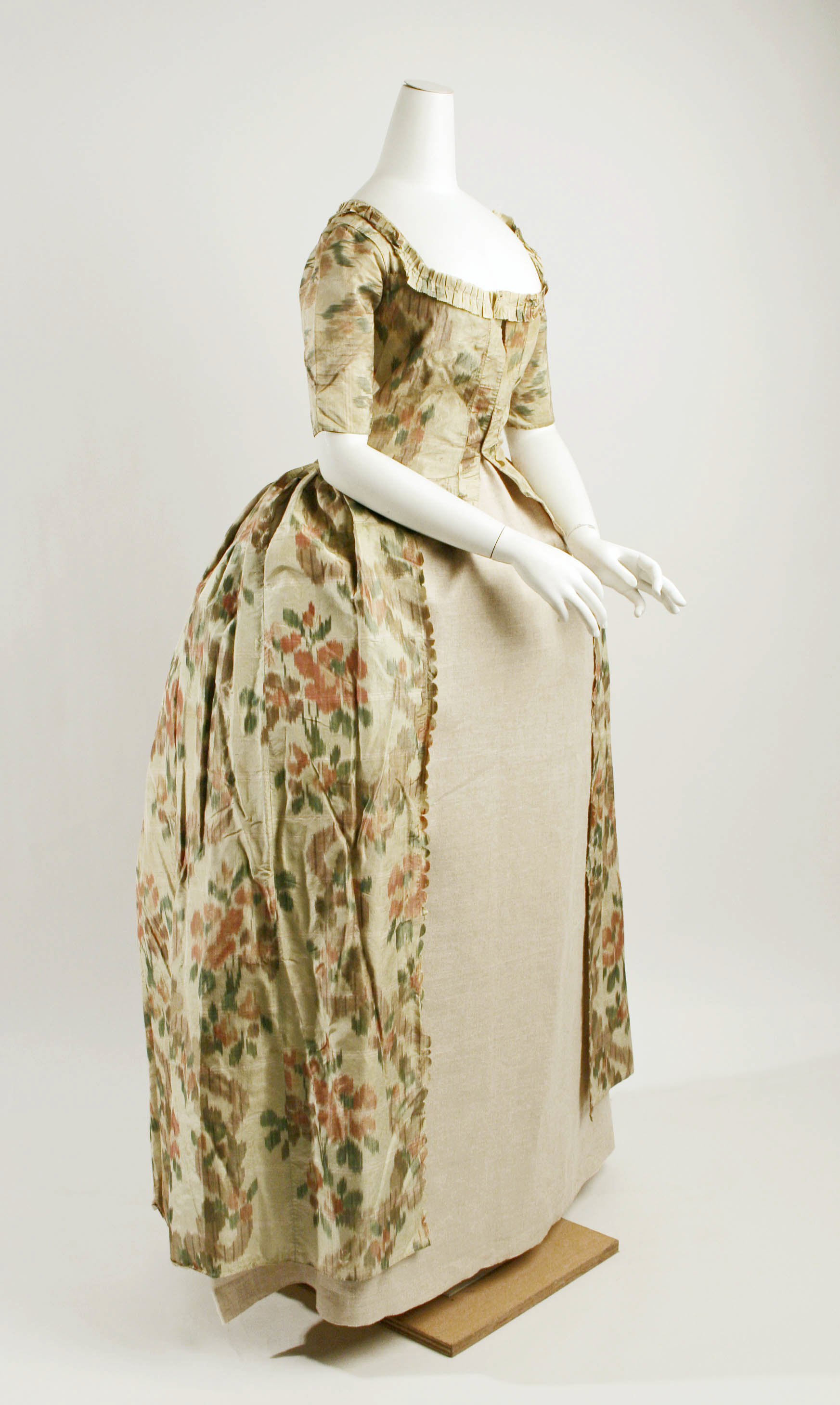
Deconstructing the Archive: The Robe à l'Anglaise as a Proto-Algorithmic Form
The historical robe à l'anglaise, with its characteristic fitted back and sack-back gown lineage, is not merely a relic of 18th-century French sartorial discourse. For Zoey Fashion Laboratory, it represents a profound architectural blueprint—a pre-industrial manifesto of structural tension and bodily negotiation. Our SS26 study, “Anglaise.exe”, does not seek to replicate but to decompile this code. We interrogate its foundational premise: a garment engineered to create a specific silhouette through intricate seaming and rigid underpinning. By transmuting its silk essence and formal logic through the lenses of parametric design and biomechanical futurism, we propose a new couture language where historical pattern-drafting converges with digital morphogenesis.
Structural Innovation: From Back Seams to Exoskeletal Webbing
The defining “robe à la française” back, with its precise, narrow pleats falling from the shoulder, is reimagined not as draped fabric but as a topographical map of tension and release. SS26 abandons the static pleat for a dynamic, exoskeletal webbing system fabricated from laser-sintered silk polymers. This web, emerging from a single nodal point between the scapulae, generates the gown’s form through calculated vectors of force, echoing the original’s seaming but replacing stitch with structural mathematics. The silhouette is no longer imposed by internal corsetry but is an emergent property of this external tensile architecture. The body’s movement actively alters the web’s geometry, creating a living, responsive silhouette that redefines the very concept of a “fitted back.”
Furthermore, the traditional tripartite construction (bodice, skirt, train) undergoes a radical molecular fusion. Utilizing ultrasonic welding and bio-adhesive bonding developed in our materials lab, we create seamless transitions between disparate textile states. A bodice of densely woven, stimulus-sensitive silk morphs into a skirt of fluid, optical-fiber-embedded organza without a seam, challenging the very ontology of garment pieces. This reflects a future where clothing is not assembled but grown into form, much like the original robe’s skirt was arranged over panniers, yet here the support is electromagnetic, not wooden.
Futuristic Silhouette: The Holographic Sack-Back & Volumetric Displacement
The iconic sack-back, a volume of excess and display, is translated from a physical drape into a holographic volume. Through a collaboration with light-field projection technologists, we create a silhouette that extends beyond the physical garment. A minimalist, sheath-like dress in matte silk becomes the canvas for a dynamic, volumetric light projection that emulates and exaggerates historical drapery. This “phantom train” or “holographic Watteau pleat” responds to ambient data—sound, movement, biometric feedback—making the silhouette an ephemeral, context-aware performance. It is the ultimate deconstruction: the form is present, yet materially absent, questioning the necessity of physical fabric for couture expression.
Simultaneously, we explore negative volume and pneumatic distortion. Inspired by the robe’s manipulation of space around the body, SS26 features silhouettes defined by controlled voids. Inflatable silk-blend bladders integrated within the garment’s lining create temporary, adjustable volumes that displace the traditional skirt. These air-filled chambers can be inflated or deflated via micro-compressors, allowing the wearer to modulate their silhouette in real-time—from a narrow robe à l’anglaise to a grand, pannier-like expanse. This embodies a futuristic autonomy, where the wearer commands their spatial footprint algorithmically.
Material Alchemy: Silk as a Bio-Interface
The mandate of silk is honored through radical transformation. We deploy three proprietary iterations. First, Silk-Ceramic Hybrid Mesh: a gossamer lattice where silk fibers are coated in a flexible ceramic resin, providing a memory-rich, sculptural quality that holds algorithmic folds indefinitely. Second, Photosynthetic Silk: infused with stabilized algae colonies, this fabric undergoes subtle color shifts in response to light exposure, a living homage to the changeable nature of historical silks under candlelight. Third, Conductive Silk Tracery: woven with graphene pathways, this material turns the garment into a sensitive bio-interface, where the touch of the hand on the skirt can control the aforementioned holographic elements or emit low-frequency sound.
This material strategy dismantles silk’s passive luxury, repositioning it as an active, functional component within a cybernetic couture system. The lustre is no longer merely visual but operational, a gleam of data flow and energetic exchange.
Conclusion: The Avant-Garde as Critical Archaeology
Zoey Fashion Laboratory’s SS26 study posits that true avant-garde practice is a form of critical archaeology. By deconstructing the robe à l’anglaise, we expose its core principles—structure, silhouette, materiality—and re-synthesize them through a future-facing paradigm. The result is a collection that exists at the nexus of heritage and hyper-innovation, where every seam is a question, every volume a variable, and every silk thread a conduit for new possibilities. We do not discard the archive; we compile it anew, creating a breathtaking, uncompromising vision where the past’s deepest structural secrets become the foundation for tomorrow’s most profound aesthetic languages.