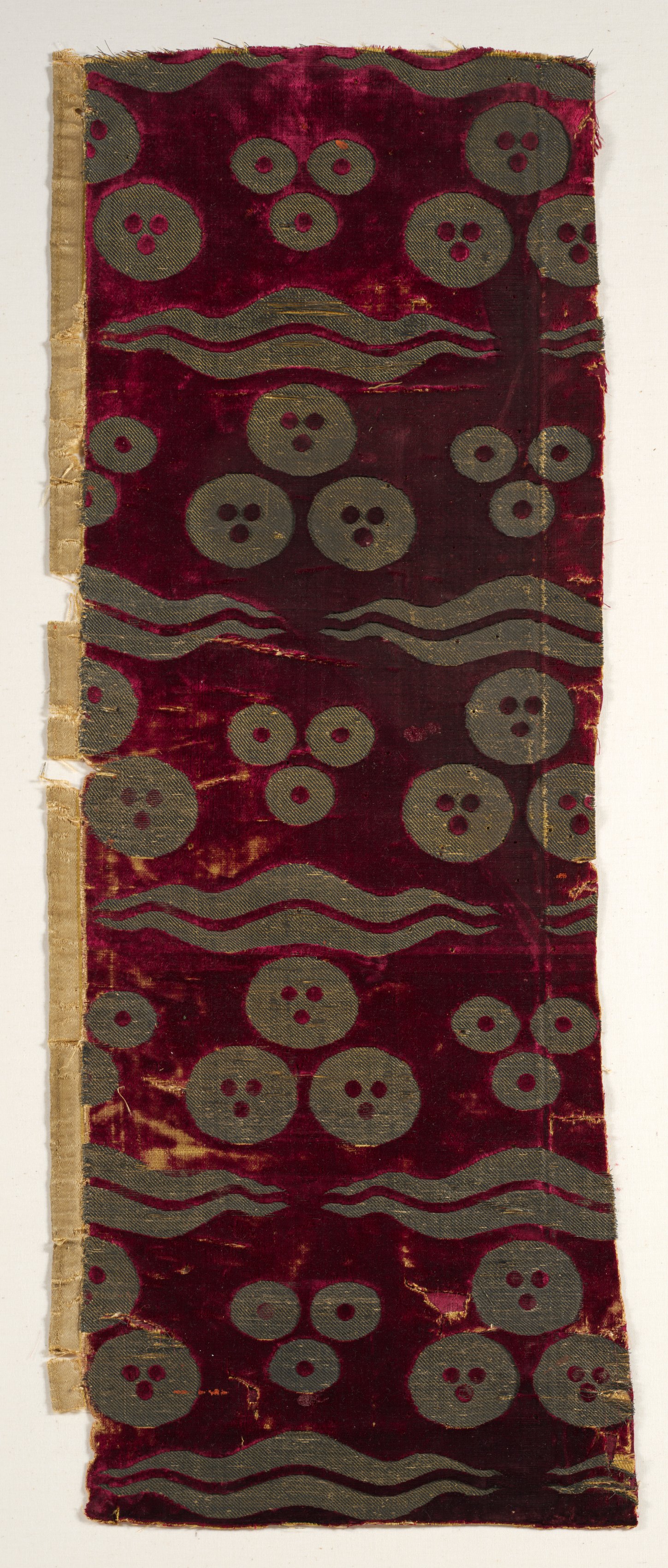
Deconstructing the New DNA Strand: Brocaded Velvet with Chintamani Design
At Zoey Fashion Lab, our mission is not merely to repurpose fabric but to re-sequence its genetic code—extracting the historical, technical, and symbolic DNA of a textile to engineer a new, avant-garde expression. The subject of this analysis, a brocaded velvet originating from Bursa, Turkey, presents a uniquely complex genome. Composed of a silk pile foundation interlaced with silver-metal thread, and bearing the ancient motif of the chintamani, this fabric is a relic of imperial power. Yet, within its dense weave, we identify a potent catalyst for deconstruction. This report dissects the material’s structural integrity, its iconographic resonance, and its kinetic potential, concluding with a proposed methodology for its transformation within our Avant-garde framework.
Technical Anatomy: The Interplay of Pile and Metal
The technical construction of this fabric is a masterclass in tension and contrast. The base is a voided velvet, a technique perfected in Bursa during the Ottoman era, where the silk pile is cut and sculpted to create a raised, plush surface against a lower ground. This alone provides a dimensional topography. However, the true innovation lies in the brocading—the supplemental weft of silver-metal thread. This metallic element is not merely printed or overlaid; it is structurally interlocked into the weave, creating a rigid, reflective lattice that sits in stark opposition to the soft, absorbent silk pile.
From a deconstructionist perspective, this technical duality is our primary fault line. The velvet pile represents organic, fluid time—it absorbs light, shifts with movement, and is susceptible to crushing and wear. The silver thread represents inorganic, frozen time—it reflects light with a hard, unyielding glare and maintains its structural integrity even as the silk degrades. This inherent material conflict is the first strand of our new DNA. We do not seek to harmonize this conflict but to amplify it. By selectively removing the silk pile in precise, laser-cut patterns, we can expose the metallic skeleton beneath, transforming the fabric from a surface into a structural membrane. The silver thread, once a decorative accent, becomes the primary load-bearing element, while the remaining velvet acts as a soft, organic insulation layer.
Iconographic Resonance: The Chintamani Motif
The chintamani—a triad of circles often accompanied by wavy lines—is a motif of profound historical depth. Originating in Buddhist and Central Asian traditions, it was adopted by Ottoman courts as a symbol of spiritual power, cosmic order, and royal might. In its traditional context, the chintamani represents the "jewel that grants wishes," the leopard's spots, and the tiger's stripes, all signifiers of strength and divine favor. For Zoey Fashion Lab, this iconography is not a static emblem but a semantic virus that we intend to mutate.
In our avant-garde re-interpretation, the chintamani is divorced from its imperial context. We no longer read it as a symbol of centralized power but as an early representation of cellular geometry—a proto-scientific diagram of clustering and repetition. The three circles become a metaphor for the trinity of our deconstruction process: Material, Memory, and Mutation. The wavy lines, traditionally representing water or tiger stripes, are re-coded as data streams, the digital noise that corrupts and re-forms the original signal. By isolating the chintamani from its repetitive, ordered pattern and enlarging it to a macroscopic scale, we transform it from a decorative repeat into a topographical map of the fabric’s own internal stress points. The silver thread will trace these enlarged circles, creating a metallic exoskeleton that appears to be growing organically, like a crystalline deposit on a velvet landscape.
Kinetic and Sensory Potential: From Static to Performative
Traditional brocaded velvet is a fabric of ceremony—heavy, static, and designed to convey authority through sheer presence. Its movement is restricted, its drape is architectural. However, the avant-garde demands a re-engagement with the body in motion. Our analysis of this fabric’s kinetic potential reveals a hidden dynamism. The differential weight between the silk pile and the silver thread creates a natural asymmetric tension. When cut on the bias, the velvet will pull against the metallic weft, causing the fabric to ripple and buckle in unpredictable ways.
We propose a series of garments that exploit this tension. A deconstructed kaftan silhouette, for instance, would be sliced into vertical panels, each panel separated by a gap of exposed silver thread. As the wearer moves, the velvet panels will float and undulate, while the metallic threads act as taut, glinting tendons. The sound of the fabric—a subtle, metallic whisper against silk—becomes a performative element, an auditory signature of the material’s internal conflict. Furthermore, the tactile experience is paramount. The contrast between the cool, smooth silver and the warm, plush velvet is a sensory paradox that demands physical interaction. We will encourage this through strategic abrasion, distressing the velvet in high-friction zones (elbows, hips, shoulders) to reveal the silver beneath, creating a garment that documents its own wear and tear as a narrative of time.
Deconstruction Methodology: The Zoey Fashion Lab Protocol
Our approach is not destructive nihilism but constructive fragmentation. The protocol for this specific textile is as follows:
Phase 1: Subversion. We will begin by digitally scanning the chintamani pattern and mapping its coordinates. Using a precision laser cutter, we will remove the silk pile only, leaving the silver ground intact, in a pattern that mimics the negative space of the chintamani. This creates a lace-like effect where the motif is defined by absence rather than presence.
Phase 2: Reconfiguration. The fabric will then be cut into modular, non-geometric panels. These panels will be re-joined using exposed, industrial-grade seams with silver rivets, echoing the metallic thread. The traditional, invisible seam of haute couture is rejected in favor of an explicit, mechanical joinery that celebrates the fabric’s component parts.
Phase 3: Growth. We will introduce a bio-mimetic element: a series of hand-embroidered silver filaments that extend beyond the fabric’s edges, resembling mycelium or root systems. These tendrils will break the rectangular boundary of the textile, allowing the design to "grow" onto the skin or into the surrounding space, blurring the line between garment and organism.
Phase 4: Weighting. To further emphasize the metallic DNA, we will add small, polished silver weights to the hem and cuffs. This will increase the gravitational pull on the velvet, enhancing the natural drape while simultaneously causing the silver threads to catch the light at sharper angles, creating a kinetic shimmer.
Conclusion: A New Genetic Expression
The brocaded velvet from Bursa is not a finished artifact; it is a raw material of immense potential. Its value lies not in its preservation but in its mutation. By severing the silk from the silver, by enlarging and distorting the chintamani, and by subjecting the fabric to a protocol of subversion and reconfiguration, we produce a new textile identity. This new DNA strand is not Ottoman, nor is it purely contemporary. It is a hybrid—a living archive that speaks of imperial grandeur while simultaneously whispering of cybernetic futures. For Zoey Fashion Lab, this fabric is a perfect subject: a paradox of softness and rigidity, of ancient symbolism and modern geometry, waiting to be deconstructed into a garment that is not merely worn, but inhabited. The result is a piece that challenges the very definition of luxury, shifting it from opulence to intellectual and sensory provocation.