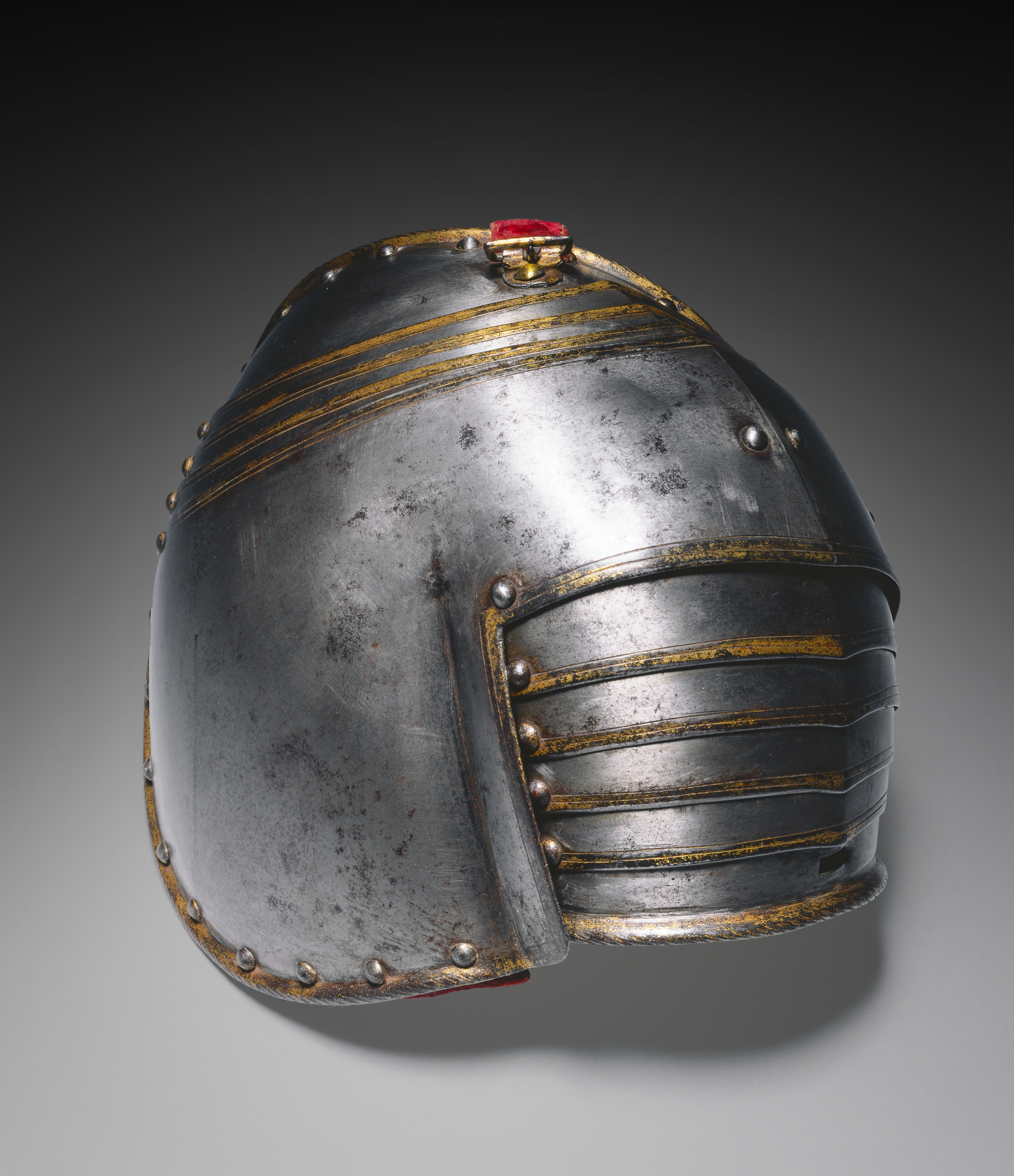
Deconstructing the Baroque Silhouette: The 17th-Century Italian Pauldron as Avant-Garde DNA
At Zoey Fashion Lab, our mandate extends beyond the mere cataloging of historical garments. We engage in a process of fabric deconstruction—a forensic and poetic dismantling of material culture to extract the genetic code of future fashion. Today’s subject, a 17th-century Italian pauldron for the right shoulder, presents a paradox: a piece of hardened steel, designed for mortal combat, yet finished with the delicate artistry of a jeweler. Its blued steel surface, oxidized to a deep, smoky indigo, and its gilt borders, shimmering with the opulence of a Medici court, position this object not as mere armor, but as a proto-sculptural statement. For the avant-garde designer, this pauldron is not a relic; it is a new DNA strand—a blueprint for reimagining the human silhouette, the politics of protection, and the very materiality of adornment.
I. Material Alchemy: Blued Steel and the Subversion of Softness
The technical choice of blued steel is our first point of extraction. The bluing process—a controlled oxidation that creates a corrosion-resistant layer—transforms a utilitarian metal into a canvas of chromatic depth. The resulting hue is not a flat blue but a living gradient, shifting from midnight to peacock depending on the light’s angle. In contemporary avant-garde practice, this challenges the binary of hard and soft. We typically associate fabric with drape, fluidity, and vulnerability. Steel, conversely, connotes rigidity and permanence. However, the blued surface introduces a visual tactility that mimics the sheen of silk velvet or the iridescence of a beetle’s wing. For Zoey Fashion Lab, this suggests a radical material substitution: imagine a couture jacket that uses laser-etched titanium mesh to replicate this blued effect, offering the visual weight of armor with the pliability of knitwear. The gilt borders—thin strips of gold applied over the steel—function as a form of metallic embroidery. They trace the pauldron’s edges, creating a graphic outline that anticipates the modern zipper or piping. In deconstruction, we read this not as decoration but as structural calligraphy, a way to delineate zones of the body with precious, luminous lines.
II. Asymmetrical Power: The Right-Shoulder Monologue
The pauldron’s singular designation—for the right shoulder—is its most radical genetic feature. Unlike symmetrical cuirasses or full suits of plate, this piece is deliberately unbalanced. It declares a hierarchy of the body. The right side, traditionally the sword arm, is privileged, armored, and amplified. The left remains vulnerable, exposed. This asymmetry is a goldmine for avant-garde silhouettes, which thrive on tension and discord. We can translate this into a modern garment: a single, exaggerated shoulder pad constructed from molded bio-resin or upcycled carbon fiber, worn over a gossamer-thin base layer. The pauldron’s structural logic—a series of overlapping lames (horizontal plates) that allow arm movement—becomes a template for articulated fashion. Instead of a static shoulder, we propose a kinetic one, where each segment is hinged with micro-chains or flexible 3D-printed joints. This allows the wearer to move with the same fluid, predatory grace as a 17th-century duelist, but in a context of urban performance art or club couture. The asymmetry also speaks to a contemporary narrative of fragmented identity—one side armored for social combat, the other exposed to intimacy. This is not a costume; it is a psychological exoskeleton.
III. Gilt Borders and the New Ornamentalism
The gilt borders challenge the minimalist dogma of much modern design. They are unapologetically ornate, yet their placement is precise. The gold does not cover the entire surface; it frames, it punctuates, it concludes. This is a lesson in restrained maximalism. For the avant-garde, this translates to a rejection of all-over embellishment in favor of strategic gilding. We envision a garment where the “gold” is not metal but a liquid metallic film applied via screen-printing or a thermoplastic polyurethane (TPU) foil. The borders would trace the seams of a deconstructed blazer, or the hem of a bias-cut skirt, creating a digital-age filigree. Furthermore, the contrast between the matte, dark blued steel and the bright, reflective gold offers a masterclass in surface tension. This pairing—darkness against light, roughness against polish—is a core principle of avant-garde textile design. We can replicate this by combining sandblasted neoprene (the “blued” effect) with hand-stitched metallic threads (the “gilt”). The result is a fabric that tells a story of conflict and opulence, of battle and ceremony, all within a single glance.
IV. The Pauldron as Wearable Architecture
Finally, we must consider the pauldron’s anthropometric geometry. It is not a flat piece of metal; it is a curved, three-dimensional shell that mirrors the deltoid and trapezius muscles. This is wearable architecture—a pre-modern form of 3D printing, hammered by hand. For Zoey Fashion Lab, this inspires a move away from flat pattern cutting toward draped and molded construction. We propose using thermoformable synthetics that can be shaped over a body form, just as the steel was shaped over an anvil. The pauldron’s overlapping lames suggest a modular system—a garment that can be disassembled and reconfigured. This aligns with the avant-garde’s obsession with transformative fashion. A cape could become a skirt; a collar could become a cuff. The historical pauldron, designed for specific combat scenarios, becomes a metaphor for adaptive clothing in a climate of flux. Its protective function is not physical but psychological—a shield against the visual noise of the world, a statement of singular intent.
V. Conclusion: From Relic to Prototype
The 17th-century Italian pauldron is not a costume piece for a historical drama. In the Zoey Fashion Lab, it is a specimen of design intelligence. Its blued steel teaches us about color through oxidation; its gilt borders teach us about precision through contrast; its asymmetry teaches us about power through imbalance. By deconstructing this object—separating its material, structural, and ornamental DNA—we can recombine these elements into a new fashion language. The avant-garde is not about invention from nothing; it is about radical reinterpretation. We take the warrior’s shoulder, strip it of its lethality, and re-inject it with the poetry of the runway. The result is a garment that carries the ghost of a sword fight, the memory of a Medici banquet, and the future of a silhouette that refuses to be symmetrical, passive, or safe. This is the new strand, woven from steel and gold, coiled into the helix of tomorrow’s fashion.