Deconstructing the Grove: An Architectural Reading of Bamboo as Bio-Textile
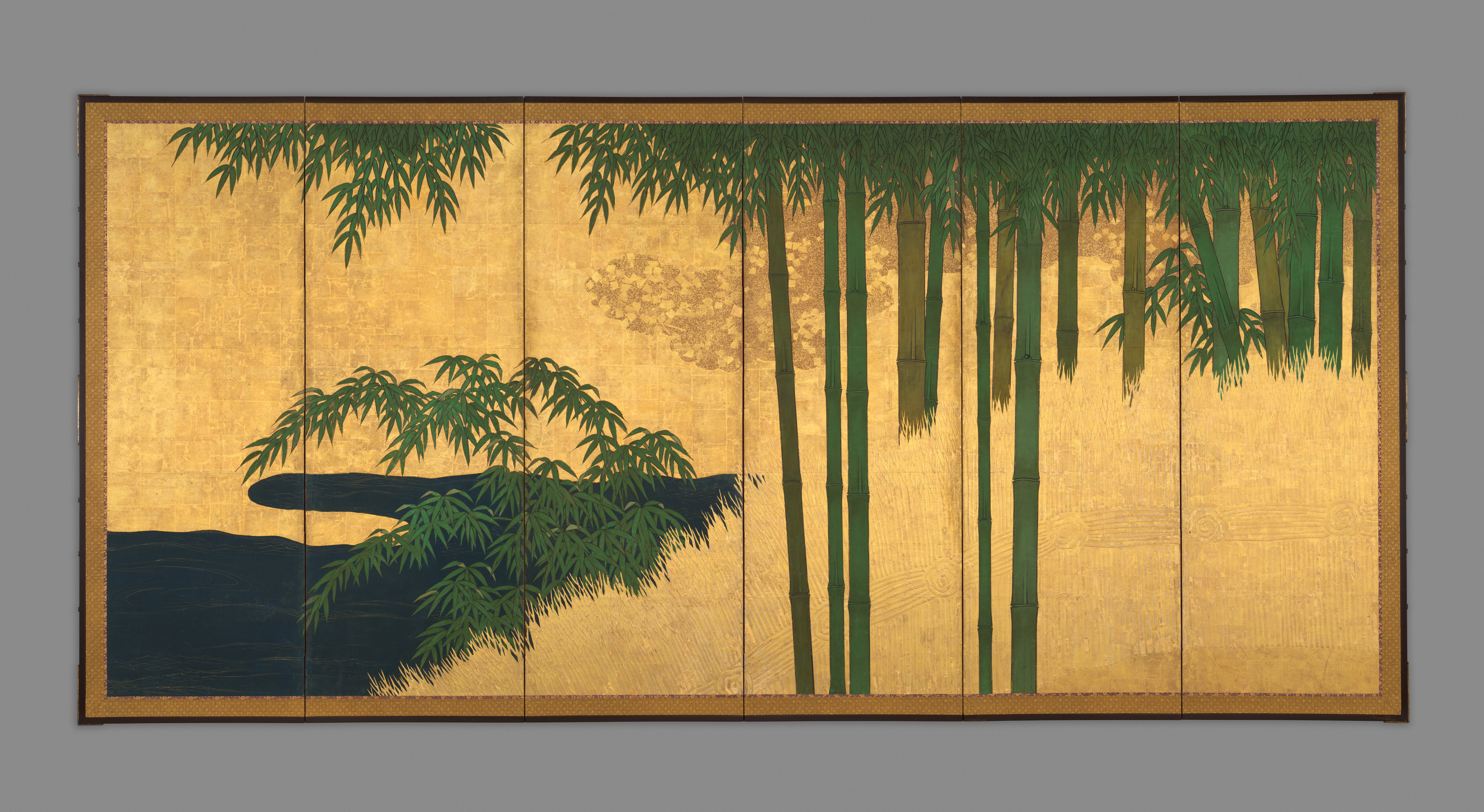
The six-panel folding screen, a relic of Edo-period Japan, is not a canvas. It is a proto-architectural system—a collapsible skeleton clad in painted skin. When we at Zoey Fashion Laboratory confront Bamboo Grove, we do not see a pastoral landscape. We see a blueprint for a new epidermal language, one that rejects the organic flow of conventional drapery in favor of a segmented, jointed, and rhythmically fractured silhouette. The screen’s materiality—ink, gold leaf, and pigment on washi paper—becomes a metaphor for the SS26 collection’s core thesis: fashion as a temporary, movable architecture that negotiates between the natural and the engineered.
The immediate provocation lies in the screen’s structural grammar: the six panels are not uniform. They shift in angle, creating a zigzag topography that mimics the irregular spacing of bamboo culms. For SS26, this translates into a radical departure from the continuous form. We propose a “culm-cut” construction, where the garment is segmented into vertical, articulated panels—each one a self-contained module with its own internal stiffness, yet hinged to its neighbor via concealed, flexible joints. The silhouette ceases to be a single volume; it becomes a sequence of compressed and expanded planes. A coat, for instance, is no longer cut from one continuous bolt. It is assembled from six distinct, elongated panels that flare at the hem and cinch at the shoulder, mimicking the screen’s fold lines. The result is a garment that moves with a percussive, almost robotic cadence, not a fluid sway—a deliberate break from the softness of nature, reinterpreted through the lens of mechanical precision.
Gold Leaf as a Digital Signal: Chromatic Disruption
The screen’s use of gold leaf is not decorative. In the original work, gold functions as a light trap, catching ambient illumination and reflecting it back with a fractured, non-linear glow. For SS26, we translate this into a material innovation: “photo-voltaic gilding”—a technique where micro-thin, flexible metallic panels are fused onto recycled technical mesh. These panels are not printed; they are applied as discrete, irregular shards, echoing the organic flakes of gold on the screen. The effect is a garment that changes its optical density based on the viewer’s angle. At a frontal glance, the surface is matte, almost black. With a lateral shift, the panels ignite into a burnished, solar flare. This is not a print. It is a spatial color field, where the hue is contingent on the wearer’s movement. The bamboo stalks, painted in muted ink, become negative space—areas of raw, unadorned technical fabric that allow the gilded shards to breathe. This interplay between the opaque and the reflective creates a fragmented, cubist portrait of the grove, one that is perpetually in motion.
The Ink Line as a Structural Seam: From Brushstroke to Bonding
Traditional ink painting relies on the bokashi technique—a gradient of tone that bleeds from deep black to pale gray. In our deconstruction, this gradient is not a visual effect but a tensile map. The darkest strokes, where the ink is most saturated, correspond to areas of maximum structural stress in the garment: the shoulder yoke, the hip seam, the internal corsetry. The lightest strokes, nearly transparent, become zones of deliberate fragility—sheer organza or perforated bio-plastic. We have developed a bonding process where the ink’s density dictates the molecular cross-linking of the fabric. A heavy stroke yields a rigid, almost carbon-fiber-like panel. A light stroke yields a silk-like drape. Thus, the painted bamboo becomes a functional blueprint for the garment’s internal engineering. The wearer is not wearing a print of bamboo; they are wearing the stress diagram of a bamboo grove, with its load-bearing nodes and delicate internodes translated into a wearable exoskeleton.
Folding as a Kinetic Principle: The Transformative Silhouette
The screen’s primary function—to fold and unfold—offers the most radical proposition for SS26. We introduce the “origami hinge” as a foundational pattern-making tool. Unlike traditional pleats, which are pressed and fixed, our hinges are engineered with reversible, magnetic or mechanical interlocks. A skirt that appears as a narrow, columnar sheath can be unfolded at the side seams to reveal a full, fan-shaped train, echoing the screen’s expansion when opened to 180 degrees. A jacket’s sleeve can be detached and re-folded into a stiff, sculptural cuff that stands away from the arm, mimicking the screen’s angled panels. This is not modular dressing in the utilitarian sense; it is choreographed transformation. The garment’s final silhouette is not predetermined at the point of sale. It is a negotiation between the wearer and the environment, a daily ritual of folding and unfolding that mirrors the screen’s own dual existence as both a flat object and a three-dimensional room divider. The wearer becomes a living hinge, a point of articulation between the painted past and the kinetic future.
Material Alchemy: Washi, Carbon, and the Bio-Future
Our primary fabric for this study is a hybrid: a high-tenacity, biodegradable washi paper that has been laminated with a micro-thin layer of recycled carbon fiber. This composite retains the tactile warmth and irregular tooth of the original paper, yet offers the tensile strength of an industrial material. The gold leaf is applied not as a foil but as a vapor-deposited metallic film, allowing for precise, micron-level control of reflectivity. The ink is replaced with a conductive, pigment-based dye that can, in future iterations, interface with biometric sensors. The bamboo stalks are not painted; they are embossed into the fabric using a high-pressure, heat-set mold, creating a three-dimensional relief that casts its own shadows. This is not a costume. It is a proto-typological garment that questions the boundary between the botanical and the mechanical. The grove is not a scene to be viewed; it is a system to be inhabited.
Conclusion: The Grove as a Wearable Paradox
Bamboo Grove is ultimately a study in controlled chaos. The bamboo’s natural irregularity is honored, but only as a starting point for a rigorous, almost brutalist geometry. The SS26 collection does not seek to imitate nature; it seeks to abstract its structural logic into a new form of wearable intelligence. The six-panel screen’s legacy is not in its painted imagery but in its collapsible, transformative, and space-defining essence. We propose a fashion that is equally mutable—a garment that can be a slender stalk in the morning and a full, shadow-casting canopy by night. The future silhouette is not draped or sewn; it is assembled, hinged, and folded. The grove is not behind us; it is on us, a living, gilded exoskeleton for the modern nomad. This is not an homage. It is a dissection, a re-engineering, and a rebirth of the natural world into a high-functioning, avant-garde armor for the soul. The bamboo bends, but it does not break. So too shall our garments—but only along the precise, gilded lines we have designed for them.