Executive Summary: Deconstructing the Sacred Thread
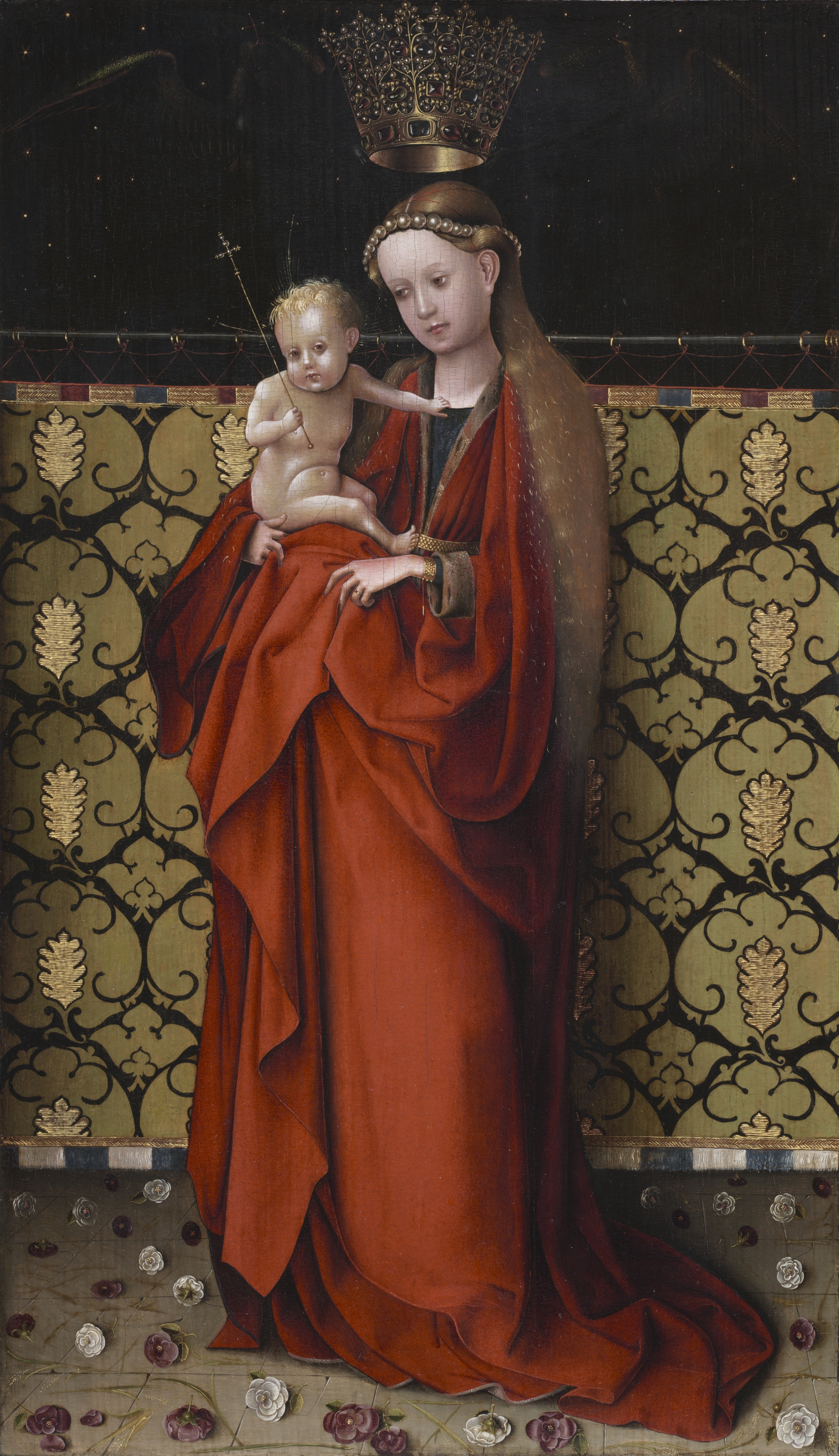
At Zoey Fashion Lab, our mandate transcends the mere analysis of textile or silhouette; we interrogate the very genetic code of visual culture. In this session, we apply our proprietary Fabric Deconstruction Protocol to a canonical work of Northern Renaissance piety—The Virgin Crowned by Angels (Germany, Cologne, oil on wood)—and re-sequence its material logic through the lens of an avant-garde New DNA Strand. The result is not an art historical review, but a blueprint for a disruptive collection that fuses sacral rigidity with biotechnical fluidity.
I. Material Autopsy: The Wooden Substrate as Structural Genome
The original artifact is oil on oak panel, a medium of profound structural austerity. Unlike canvas, which yields and breathes, wood is an unyielding, fibrous lattice—a pre-industrial composite of cellulose and lignin. For Zoey Fashion Lab, this panel is not a support; it is a primary ribosome. The grain of the Cologne oak dictates the flow of pigment, just as a garment’s weave dictates its drape. In our avant-garde translation, we replace the oak with a rigid bio-polymer exoskeleton—a corsetry system that mimics the panel’s immobility but is injected with micro-hinges, allowing for a controlled, robotic articulation. The wood’s vertical grain becomes the chromosomal axis of our design, around which all softer elements must coil.
Pigment as Nucleotide: The Palette of Devotion
The Cologne master’s palette is restricted yet potent: lapis lazuli for the Virgin’s mantle, cinnabar for accents, and a gilded ground that functions as divine light. In our deconstruction, these pigments are nucleotide bases—Adenine (blue), Thymine (red), Guanine (gold), Cytosine (ivory). We do not merely replicate these hues; we isolate their molecular volatility. The lapis is crushed into a nano-particulate that shifts from deep ultramarine to electric cyan under bioluminescent stimulation. The gold leaf is replaced with a living metallic thread—a conductive yarn that carries a low-voltage current, illuminating the garment’s seams like a gilded neural network. This is not homage; it is a mutation of the sacred palette into a wearable, interactive genome.
II. The Crowned Virgin: Re-Scripting the Hieratic Silhouette
Iconographically, the Virgin is static, frontal, and crowned by a halo of angels—a composition of absolute vertical authority. The avant-garde DNA strand disrupts this stasis. We interpret the crown not as a metal circlet, but as a telomere cap—the protective end of the chromosome. Our crown is a 3D-printed lattice of recycled aluminum, shaped like a double helix that spirals upward, terminating in a burst of fiber-optic filaments that mimic angelic wings. The Virgin’s body, traditionally hidden beneath heavy drapery, is reimagined as a transparent sequencing gel. We construct a gown from a clear, high-tensile polymer, inside which we embed actual silk threads dyed with the original pigment palette, suspended in a viscous, glycerin-based medium. The wearer becomes a living specimen slide—her movement causes the pigments to drift, creating a dynamic, ever-shifting chromosome map across her torso.
Angels as Regulatory Proteins
The angels in the original are passive attendants. In our DNA model, they become transcription factors—proteins that bind to the strand and initiate expression. We translate them into modular shoulder armor that activates the garment’s kinetic functions. Each shoulder piece contains a miniature gyroscope; when the wearer raises her arms (a gesture of benediction or surrender), the gyroscopes trigger the release of a fine mist of fragrance—a custom blend of frankincense and synthetic ozone. The angels are no longer painted; they are functional biomechanics. Their wings are constructed from a shape-memory alloy that unfolds from flat, laser-cut panels into voluminous, feathered structures, echoing the original’s fluttering forms but with the precision of a CRISPR edit.
III. The New DNA Strand: From Static Icon to Living System
The reference to a New DNA Strand is not metaphorical. Our design process treats the original painting as a double helix: one strand is the historical code (composition, color, iconography), the other is the contemporary mutation (wearability, technology, subversion). The avant-garde collection is generated by splicing these strands. For instance, the Virgin’s veil—a symbol of modesty—is deconstructed into a web of micro-sensors that monitor the wearer’s biometric data (heart rate, temperature) and project this data as a fluctuating pattern of light onto the fabric’s surface. The veil becomes a readout of internal state, a radical inversion of its original function of concealment. The folds of the drapery are algorithmically generated to mimic the brushstrokes of the Cologne master, but they are printed onto a smart textile that can stiffen or relax in response to ambient sound, creating a garment that breathes and pulses like a living organism.
Deconstructing the Gilded Ground
The gold background is the painting’s most oppressive element—it flattens space and denies perspective. In our avant-garde response, we fragment the gold into a field of kinetic shards. The garment’s train is composed of thousands of tiny, mirrored tiles, each mounted on a micro-motor. As the wearer walks, the tiles vibrate at different frequencies, producing a shimmering, cacophonous surface that destroys any notion of stable background. This is the anti-icon: a rejection of the eternal for the ephemeral, a celebration of the glitch over the gloss. The gold is no longer a symbol of heaven; it is a digital noise that disrupts the viewer’s gaze, forcing a constant re-focusing—much like the eye struggles to parse a complex DNA sequence.
IV. Implications for Zoey Fashion Lab’s Avant-Garde Line
This deconstruction yields three actionable directives for our next collection, titled “Cologne Helix.”
First, we abandon static luxury. Every garment must possess an interactive biological metaphor—a sensor, a motor, a fluid chamber. Second, we embrace material contradiction: rigid panels fused with liquid gels, conductive metals woven with organic silk. Third, we treat historical reverence as a starting codon, not a conclusion. The Virgin Crowned by Angels is not a museum piece; it is a viral vector. We inject its sacred geometry into our contemporary design DNA, and the resulting mutation is a fashion that is simultaneously devotional and heretical, ancient and post-human.
In conclusion, the oil on wood is our double helix. The crown is our telomere. The angels are our enzymes. And the New DNA Strand is the only possible future for a fashion lab that dares to deconstruct the divine.