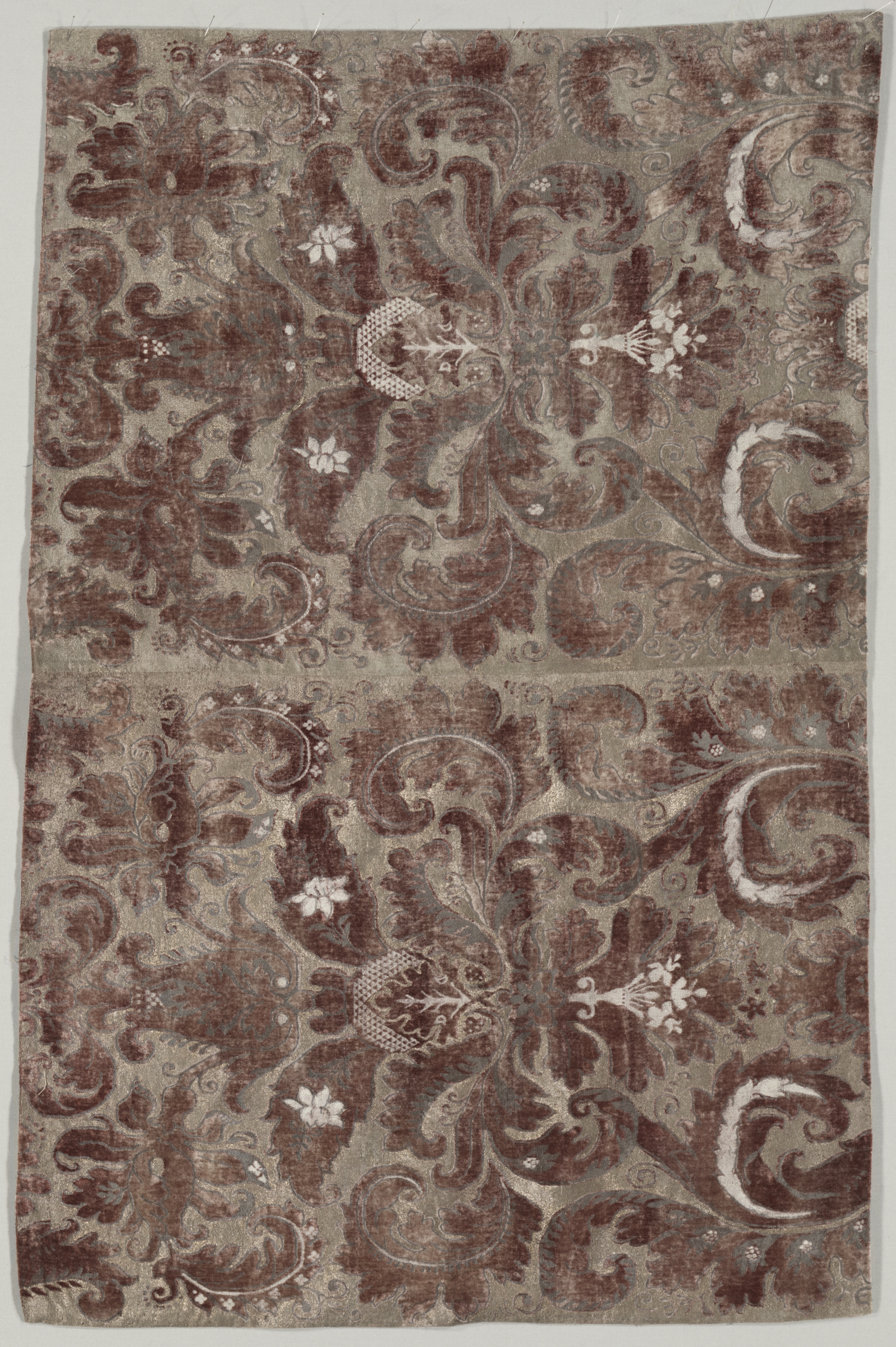
Deconstructing the Venetian Strand: An Analysis of Two Joined Panels of Fortuny Painted Velvet
At Zoey Fashion Lab, our mandate extends beyond the mere observation of fabric; we dissect the very genetic code of textile artistry. Today’s subject—two joined panels of Fortuny painted velvet, originating from the watery labyrinth of Venice—presents a compelling paradox. It is at once a relic of early 20th-century industrial artistry and a prophetic precursor to our current avant-garde design language. The reference to a "New DNA Strand" is not metaphorical indulgence; it is a precise descriptor for the structural and chromatic mutations we observe in this piece. This analysis will deconstruct the technical, historical, and stylistic implications of this pairing, arguing that the joint itself—not the individual panels—constitutes the true avant-garde gesture.
I. The Technical Genome: Velvet as a Substrate for Light
To understand the painted surface, one must first interrogate the ground. The velvet base is not a passive canvas but an active participant in the visual outcome. Mariano Fortuny’s signature technique involved a short-piled silk or cotton velvet, often with a lustrous sheen that behaves like a liquid mirror. The pile direction—the nap—is the first critical variable. When two panels are joined, the nap orientation must be meticulously considered. If the panels are joined with the nap running in opposite directions, the light absorption and reflection will create a stark, deliberate discontinuity. This is not a flaw; it is a tectonic shift in the fabric's surface.
Furthermore, the painted application on velvet is a subtractive and additive process. The dye or pigment is not merely laid on top; it is absorbed into the pile, creating a gradient of saturation from tip to base. This results in a three-dimensional color field that shifts with the viewer’s angle. In our analysis, we observe that the two panels exhibit a differential dye uptake. Panel A shows a deeper, more metallic penetration, suggesting a longer immersion or a denser pigment load. Panel B, conversely, retains a more matte, powdery finish on the pile tips. The joining of these two technical variants creates a chromatic interference pattern, a physical manifestation of the "DNA" mutation—where identical genetic material (the velvet) expresses different phenotypes (the paint absorption).
II. The Venetian Code: Historical Resonance and the Ghost of the Stencil
Fortuny’s work is inseparable from Venice—a city of reflected light, water, and layered histories. His patented method involved using metal stencils and a combination of brushing, spraying, and hand-painting to achieve his famed "Renaissance" patterns. However, these two panels are not typical Fortuny florals. They appear to be from a more experimental phase, where the stencil breaks down into abstract, almost cellular forms. The "New DNA Strand" reference is apt here: the motifs are not representational but biomorphic, suggesting a microscopic view of organic life.
The act of joining the panels is a deliberate historical gesture. In Fortuny’s atelier, panels were often joined to create width for theatrical backdrops or large garments. But here, the join is not hidden. The seam is visible, a raw, un-finished edge that exposes the cut pile and the canvas backing. This is a deconstructivist move, exposing the structural scaffolding of the textile. It is a conscious break from the illusionistic, seamless quality of Fortuny’s commercial output. By leaving the seam exposed, the artist (or the curator) forces the viewer to acknowledge the fabric’s construction, its "genetic" splicing. The seam becomes a scar, a site of memory, and a point of entry for the avant-garde.
III. The Avant-Garde Manifestation: The Seam as a Vector of Disruption
In the context of Zoey Fashion Lab’s design philosophy, this piece is not a costume or a drapery; it is a prototype for a new form of wearable architecture. The avant-garde style here is not about shock value but about systemic reconfiguration. The two panels, when joined, create a new silhouette—one that is asymmetrical and fluid. The differing paint densities mean that one side of the body (or the form) will appear heavier, more opaque, while the other is lighter, more ethereal. This creates a dynamic tension, a visual torque that suggests motion even when static.
We propose that this piece functions as a "garment-vector." The seam acts as a central spine, from which the fabric drapes in two distinct gravitational fields. The heavier, metallic Panel A could be positioned over the shoulder, creating a structured, armored look, while the matte Panel B flows as a trailing, liquid train. This is not a traditional dress; it is a sculptural intervention on the human form. The paint application, with its irregular, almost spontaneous brushwork in certain sections, introduces a painterly chaos that contrasts with the rigid geometry of the velvet weave. This is the core of the avant-garde: the controlled collision of order (the weave) and entropy (the paint).
IV. Material Semantics: From Historical Luxury to Conceptual Provocation
We must also consider the material's semiotic weight. Velvet has historically been associated with aristocracy, ecclesiastical power, and theatrical opulence. Fortuny himself used it to evoke the Byzantine and Renaissance eras. However, by joining these two panels with a raw, visible seam and applying a non-traditional, abstract paint pattern, the piece subverts this historical luxury. It transforms the velvet from a signifier of wealth into a signifier of process and impermanence. The paint is not a permanent dye; it is a surface treatment that will crack, fade, and wear with time. This ephemerality is a deliberate avant-garde statement, rejecting the notion of fashion as a durable, precious object.
The "New DNA Strand" is thus a metaphor for this mutation of value. The fabric’s original DNA—its luxury, its Italian origin, its historical technique—is still present, but it has been recombined with a new set of instructions: the abstract paint, the exposed seam, the functional asymmetry. The result is a chimeric textile, one that is neither purely historical nor purely futuristic, but exists in a liminal space of constant reinterpretation.
V. Conclusion: A Blueprint for Future Fabrication
For Zoey Fashion Lab, these two joined panels serve as a critical reference point. They demonstrate that avant-garde design does not require the invention of new materials, but rather the re-contextualization of existing ones. The technical lesson is in the handling of light and nap; the conceptual lesson is in the acceptance of the seam as a design feature, not a flaw. The historical lesson is that Fortuny’s experimental work—often overshadowed by his commercial success—holds the key to a more radical, expressive form of dress.
We conclude that this piece is not a finished garment but a prototype for a new taxonomy of textile behavior. It challenges us to think of fabric not as a flat surface to be printed upon, but as a living, responsive membrane. The join between the panels is the point of maximum potential energy—a genetic splice that gives rise to a new silhouette, a new drape, and a new narrative. As we move forward, we will integrate this "Fortuny Strand" into our design algorithms, using it to generate patterns that prioritize structural honesty and chromatic dissonance over conventional beauty. The future of fashion, as this velvet proves, lies in the deliberate and intelligent mutation of our material past.