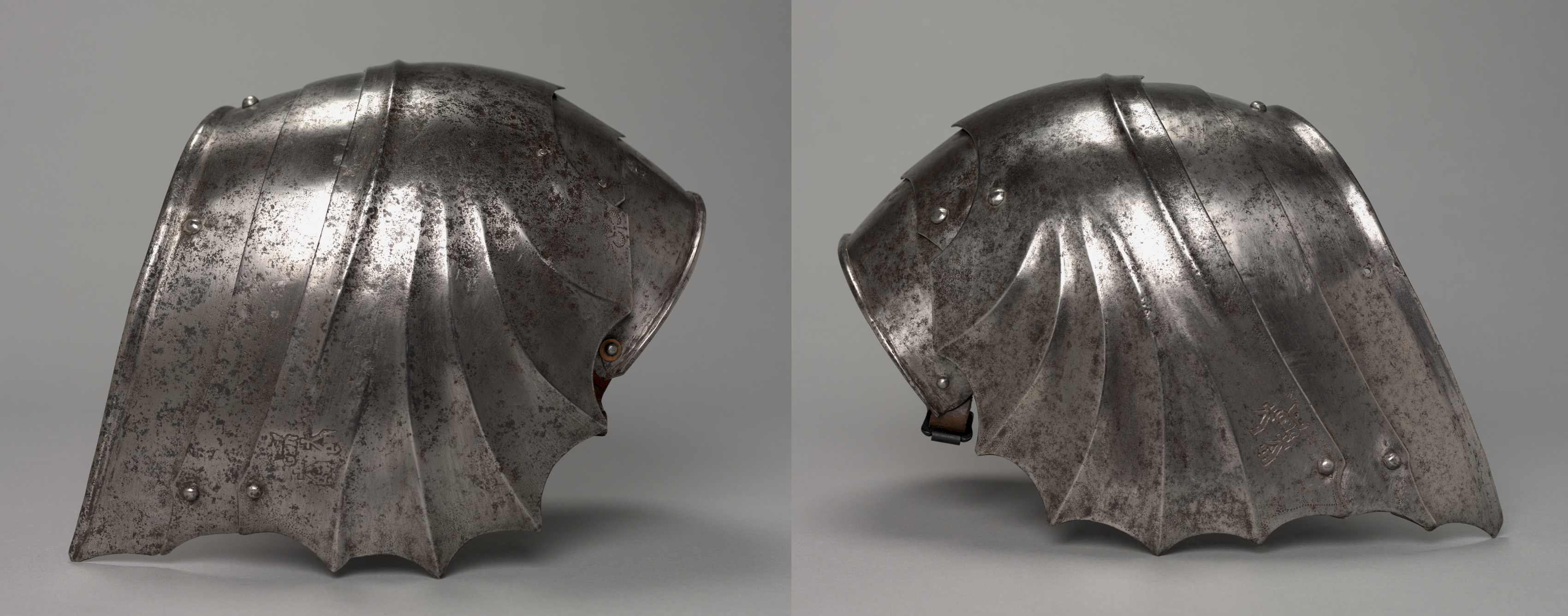
Deconstruction Analysis: The Gothic Fan-Shaped Pauldron as a New DNA Strand
At Zoey Fashion Lab, our mandate transcends mere garment analysis. We dissect the skeletal architecture of historical armor to extract the genetic code of future silhouettes. The subject of this deconstruction—a pair of Gothic fan-shaped pauldrons from Milan, forged in steel—is not an artifact of the past but a progenitor of avant-garde form. When we speak of a "New DNA Strand," we refer to the transposition of structural logic from one material epoch to another. This Milanese steel, once a shield for the shoulder, becomes a blueprint for sculptural fashion that challenges the human form’s static boundaries.
I. Historical Genesis: The Milanese Metallurgical Signature
The Gothic style, particularly in Milan, was defined by an obsessive pursuit of both mobility and visual lightness. Unlike the blunt, heavy plate of earlier centuries, Milanese armorers developed a sophisticated system of overlapping lames, articulated rivets, and fluted surfaces. The fan-shaped pauldron—a term derived from its radial, shell-like expansion over the deltoid—was a masterpiece of weight distribution. The steel was not merely hammered; it was reasoned. Each ridge and valley in the metal served a dual purpose: structural rigidity against a blade and the deflection of force through curvature.
For the fashion deconstructionist, this is the primary genetic marker. The pauldron’s fan is not decorative flourish; it is functional dynamism. The radiating lines, often terminating in a crisp, outward flare, create a visual rhythm that suggests motion even at rest. This is the first strand of our new DNA: the idea that armor can be a kinetic sculpture, not a static cage. The Milanese smiths understood that the body’s most expressive joint—the shoulder—required a design that honored its spherical rotation while projecting an intimidating, geometric authority.
II. Deconstructing the Fan: Form, Line, and Negative Space
Our analysis isolates three core anatomical components of the pauldron: the collar, the main fan plate, and the articulated lower lames. In the Milanese example, the collar is a tight, high-standing gorget that anchors the piece to the neck, creating a dramatic vertical contrast to the horizontal expansion of the fan. The main fan plate is the hero—a sweeping, almost semicircular expanse that covers the trapezius and extends past the acromion. Its surface is often etched with parallel, concave flutes that catch light and shadow, creating a moiré effect of alternating brilliance and darkness.
The most radical element for fashion translation is the negative space between the lames. These gaps, necessary for articulation, are not voids but active lines. They suggest a layering system, a palimpsest of steel scales. In our avant-garde reinterpretation, this negative space becomes the site of innovation. We replace steel with rigid, laser-cut polymer or upcycled carbon fiber, but we preserve the gap. The gap becomes a seam of transparency, allowing the skin or an under-layer of sheer technical mesh to peek through. This is the "New DNA Strand"—the conversion of defensive spacing into erotic, architectural exposure.
III. Material Transmutation: From Steel to Stretch
The steel itself is a paradox. It is heavy, cold, and unyielding—yet the fan shape makes it appear light. The avant-garde fashion lab does not copy the material; it abstracts its properties. We propose a hybrid composite: a base of bio-based nylon, fused with a lattice of stainless steel micro-wires. This yields a fabric that holds a three-dimensional, fluted shape when pleated, yet flexes with the wearer’s arm. The surface finish is critical. We employ a galvanic etching technique that reproduces the Milanese fluting at a micro-scale, creating a fabric that shimmers with the same optical vibration as the original armor.
This transmutation is not a loss of authenticity but a genetic mutation. The steel’s stiffness is translated into a memory-shape textile that snaps back to its fan silhouette after compression. The weight is reduced by 90%, allowing the pauldron to be worn as a detached shoulder piece over a silk gown or a technical parka. The coldness of steel is replaced by a temperature-regulating phase-change material, ensuring the wearer’s comfort while retaining the visual chill of the original. This is the essence of the New DNA Strand: we extract the informational code of the artifact, not its physical heft.
IV. Avant-Garde Silhouette: The Shoulder as a Radical Proposition
The fan-shaped pauldron offers the avant-garde designer a radical proposition: the shoulder is not a joint, but a horizon. In contemporary fashion, the shoulder has been padded, exaggerated, or erased. The Gothic fan suggests a different path—the shoulder as a radiating crown. We envision a garment where the pauldron is detached from the torso, floating via a hidden magnetic suspension system. The wearer’s arm moves freely, but the fan remains stationary, creating a surreal, anti-gravitational effect.
This design challenges the viewer’s perception of anatomy. The natural slope of the shoulder is replaced by a sharp, 90-degree architectural line that cuts outward. The fan’s ridges can be echoed in the garment’s pleats, creating a cascading waterfall of fabric that mimics the steel’s fluting. Alternatively, the pauldron can be inverted—worn on the hip or the back—as a modular exoskeleton. This is the true avant-garde move: to sever the artifact from its historical function and let it become a free-floating signifier of power and precision.
V. The New DNA Strand: A Code for Future Collections
Our "New DNA Strand" is not a single garment but a system of rules. From this Milanese pauldron, we extract four genetic sequences:
Sequence 1: Radial Expansion. The principle that a garment can grow from a central point outward in controlled, fluted increments. This informs our sleeve constructions, capes, and even skirt silhouettes.
Sequence 2: Articulated Rigidity. The balance between hard and soft, where rigid panels are joined by flexible, transparent membranes. This creates a hybrid body that is both armored and fluid.
Sequence 3: Optical Fluting. The use of alternating concave and convex surfaces to manipulate light, creating a shifting, kinetic appearance without actual movement. This is achieved through textile pleating, laser-cut overlays, and 3D-printed structural trims.
Sequence 4: Functional Negative Space. The deliberate use of gaps and voids as active design elements, allowing for breathability, movement, and a provocative glimpse of the body beneath.
VI. Conclusion: The Armor of Tomorrow
The Gothic fan-shaped pauldron from Milan is a testament to human ingenuity—a fusion of metallurgy, anatomy, and aesthetics. At Zoey Fashion Lab, we do not preserve it in a museum case; we re-sequence its DNA into a new species of garment. The avant-garde is not about shock for its own sake, but about seeing the future embedded in the past. This steel fan, once a defense against swords, becomes a defense against the mundane. It offers the wearer a new posture, a new presence, and a new dialogue between the body and the space it occupies.
Our analysis concludes that the pauldron’s true legacy is not in its historical context but in its formal potential. By deconstructing its steel into a flexible, luminous, and modular system, we create fashion that is not worn but inhabited. The New DNA Strand is thus a promise: that the future of style is forged from the forgotten logic of ancient craft. The Milanese smiths built for war; we build for the spectacle of existence. And in that translation, the fan-shaped pauldron finds its ultimate, avant-garde expression.