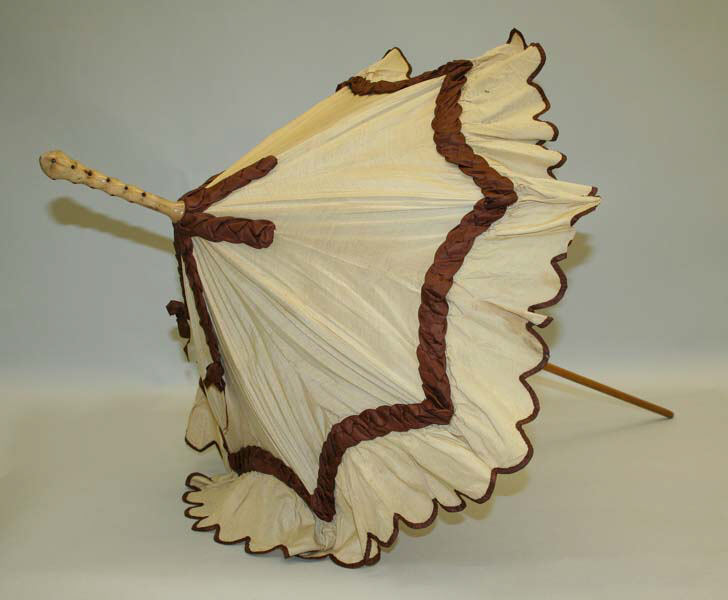
The Parasol Recalibrated: An Avant-Garde Architecture for SS26
In the lexicon of fashion, the parasol has historically been relegated to the decorative—a Victorian flourish, a bourgeois shield against the sun, a prop of passive femininity. For Zoey Fashion Laboratory’s SS26 investigation, we reject this taxonomic inertia. We propose the parasol not as an accessory, but as a wearable structural prototype—a mobile chassis for the body’s future. This analysis deconstructs the American parasol (in silk and wood) to its elemental forces: tension, canopy, and axis. By severing its ties to nostalgia, we reimagine it as a system of kinetic architecture, where the garment is no longer draped but deployed.
Deconstructing the Canopy: From Shade to Silhouette
The traditional parasol’s canopy is a hemisphere of passive coverage. Our intervention begins with a radical act of topological inversion. The silk, typically stretched over rigid ribs, is instead treated as a pre-tensioned membrane. We propose a silhouette where the canopy collapses inward, folding into a series of asymmetric, blade-like panels that jut from the shoulder and hip. This is not a skirt nor a cape; it is a fossilized shadow, a three-dimensional negative space made tangible.
The American origin of our subject is critical here. Unlike its European counterparts, the American parasol often favored utilitarian simplicity—a pragmatic object for a new republic. We amplify this pragmatism into brutalist elegance. The silk is not printed with florals but left in its raw, undyed state, or treated with a resinous finish that mimics the rigidity of architectural fiberglass. The silhouette becomes a series of cantilevered planes, echoing the work of Zaha Hadid translated into fabric. The body moves under the garment, not in it, creating a dynamic of occupant and structure.
The Axis as Spine: Reimagining the Wooden Shaft
If the canopy is the garment’s facade, the wooden shaft is its vertebral column. Conventionally, this is a straight, passive handle. In our SS26 paradigm, the shaft is re-engineered as a curved, articulated exoskeleton. We use steam-bent American ash or maple, not for a handle, but as a structural spine that traces the wearer’s scapula and curves outward over the crown of the head. This is not a stick to hold; it is a biomechanical appendage.
The result is a futuristic silhouette that is both prehistoric and intergalactic. The wooden element, once a symbol of pastoral leisure, becomes a load-bearing beam. It can be hinged at the mid-back, allowing the canopy to rotate 180 degrees and transform into a rear train—a morphing exoskeleton that responds to the wearer’s gait. The wood is not polished to a high gloss; it is left with a matte, sandblasted texture, evoking a material that has survived a post-climate apocalypse. This is structural innovation via material honesty: silk for fluidity, wood for rigidity, and the tension between them for movement.
Silk as a Conductive Skin, Not a Decorative Veil
Our treatment of silk defies its traditional drape. We employ a technique of thermal pleating and laser-perforation, transforming the fabric into a semi-rigid lattice. The silk is no longer a veil; it is a sensory membrane. Perforations are mapped to allow for ventilation and light filtration, but more importantly, they create a moiré effect when the canopy shifts. This is not about hiding the body but about fragmenting its perception. The wearer becomes a composite of moving parts—a human-machine hybrid where the silk acts as a conductive skin that captures ambient light and re-emits it as a shifting pattern.
For SS26, we propose a palette of industrial whites, bone, and oxidized metal tones. The silk is often dyed with a mineral-based pigment, giving it a chalky, non-reflective finish. This is a deliberate move away from the romantic sheen of traditional parasols. Instead, we aim for a matte, architectural absorption—a garment that consumes light rather than reflecting it. The silhouette is thus defined by its shadows, by the negative spaces carved between the wooden struts and the silk panels.
Wearable Mechanics: The Parasol as a Kinetic System
The true innovation lies in the parasol’s mechanical integration. We propose a system of micro-cables and ratchet joints housed within the hollowed wooden shaft. A simple wrist twist can release the canopy’s tension, causing it to collapse into a compact, sculptural bustle. Another twist can extend the canopy forward, creating a veil of protection that obscures the upper torso entirely. This is not costume; it is functional futurism. The garment adapts to environmental and social pressures—shade, surveillance, or spectacle—with a fluid, almost robotic precision.
This kinetic capability redefines the runway. A model does not simply walk; she deploys her architecture. The parasol-garment becomes a live, responsive entity. The silhouette shifts from a compressed, vertical column to a wide, horizontal wing span in under three seconds. This is the avant-garde imperative: the garment is not a static object but a sequence of states. The American pragmatism of our source material is thus elevated into a philosophy of adaptive wear—a garment that performs, protects, and transforms.
Conclusion: A Parasol for the Post-Human Era
In this standalone study, the parasol is no longer an accessory of the past. It is a blueprint for a new body—one that is armored, kinetic, and deeply connected to structural logic. By deconstructing the American silk and wood parasol, we have uncovered a system of tension, cantilever, and deployment. The SS26 silhouette is not about fabric against skin; it is about architecture around the void. The wearer becomes a living column, a mobile pavilion, a walking paradox of fragility and strength.
Zoey Fashion Laboratory posits that the future of couture lies not in embellishment but in engineering. The parasol’s canopy becomes a solar sail; its shaft, a spine; its ribs, a skeletal frame. This is the definitive avant-garde recalibration—a garment that asks not "What does it look like?" but "What can it do?" In the heat of SS26, we do not offer shade. We offer a new structural reality, where the parasol is the first step toward a fully wearable, responsive environment. The future is not draped. It is deployed.