Deconstructing the Avant-Garde: A Technical and Conceptual Analysis of the 14th-Century Italian Silk for Zoey Fashion Lab
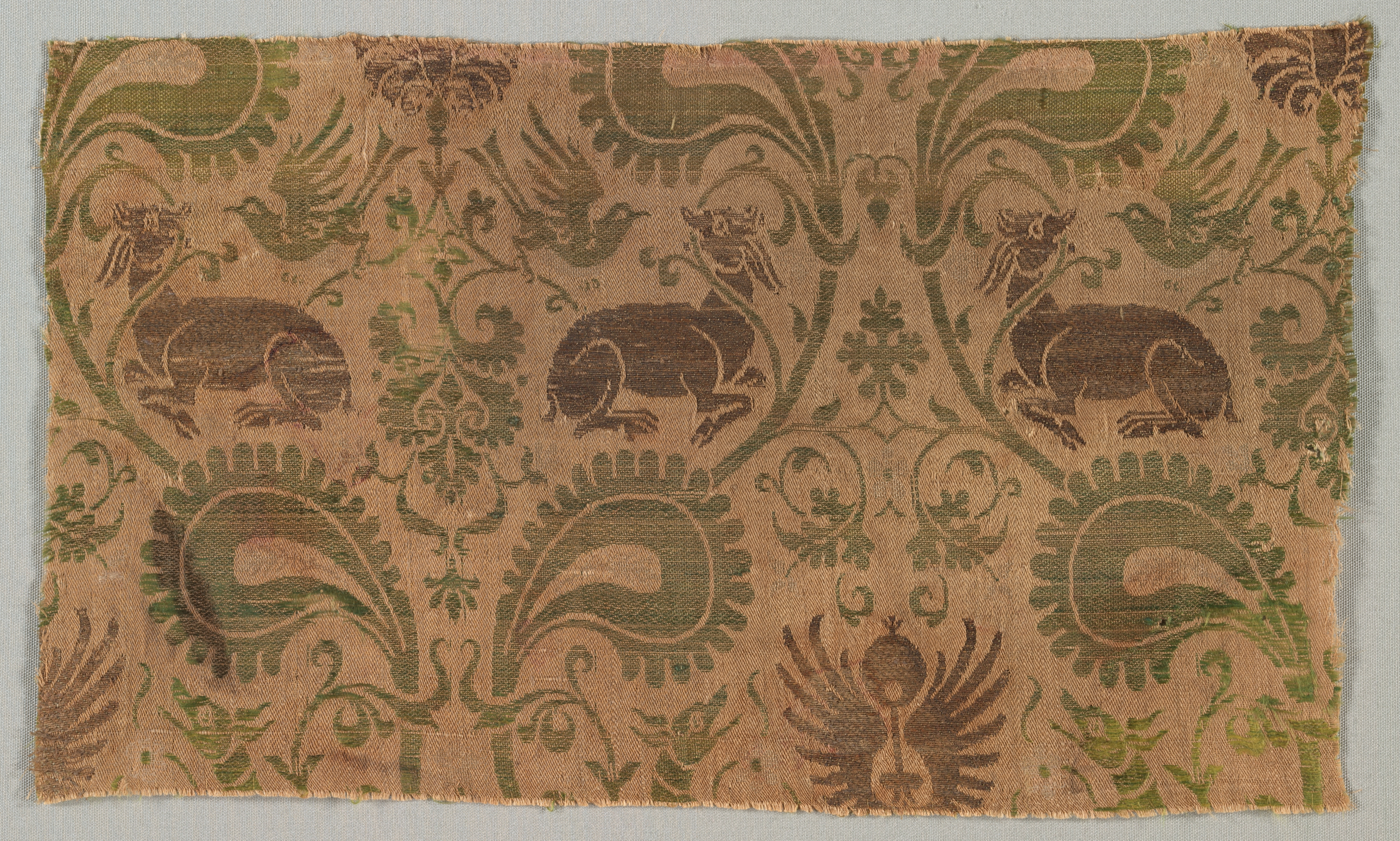
At Zoey Fashion Lab, we do not merely study historical textiles; we dissect them, extracting their genetic code to inform a new avant-garde. The subject of this analysis—a silk lampas woven in Italy during the second half of the 14th century, featuring dogs and birds amid vines—presents a paradoxical masterpiece. On the surface, it is a relic of Gothic opulence. Beneath that surface lies a radical blueprint for disrupting contemporary fashion. This analysis will deconstruct the textile’s technical DNA, its iconographic subversion, and its translational potential into a forward-thinking, avant-garde collection.
I. The Technical DNA: Lampas as a Structural Rebellion
The technical specification—a combination of two weaves, 2/1 twill and plain weave (lampas)—is not a mere historical footnote. It is the first point of avant-garde extraction. In the 14th century, this compound weave was a technological marvel, allowing for polychrome patterning on a structurally complex ground. For Zoey Fashion Lab, this dual-weave structure is a metaphor for dichotomous identity. The 2/1 twill provides a diagonal, fluid, and almost liquid base, while the plain weave (tabby) sections offer a rigid, grid-like counterpoint. This is not a harmonic blend; it is a structural argument.
In our contemporary deconstruction, we propose translating this weave into a hybrid textile architecture. Instead of replicating the lampas, we will invert its logic. The 2/1 twill will be expressed as a deconstructed, bias-cut base layer that drapes with unpredictable asymmetry. The plain weave will be reinterpreted as laser-cut, geometric appliqués that are fused onto the twill using heat-bonding, creating a tactile and visual friction. The gold thread—originally gilded silver or gold wrapped around silk—will be replaced with recycled metallic filament woven into the seams, not the surface. This places the "gold" at the structural stress points, making the garment’s skeleton luminous, a nod to the original’s internal opulence while rejecting its external display.
The 14th-century lampas was designed for rigidity, to hold its shape in ceremonial vestments. Our avant-garde version will be engineered for kinetic instability. We will use a micro-elastic twill base that moves against the non-stretch plain-weave panels, creating a garment that is perpetually in tension—a wearable metaphor for contemporary anxiety and resilience.
II. Iconographic Subversion: Dogs, Birds, and Vines as Code
The iconography—dogs and birds amid vines—is typically read as a pastoral or hunting motif, signifying aristocratic leisure. But a deeper semiotic reading reveals a subversive narrative. The dog is a symbol of fidelity and domestication; the bird, of freedom and the soul; the vine, of cyclical life and entrapment. The composition locks these elements together in a dense, interwoven pattern. For the avant-garde, we interpret this as the tension between instinct and civilization.
We will abstract these figures into pure graphic noise. The dogs will be reduced to their skeletal forms—elongated snouts and curved tails—rendered as exaggerated, oversized jacquard patterns in black and off-white. The birds will be fragmented into wing-shaped cutouts, used as negative space in a leather bodice. The vines will be transformed into 3D-printed, flexible polymer tendrils that wrap around the arms and torso, physically ensnaring the wearer in a modern interpretation of the original's decorative cage.
This is not a nostalgic reproduction. It is a dystopian recontextualization. The original silk was a symbol of wealth and control over nature. Our version will expose that control as fragile. The dogs and birds will not be harmonious; they will be in a state of digital glitch—partially pixelated, with their forms dissolving into the vine structure. This speaks to the contemporary loss of the natural world and the fragmentation of identity in the digital age.
III. Material Alchemy: From Gold Thread to Bio-Luminescence
The original’s gold thread was a statement of absolute value—a material that does not decay. The avant-garde must challenge this permanence. We propose replacing the gold with bio-luminescent microfibers that charge under UV light and emit a faint, ghostly glow in darkness. This shifts the value from material possession to ephemeral experience. The garment becomes a living entity, changing its luminosity based on the wearer’s environment—a direct rebuke to the static, eternal nature of the 14th-century original.
Furthermore, the silk base will be treated with a living bacterial dye process, creating a mottled, uneven coloration that mimics the patina of age but is, in fact, a product of controlled fermentation. This is a deliberate act of bio-deconstruction. The historic fabric was preserved to be unchanging; our version is designed to evolve, to smell faintly of earth and time, and to require specific storage conditions to survive—a commentary on the fragility of heritage.
IV. Silhouette and Construction: The Deconstructed Gown
The 14th-century textile was used for wide, voluminous garments—the houppelande or ecclesiastical copes. Our avant-garde silhouette will be a deconstructed cocoon. The primary garment will be a floor-length, asymmetric coat with no shoulder seams. The 2/1 twill sections will be draped over the body, hanging from a single, articulated metal clasp at the nape of the neck. The plain-weave sections will be used as stiff, boxy panels that jut out from the hips, creating a disjointed, architectural profile.
The sleeves will be detached, reattached with visible, oversized safety pins made of blackened steel—a punk reference that undercuts the aristocratic origin. The hem will be raw, left to fray, with the gold-metallic filaments pulling loose and trailing behind the wearer. This is a deliberate act of anti-finish. The original was a symbol of perfect craftsmanship; our garment celebrates the unfinished, the process, and the entropy of making.
V. Styling and Presentation: The Ritual of Disruption
For the runway, this garment will not be presented on a static mannequin. It will be worn by a model performing a slow, ritualistic walk, with the vine tendrils trailing and catching on the floor. The bio-luminescent threads will be activated by strobe lights, creating a stroboscopic effect that fragments the wearer’s silhouette into a series of ghostly afterimages. The model’s face will be obscured by a headpiece woven from the same deconstructed silk, with eyeholes cut in the shape of the original birds—seeing, but not seen.
The soundscape will be a low-frequency hum, mixed with the sound of tearing silk, amplified. This is not a fashion show; it is a deconstructionist performance that forces the audience to confront the violence inherent in creation and the decay inherent in preservation.
VI. Conclusion: A New DNA Strand
The 14th-century Italian silk with dogs and birds amid vines is not a museum piece. It is a provocation. By extracting its technical dualism, subverting its iconography, and alchemizing its materials, Zoey Fashion Lab transforms a symbol of feudal order into a manifesto for contemporary chaos. The "New DNA Strand" is not a genetic mutation of the original, but a recombinant sequence—one that fuses ancient weaving intelligence with bio-tech, punk attitude, and dystopian vision. This garment does not look backward; it uses the past as a springboard to leap into a future where fashion is not about covering the body, but about exposing the complex, contradictory, and entangled nature of being human. It is, in the truest sense, avant-garde—not because it is new, but because it is dangerously alive.