The Crescent Pendant as Architectural Prototype: Deconstructing the Avant-Garde Silhouette
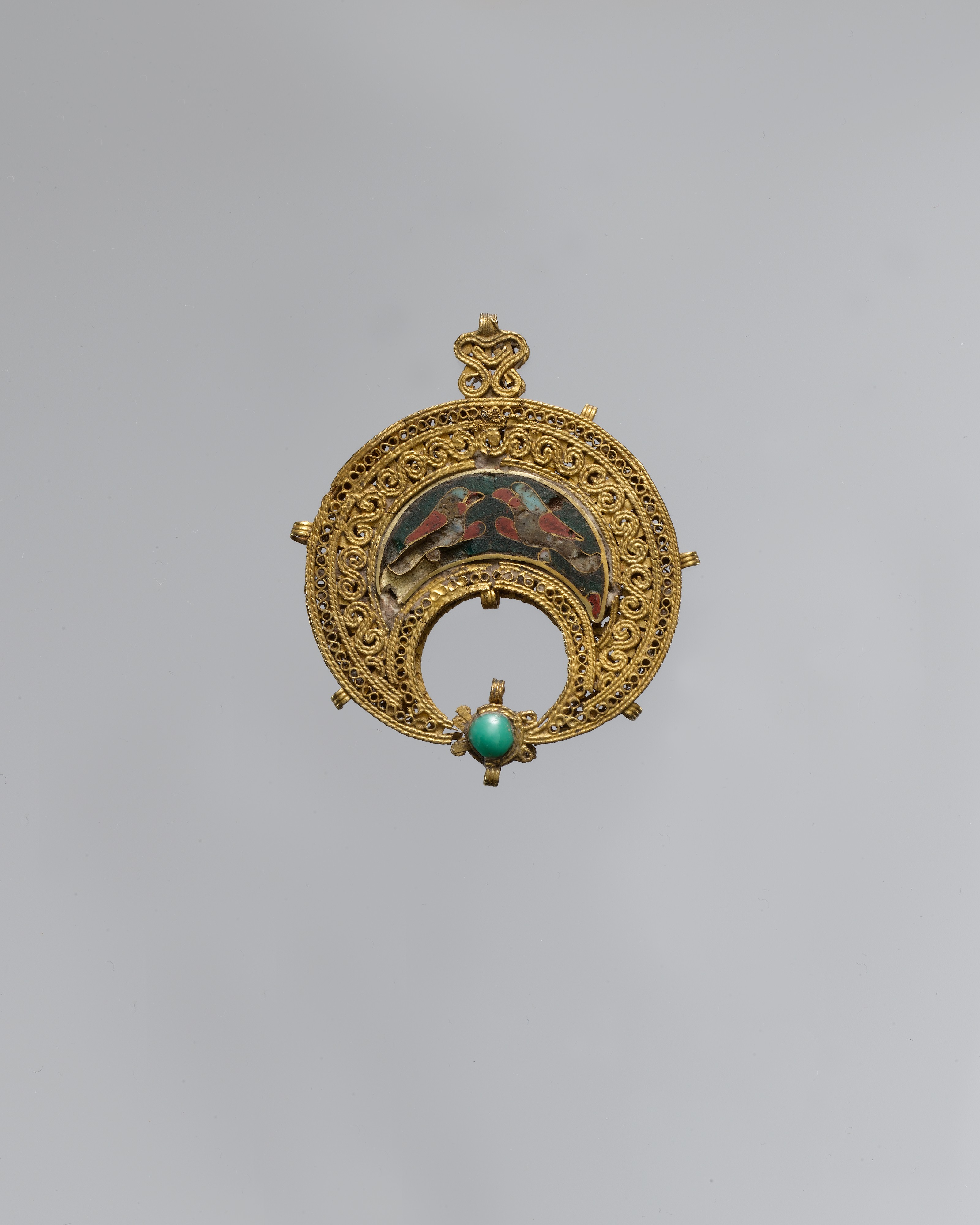
In the rarefied echelons of Zoey Fashion Laboratory, the artifact ceases to be mere ornament. The crescent-shaped pendant, adorned with confronted birds, is not a relic of a bygone global frontier—it is a schematic for the SS26 silhouette. This object, forged in gold, cloisonné enamel, turquoise, and filigree, operates as a compressed manifesto of tension, asymmetry, and structural counterpoint. For the avant-garde curator, the pendant’s lunate geometry and avian dyad offer a radical departure from the anthropomorphic norm, proposing a wearable architecture that redefines the human form as a dynamic, gravitational field. The SS26 collection must not reference this pendant; it must *become* its spatial logic.
Lunate Dynamics: The Crescent as a Negative-Space Chassis
The crescent’s defining characteristic is its inherent incompleteness—a circle interrupted, a void made tangible. In the context of futuristic silhouettes, this shape translates into a surgical excision of the garment’s foundational mass. We are not draping fabric; we are carving space. For SS26, the crescent manifests as a rigid, cantilevered shoulder yoke that arcs from the nape to the sternum, leaving the clavicle and trapezius exposed in a deliberate act of negative-space articulation. This is not a neckline; it is a structural chord that redistributes the garment’s weight, creating a gravitational pull toward the wearer’s center.
Furthermore, the crescent’s dual tips—one ascending, one descending—suggest a dynamic asymmetry that defies static equilibrium. In constructing the SS26 outer shell, we employ a hybrid of milled titanium and recycled polymer, finished in a matte, gunmetal patina that echoes the oxidized depth of aged cloisonné. The shell’s front panel is cut on a severe bias, terminating in a sharp, crescentic point that hovers three centimeters above the waistline. The rear panel, conversely, extends into a sweeping, comet-like train, its edge stiffened with a memory-wire filament. This juxtaposition of abrupt termination and elongated flow creates a visual torque, compelling the eye to travel in a continuous, orbital motion around the wearer.
Confronted Birds: The Dialectic of Duality and Kinetic Tension
The pendant’s confronted birds—beaks nearly touching, wings folded in aggressive readiness—are not merely decorative. They embody a dialogic tension between opposing forces: predator and prey, stasis and flight, the terrestrial and the celestial. In garment architecture, this translates into a system of dual-layer, counter-rotating panels. The inner layer, constructed from a high-tensile, liquid-metal jersey, is cut to cling to the body’s kinetic core. The outer layer, a rigid, laser-sintered lattice of enamel-coated aluminum, is hinged at the shoulder and hip, allowing it to pivot independently. When the wearer moves, the outer shell rotates against the inner skin, creating a visual friction—a shimmering, cloisonné-like play of light and shadow that mirrors the birds’ imminent clash.
This confrontational motif also informs the garment’s fastening system. Traditional zippers and buttons are rejected in favor of magnetic, beak-like clasps that interlock at the sternum and scapula. These closures are not hidden; they are celebrated as structural punctuation, their turquoise-inlaid surfaces catching the light like the pendant’s original stone. The clasps are positioned to force a slight forward hunch in the wearer’s posture, a deliberate subversion of the upright, heroic stance. This is a silhouette of preparedness, not repose—a body poised for dialogue, conflict, or flight.
Filigree as Structural Cartography: From Ornament to Load-Bearing Matrix
Filigree, traditionally a delicate, ornamental wirework, is reimagined in SS26 as a load-bearing, exoskeletal mesh. The pendant’s intricate gold threads become a blueprint for a full-body, 3D-printed lattice that wraps the torso and upper thighs. This is not an overlay; it is the primary structural element. The lattice is composed of interlocking, crescent-shaped cells, each one a micro-echo of the pendant’s form. These cells are printed in a lightweight, high-strength cobalt-chrome alloy, then selectively infilled with a translucent, enamel-like resin in shades of oxidized turquoise and deep lapis.
The filigree mesh serves a dual purpose: it provides unprecedented structural rigidity without bulk, while simultaneously creating a cartographic narrative across the body. The pattern densifies over the deltoids and iliac crest—areas of high biomechanical stress—and thins over the ribcage and inner thighs, allowing for breathability and articulation. This is a garment that functions as a wearable exoskeleton, but one that speaks the language of haute joaillerie. The wearer is not clothed; they are armored in a memory of ornament.
Material Alchemy: Gold, Enamel, and Turquoise in a Futurist Palette
The pendant’s material triad—gold, cloisonné enamel, turquoise—is not a nostalgic homage but a chromatic and tactile directive for SS26. Gold is translated as a high-polish, liquid-metal finish applied to the garment’s rigid seams. It is not used as trim; it is used as wiring, a conductive thread that runs through the lattice, carrying a subtle, low-voltage current that activates micro-vibrations in the fabric. This is not mere gimmickry; it is a haptic response to the wearer’s pulse, a garment that reacts to the body’s own tempo.
Cloisonné enamel finds its modern equivalent in a multi-layer, resin-infused composite that is applied to the shell panels in segmented, cell-like compartments. Each compartment is filled with a different hue—from deep, oxblood red to electric cobalt—creating a stained-glass effect that fractures and refracts light as the wearer moves. Turquoise, in its most radical reinterpretation, becomes a biodegradable, mineral-based pigment embedded in the garment’s inner lining. This pigment is thermochromic, shifting from a pale, robin’s-egg blue to a deep, verdigris green in response to body heat. The garment thus becomes a living document of the wearer’s thermal state, a silent, chromatic conversation between skin and shell.
Conclusion: The Pendant as a Portal to SS26’s New Human
The crescent pendant with confronted birds is far more than an artifact of the Global Frontier. It is a portal into a new paradigm of dress, one where ornamentation is re-coded as engineering, and where the body is not a passive mannequin but an active participant in a kinetic, architectural dialogue. For SS26, Zoey Fashion Laboratory proposes a silhouette that is simultaneously archaic and futuristic, rigid and fluid, confrontational and contemplative. The crescent is not worn; it is inhabited. The birds are not depicted; they are embodied in every pivot, every clasp, every counter-rotating panel. This is not fashion as adornment; this is fashion as structural philosophy, a wearable thesis on the eternal tension between the void and the form, the static and the kinetic, the ancient and the unprecedented. The future of couture is not in the fabric—it is in the frame.