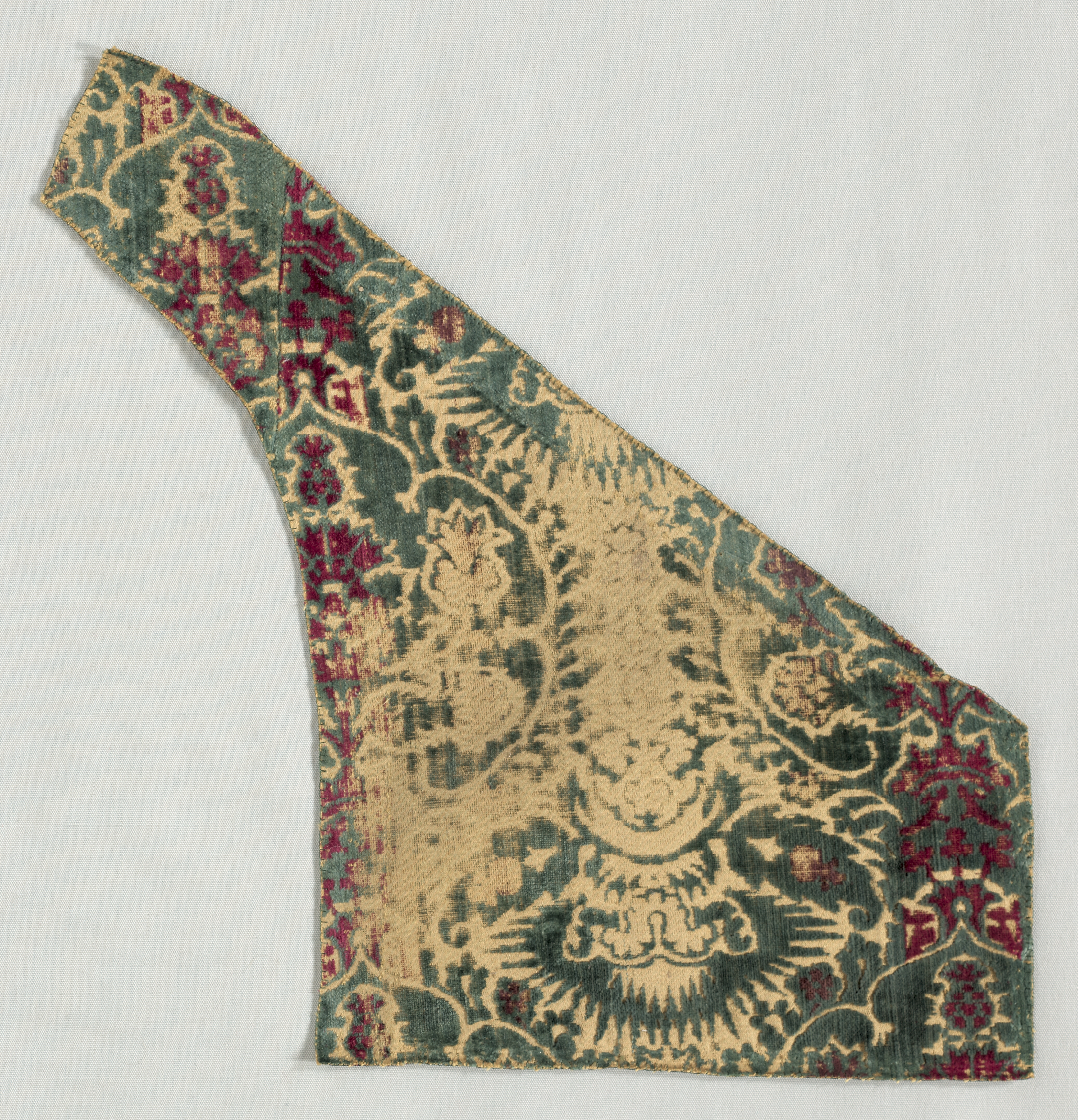
Deconstructing the Renaissance Shadow: The Velvet Fragment as a New DNA Strand
At Zoey Fashion Lab, our mandate transcends the mere preservation of historical textiles. We engage in a forensic dialogue with the past, extracting the structural and philosophical essences that can inform the radical future of garment construction. Today’s subject is a 15th-century Italian velvet fragment—a piece of cut and voided pile—which, upon first glance, appears to be a relic of aristocratic opulence. Yet, under our microscopic and conceptual lens, this fragment reveals itself not as a static artifact, but as a New DNA Strand: a genetic code for an avant-garde aesthetic that challenges the very syntax of contemporary fashion.
I. Technical Autopsy: The Grammar of Cut and Voided Velvet
The technical construction of this fragment is the first locus of our deconstruction. The term “cut and voided” is not merely a historical descriptor; it is a blueprint for spatial manipulation. In this technique, the weaver employed a complex loom system to create a raised pile of silk, which was then selectively sheared to produce a lustrous, dense surface. The “voided” areas—those left flat with the ground weave—create a stark topographical contrast. This is not a simple print or embellishment; it is a three-dimensional stratification of light and shadow.
For the avant-garde designer, this technique offers a radical departure from the flatness of modern digital printing. The fragment teaches us that texture is not a surface treatment but a structural event. The pile acts as a micro-architecture, catching light at varying angles to create a dynamic, shifting visual field. In our lab, we are translating this principle into biomimetic materials—using heat-reactive polymers and laser-etched recycled fibers to replicate the “voided” effect without the weight of historical silk. The result is a garment that breathes, moves, and alters its appearance in real-time, echoing the fragment’s original kinetic energy.
Furthermore, the voided aspect is crucial for our new DNA model. The empty spaces are not negative; they are active agents. In contemporary design, we often treat fabric as a continuous plane. This fragment insists on the power of the gap, the interruption, the silence between notes. We are now experimenting with negative-space construction, where seams are not closures but deliberate voids, allowing the skin or an under-layer to become part of the composite textile. This is a direct genetic inheritance from the 15th-century loom.
II. The Historical Genome: Decoding Italian Opulence
To understand the mutation we wish to induce, we must first sequence the original genome. This velvet fragment originated in the crucible of Italian Renaissance commerce—most likely Florence or Venice—where silk weaving was a state-sanctioned art form. The patterns, often pomegranate or artichoke motifs, were symbols of eternal life and divine abundance. The material itself was a currency of power, worn by the clergy and the mercantile elite to project wealth and spiritual authority.
However, our analysis rejects the nostalgic reading of this fabric as merely “luxury.” Instead, we see it as a proto-cybernetic system. The velvet’s pile is a dense field of data points, each one reflecting a specific wavelength of light. The voided areas are the algorithmic pauses that give the pattern its rhythm. The fragment is a pre-industrial computer, encoding social status, religious iconography, and artisanal mastery into a wearable interface.
For the avant-garde, this historical weight is a springboard for subversion. We are not interested in reproducing the pomegranate motif. Instead, we are extracting the logic of that motif—its symmetrical, radial growth—and re-coding it into chaotic, asymmetrical forms. Our new garments will use the fragment’s genetic propensity for order to generate a deliberate disorder. Think of a deconstructed ball gown where the velvet-like pile grows in erratic, directional bursts, mimicking digital glitches. This is a heretical homage: we honor the technical mastery of the original while violently rejecting its social function of exclusion.
III. The Avant-Garde Mutation: From Relic to Reactive Skin
The transition from historical artifact to avant-garde prototype requires a violent interpretive leap. The fragment’s DNA is not a cage; it is a set of instructions to be corrupted. Our lab’s primary intervention is to re-contextualize the velvet’s tactile authority. In the 15th century, velvet was a fabric of distance—it signaled “do not touch” due to its cost and ceremonial use. The avant-garde imperative is to invert this into a fabric of radical intimacy.
We are developing a “smart velvet” using a base of organic cotton and a pile of conductive, bio-based filaments. This new textile will respond to the wearer’s biometrics—heart rate, body temperature, even stress levels—by altering its pile density or color. The voided areas will become sensory portals, opening to reveal thermochromic inks or haptic feedback nodes. This is the fragment’s DNA re-expressed: the historical pile was a passive reflector of light; the new pile is an active transmitter of data.
Moreover, the voided technique is being repurposed for modular fashion. By laser-cutting the “voids” into precise, interlocking shapes, we can create garments that assemble without stitching—a kind of textile Velcro based on the historical negative space. This allows for a garment that can be disassembled and reconfigured, challenging the linear lifecycle of fast fashion. The 15th-century fragment was a permanent statement; our new strand is a transient, adaptable system.
IV. The Final Synthesis: A New Wardrobe for a New Human
In conclusion, the Italian velvet fragment is not a museum piece to be admired from behind glass. It is a progenitor. Its cut and voided construction provides a masterclass in topographical design, teaching us to treat fabric as a landscape of highs and lows. Its historical context provides the cultural gravity necessary for meaningful subversion. And its technical DNA offers the blueprint for a new generation of smart, reactive, and modular textiles.
At Zoey Fashion Lab, we are not in the business of costume history. We are in the business of genetic recombination. We take the 15th century’s obsession with surface and transform it into the 21st century’s obsession with interface. The velvet fragment, with its silent, luxurious pile and its deliberate voids, becomes the perfect metaphor for the avant-garde condition: a dense, complex surface that is perpetually interrupted by the unknown. By splicing this ancient code with modern material science, we are not just designing clothes; we are engineering a new skin for a new era—one that is as responsive, as contradictory, and as profoundly textured as the world we inhabit. The fragment is dead. Long live the strand.