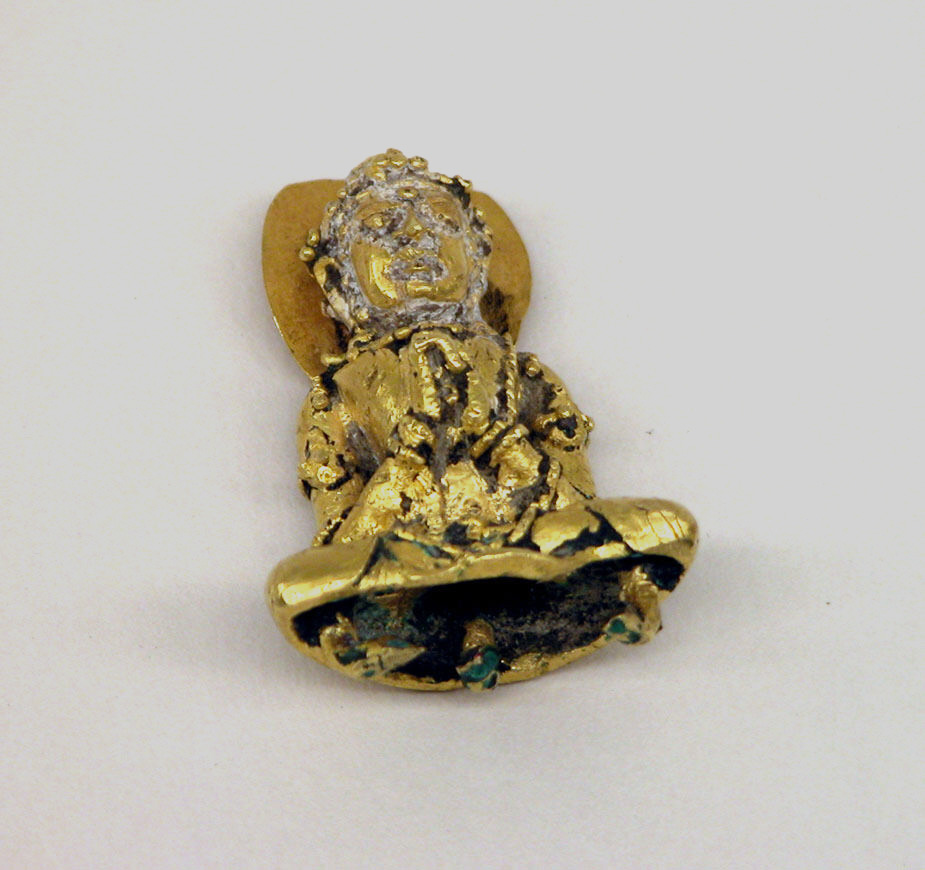
Transcendent Metallurgy: Deconstructing the Vairochana Nimbus for SS26
The sacred geometry of the Vairochana sculpture—a golden effulgence frozen in meditative equipoise—is not an artifact of the past. For Zoey Fashion Laboratory, it is a blueprint for the post-human silhouette. Hailing from Java, this gold sculpture with its attached nimbus operates as a radical precursor to our SS26 thesis: the garment as a field of energy, not a container for flesh. We reject the passive drape of conventional couture. Instead, we extract the nimbus’s radial authority—its halo of concentric light—and re-engineer it as a structural exoskeleton for the modern body. This is not homage; it is vivisection.
From Halo to Hard-Shell: The Nimbus as Wearable Architecture
The immediate correlation with our archive node—Mirror with Split-Leaf Palm—is unavoidable. Where that piece juxtaposed a polished silver mirror against gold-encrusted palm fronds, the Vairochana nimbus offers a more severe dialectic: the immaterial versus the mineral. The sculpture’s halo is not a flat disc; it is a torus of compressed light, a ring of absolute stillness. For SS26, we translate this into a nimbus collar—a rigid, 3D-printed titanium alloy ring that floats three centimeters off the clavicle, suspended by invisible magnetic couplings. This is not jewelry. It is the first layer of a garment that refuses to touch skin, creating a negative-space aura that mimics the sculpture’s divine detachment.
The gold materiality itself is interrogated. Javanese gold, with its warm, slightly reddish patina, is not replicated but sublimated. We employ a bio-fabricated gold leaf, grown on bacterial cellulose, which is then laser-sintered into fractal, split-leaf patterns. This echoes the Buddhist concept of upaya—skillful means—where the material is both the message and the medium. The resulting textile is impossibly light, yet structurally rigid, capable of holding a cantilevered shoulder pad that extends 45 centimeters outward, mimicking the nimbus’s radiating spokes. The silhouette is no longer human; it is a mandala in motion.
Deconstructing the Lotus: Asymmetric Draping and the Void
Vairochana’s posture—seated in deep meditation—offers a counterpoint to the nimbus’s radial symmetry. We deconstruct this stillness into a series of asymmetric, gravity-defying panels. The sculpture’s robes, which flow in rhythmic, carved folds, are reinterpreted as high-tensile, liquid-metal jersey. However, the fabric is not draped; it is programmed. Using shape-memory alloys woven into the textile, each panel is pre-set to curl and fold into a permanent, sculptural wave. The left side of a jacket will flare into a sharp, architectural fin, while the right side dissolves into a train of shredded, gold-sequined filaments—a visual representation of the split between the mirror’s cold reflection and the sarcophagus’s carved narrative.
The void becomes the protagonist. The nimbus’s empty center—the space where the head resides—is replicated as a series of negative-space cutouts in the torso. Laser-cut apertures, shaped like the split-leaf palm, expose the skin beneath, but only through a layer of iridescent, holographic mesh. This is not eroticism; it is a meditation on impermanence. The body is present, yet obscured, just as Vairochana’s physical form is subsumed by his radiant aura. The structural innovation lies in the tension system: internal, corset-like straps made of carbon fiber that pull the garment into a state of perpetual suspension, ensuring the cutouts never gape or collapse.
Futuristic Silhouettes: The Nimbus Shoulder and the Reliquary Sleeve
For SS26, the shoulder is not a joint; it is a horizon. The Nimbus Shoulder—a fully articulated, multi-layered epaulet—extends from the acromion like a golden halo sliced in half. It is constructed from overlapping, gilded aluminum scales, each one laser-etched with the script of the Mirror with Split-Leaf node. When the wearer moves, the scales fan open, revealing a secondary layer of phosphorescent, chartreuse silk—a nod to the gold’s reflective properties against the dark stone of the original sarcophagus. This is a garment that performs its own cosmology.
Conversely, the Reliquary Sleeve is a study in containment. Inspired by the nimbus’s protective enclosure, the sleeve is a rigid, elbow-length gauntlet that opens at the wrist like a flower. Inside, a series of compressed, pneumatic bladders inflate and deflate in response to the wearer’s pulse, creating a living, breathing sculpture. The texture is that of the sculpture’s gold surface—smooth yet granular, with micro-engravings of Javanese floral motifs that catch light at oblique angles. The sleeve does not end; it tapers into a point, a calligraphic stroke that references the split-leaf palm’s sharp apex.
Material Alchemy: Gold, Shadow, and the Digital Afterlife
The definitive innovation of this collection is the Chiaroscuro Matrix—a proprietary technique that bonds gold leaf to a base of black, liquid-crystal polymer. When static, the fabric appears as a matte, obsidian surface. When voltage is applied, the polymer aligns, and the gold leaf becomes luminous, casting a halo of light around the wearer’s silhouette. This is the nimbus made literal. It is a garment that shifts between the two poles of our archive node: the bright, reflective mirror and the dark, narrative stone. The wearer becomes a living sculpture, oscillating between divine radiance and mortal gravity.
The construction process itself is a form of ritual. Each garment is assembled in a vacuum-sealed chamber, where gold particles are electrostatically deposited onto the fabric in a pattern derived from 3D scans of the Vairochana’s halo. The result is a textile with a memory of the sacred. The seams are not sewn; they are fused using ultrasonic welding, creating a seamless, continuous surface that mimics the cast gold of the original. This eliminates the human hand’s error, achieving a perfection that borders on the inhuman—a fitting tribute to Vairochana’s transcendent nature.
Conclusion: The Garment as a Reliquary for the Future
The Vairochana sculpture is not a static object; it is a directive. For SS26, Zoey Fashion Laboratory converts its golden stillness into a kinetic, futuristic wardrobe that challenges the very definition of clothing. We are not designing garments; we are designing portable sanctuaries. The nimbus shoulder, the reliquary sleeve, and the chiaroscuro matrix are not mere stylistic flourishes—they are structural innovations that reconfigure the body’s relationship to space, light, and time. This is couture as a metaphysical practice. The mirror and the stone, the gold and the void, the past and the future—all collapse into a single, wearable moment. This is not fashion. This is the sculpture of consciousness, draped in gold. Welcome to the new Enlightenment.