Deconstructing the Canopy: A Study in Temporal Collision and Textile Alchemy
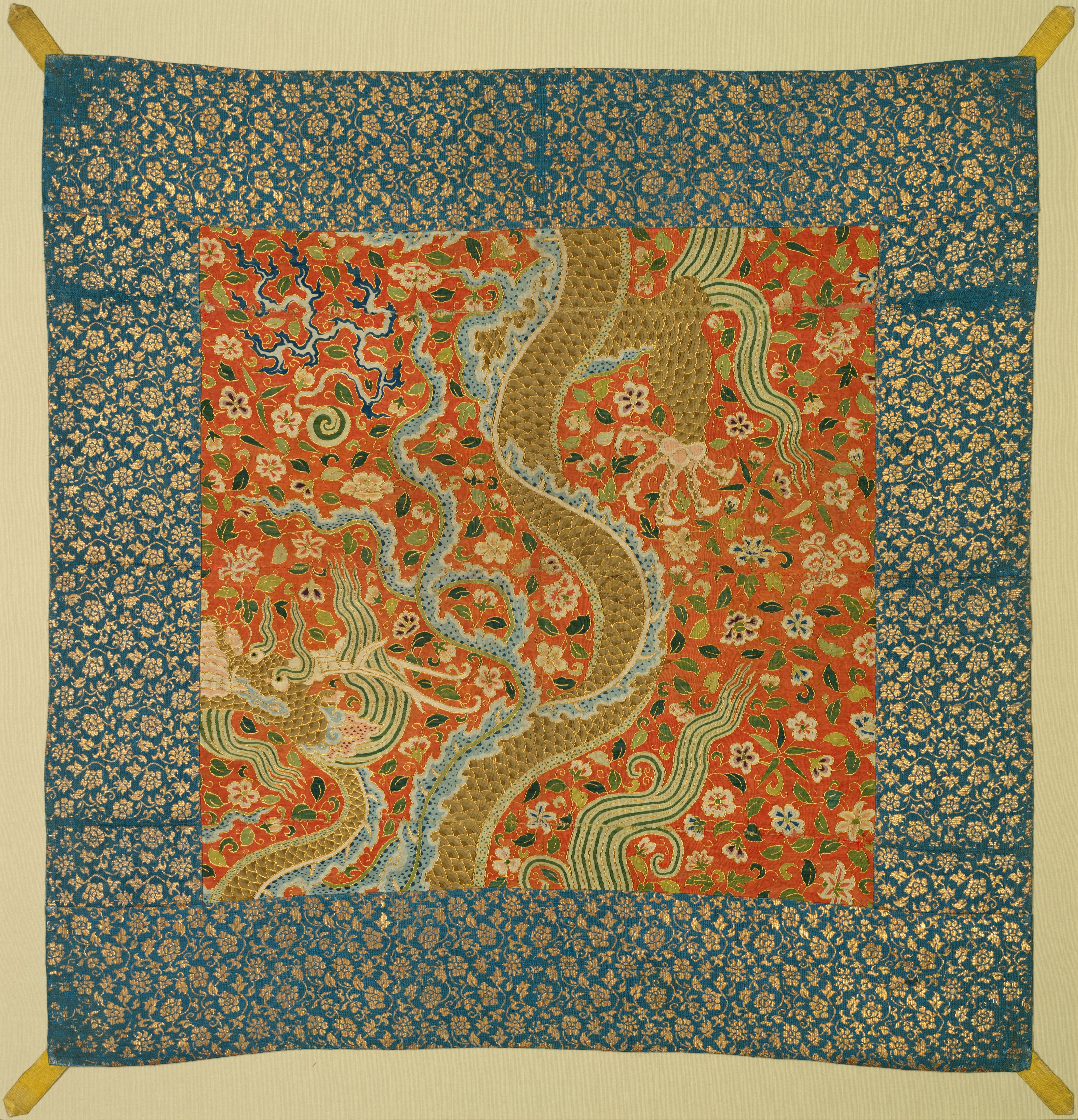
At Zoey Fashion Lab, we do not merely observe artifacts; we interrogate them. We dissect their materiality, challenge their historical boundaries, and re-assemble their narratives through an avant-garde lens. The subject of today’s analysis—a Canopy with Dragon among Flowers, originating from China’s Southern Song dynasty (1127-1270) with a border added during the Ming dynasty (1368-1644)—presents a profound paradox. It is an object of imperial grace, yet its very construction is an act of temporal vandalism. This canopy is not a singular creation but a palimpsest, a deliberate layering of two distinct dynastic voices. For the contemporary designer, this artifact is not a relic; it is a blueprint for radical design thinking, where the past is not preserved but activated through the friction of its own inconsistencies.
Material Dialectics: Kesi vs. Lampas
The technical bifurcation of this canopy is its primary source of aesthetic tension. The center, a masterpiece of kesi (tapestry weave) in silk and gold, represents the zenith of Southern Song craftsmanship. Kesi, literally meaning ‘cut silk,’ is a technique of incredible slowness and precision. The weft threads are not continuous; they are individually manipulated to create pictorial details, resulting in a fabric that is structurally identical on both sides—a feat of engineering that mimics painting. The dragon, rendered in gold-wrapped threads, does not merely sit on the fabric; it is the fabric’s structural logic. The gold is not applied but woven, creating a surface that reflects light with a muted, internal glow. This is a material of pure, monastic focus—a meditation on form and negative space.
In stark contrast, the Ming dynasty border employs lampas weave. A compound weave, lampas allows for a ground weave and a pattern weave to coexist, creating a more complex, textured, and frankly, more assertive surface. The Ming border is not a quiet accompaniment; it is a loud, decorative exclamation point. Its floral motifs are denser, its gold more ostentatious, its rhythm more repetitive. Where the Southern Song center is a solitary figure in a vast landscape, the Ming border is a crowded, bustling marketplace. This is not a harmonious marriage. It is a violent, beautiful collision. The lampas border acts as a structural frame that attempts to contain the ethereal kesi, yet the kesi refuses to be subdued. The visual friction between the two—the quiet, pictorial depth of the center versus the flat, ornamental pattern of the border—creates a dynamic energy that is inherently modern.
The Dragon’s New Clothes: Iconography in Flux
Iconographically, the dragon is a symbol of imperial power, cosmic energy, and auspiciousness. In the Southern Song center, the dragon is likely rendered with a certain lyrical elegance—a creature of the air, weaving through stylized clouds and flowers with sinuous grace. It is a philosophical dragon, embodying the Neo-Confucian ideals of balance and introspection. However, by adding a Ming border, the curators (or original patrons) of this object have fundamentally altered the dragon’s context. The Ming dynasty was an era of cultural restoration and assertive, outward-facing power. The border’s dense floral lattice—likely peonies and chrysanthemums—speaks of wealth, rank, and seasonal harmony, but it is a different kind of harmony: one of abundance and display, not of quiet contemplation.
This layering is an act of curatorial violence, and it is precisely this violence that fascinates the avant-garde. The canopy becomes a metaphor for the modern condition: we are all composites of different eras, our identities framed and re-framed by external forces. The dragon is no longer a Song dynasty ideal; it is a Ming dynasty reinterpretation of that ideal. The gold threads of the center are now in dialogue with the gold of the border, creating a chromatic argument about the nature of value. Is value found in the intrinsic, laborious process of kesi, or in the expansive, decorative application of lampas? The artifact refuses to answer, leaving the question open for the viewer—and the designer—to resolve.
Avant-Garde Resonance: From Archive to Atelier
For Zoey Fashion Lab, the Archive Resonance is not about nostalgia; it is about extraction. We extract the structural DNA of this canopy and re-engineer it for contemporary wear. The first extraction is the concept of temporal patching. Imagine a modern gown where the bodice is constructed from a painstakingly hand-loomed, jacquard-woven silk that mimics the pictorial depth of kesi, while the skirt is a high-tech, laser-cut metallic mesh that echoes the repetitive, assertive pattern of the Ming lampas. The seam between them is not hidden; it is exposed, top-stitched with a contrasting gold filament, celebrating the point of collision.
Secondly, we deconstruct the color palette. The Southern Song aesthetic favors muted, scholarly tones: celadon greens, pale ivories, and soft aubergines. The Ming border introduces saturated, imperial hues: deep cinnabar reds, lapis blues, and brilliant golds. Our avant-garde application would juxtapose these palettes not as a gradient but as a hard block. A coat might have a body in a faded, almost monochromatic silk (Song) with sleeves in a vibrant, digitally printed metallic brocade (Ming). The wearer becomes a living archive, a mobile museum of conflicting aesthetics.
Finally, we consider the tactile hierarchy. Kesi is flat, smooth, and almost painterly to the touch. Lampas is raised, textured, and sculptural. Our designs must translate this tactile dissonance into form. A structured, architectural shoulder (Ming) flowing into a fluid, bias-cut, liquid-silk train (Song) creates a silhouette that is both armored and ethereal. The garment does not sit still; it performs the tension of its own history.
Conclusion: The Canopy as a Manifesto
This Chinese canopy is a radical manifesto disguised as a decorative object. It argues that purity is a myth and that true innovation arises from the friction of disparate elements. The Southern Song center and the Ming border do not blend; they coexist in a state of productive conflict. For the designer, this is a call to action. We must stop seeking cohesive narratives and instead embrace the fragmentary, the contradictory, and the layered. The future of fashion lies not in creating new fabrics but in re-contextualizing ancient ones, in forcing dialogues between eras that never intended to meet. This canopy, with its silent, golden dragon and its boisterous floral frame, is not an artifact of the past. It is a prototype for the future—a testament to the power of deconstruction as a form of creation. At Zoey Fashion Lab, we do not copy this canopy; we channel its disruptive spirit, cutting through the fabric of convention to reveal the shimmering, contested threads of history beneath.