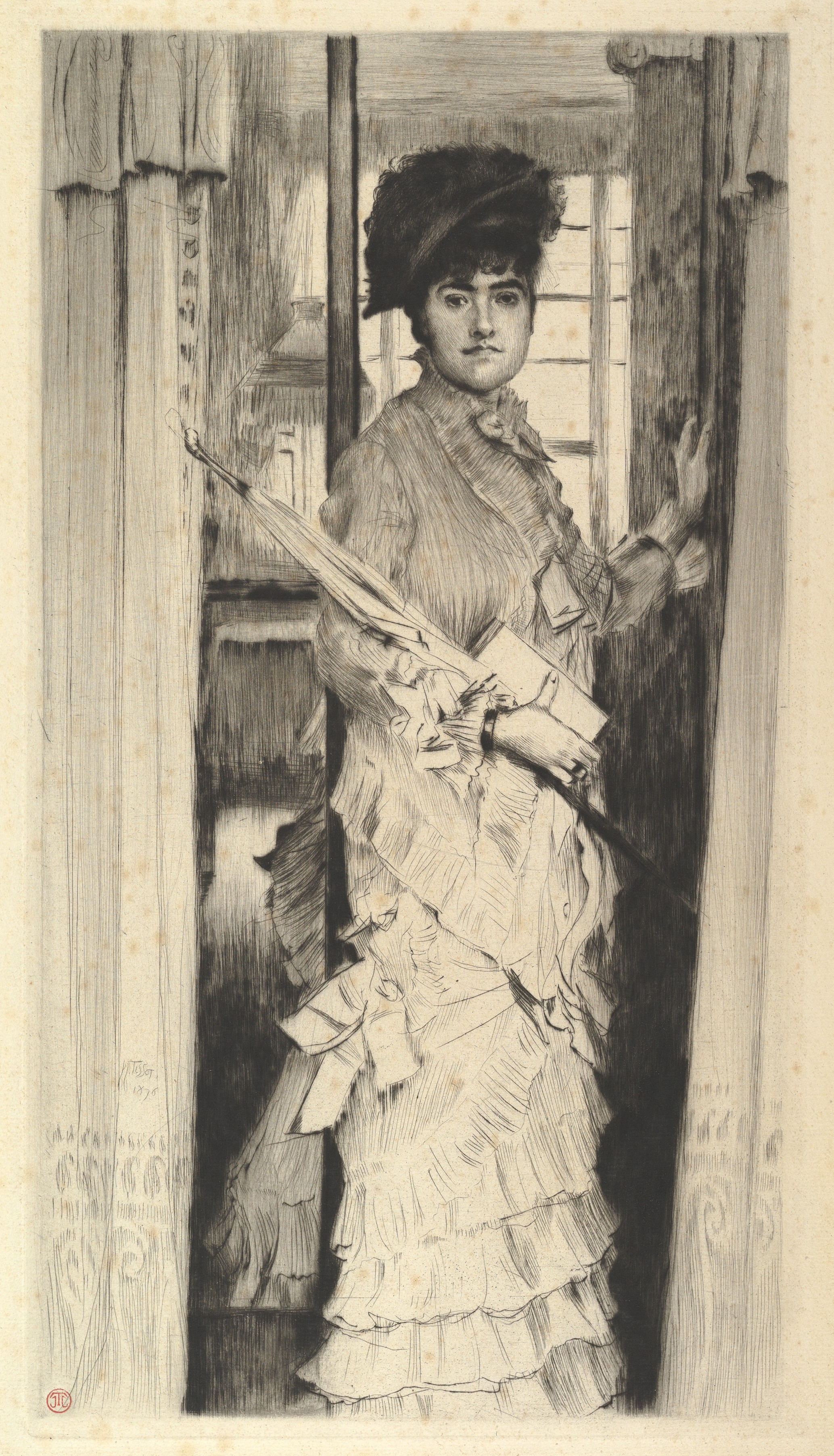
Portrait of Miss L...: The Dialectical Silhouette as Architectural Manifesto
The presented artifact, Portrait of Miss L..., or A Door Must Be Either Open or Closed, transcends its drypoint medium to serve as the foundational theorem for Zoey Fashion Laboratory's SS26 collection. This is not a mere fashion sketch; it is a deconstructed blueprint, a philosophical proposition rendered in line and negative space. The title itself, a nod to Musset’s proverbial dilemma, establishes the core tension: the binary is a fallacy. In avant-garde couture, as in advanced thought, a door can be paradoxically both open and closed—a portal that reveals through concealment, a structure that liberates through constraint. This analysis deciphers the sartorial algorithms embedded within this standalone study, projecting its principles onto the three-dimensional, wearable architecture of the forthcoming season.
Deconstructing the Binary: The Silhouette as Interstitial Space
The genius of the "Portrait" lies in its rejection of the historic fashion silhouette—a closed, defined form—in favor of what we term the Interstitial Silhouette. The figure is not drawn as a solid mass but as a series of strategic apertures, planes, and implied volumes. The line work suggests not contour, but edge. This translates directly to SS26’s structural innovation: garments will be conceived as exoskeletal frameworks. Imagine a dress not as a sheath, but as a series of polished, anatomical struts—crafted from recycled aerospace polymers and brushed titanium—that trace the clavicle, scapula, and iliac crest, connected by tensile bands of liquid-like matte jersey. The body is not hidden; it is mapped and punctuated, existing in the deliberate voids between the structural elements. The "door" of the garment is neither open nor closed; it is a dynamic lattice, offering glimpses of the epidermis as an integral, textured component of the total architecture.
Material Dialectics: The Rigidity of Paper, the Fluidity of Idea
Noting the specification "drypoint on laid paper" is critical. Drypoint creates a burr, yielding a rich, velvety line, while laid paper possesses a inherent texture and grain. This material tension—between the precise, incised line and the organic, receptive ground—informs SS26’s material manifesto. We will pioneer contradictory fabric fusions. Expect to see rigid, laser-sintered lace, its patterns not floral but derived from circuit-board tracings or structural stress diagrams, fused onto a base of thermo-responsive gel-textile. This substrate will shift in opacity and texture in response to ambient temperature or biometric data, literally reconfiguring the "open" or "closed" state of the garment in real-time. The "only state" of the artwork belies the multitude of states the garment will possess, championing a couture of dynamic performance.
Structural Innovation: The Portal as Functional Seam
The philosophical "door" of the title manifests physically in SS26 through kinetic seamology and portal construction. Seams will cease to be mere joins; they will be articulated hinge-points, gussets, and operable apertures. A coat may feature a seam that, via a silent magnetic or pneumatic mechanism, unfurls into a dramatic cowl or retracts into a severe, minimalist line. Inspired by the negative space in the "Portrait," we will engineer garments with parametric cut-outs that are not decorative, but functional—serving as ventilation systems, access points for wearable tech interfaces, or frames for embedded bioluminescent elements. The silhouette becomes adaptive, a personal microenvironment that responds to and interacts with the Global Frontier—a context hinting at extreme environments, digital saturation, and nomadic existence.
Futuristic Silhouettes: The Cartesian Grid Re-imagined
Moving beyond the deconstructed, SS26 will introduce the Volumetric Displacement Silhouette. The "Portrait" implies volume through absence. We will realize this through inflated forms, not of soft fabric, but of molded, translucent memory foams or sealed air-cells within transparent polymer membranes. These volumes will be strategically displaced—hovering away from the shoulder, extending from the hip in a geometric cantilever, creating a halo-like form behind the head. These are not garments that follow the body; they are architectural propositions that orbit the form, creating a protected, personal space. They echo the standalone nature of the study, making each wearer a walking, autonomous installation.
Conclusion: The Couture Proposition for a Frontier Epoch
Portrait of Miss L..., or A Door Must Be Either Open or Closed is ultimately a directive. For Zoey Fashion Laboratory's SS26, it mandates a departure from sartorial convention into the realm of embodied philosophy. The collection will be a series of wearable arguments against false binaries—between hard and soft, revealing and obscuring, past and future, art and utility. It proposes a couture for the Global Frontier citizen: one who requires garments that are intelligent, adaptive, and structurally eloquent. The final silhouette is not a shape, but a condition of potential. It is a door perpetually ajar, inviting not passage, but a new way of perceiving the interface between self, society, and space. The drypoint line is our starting coordinate; the future silhouette is our destination.