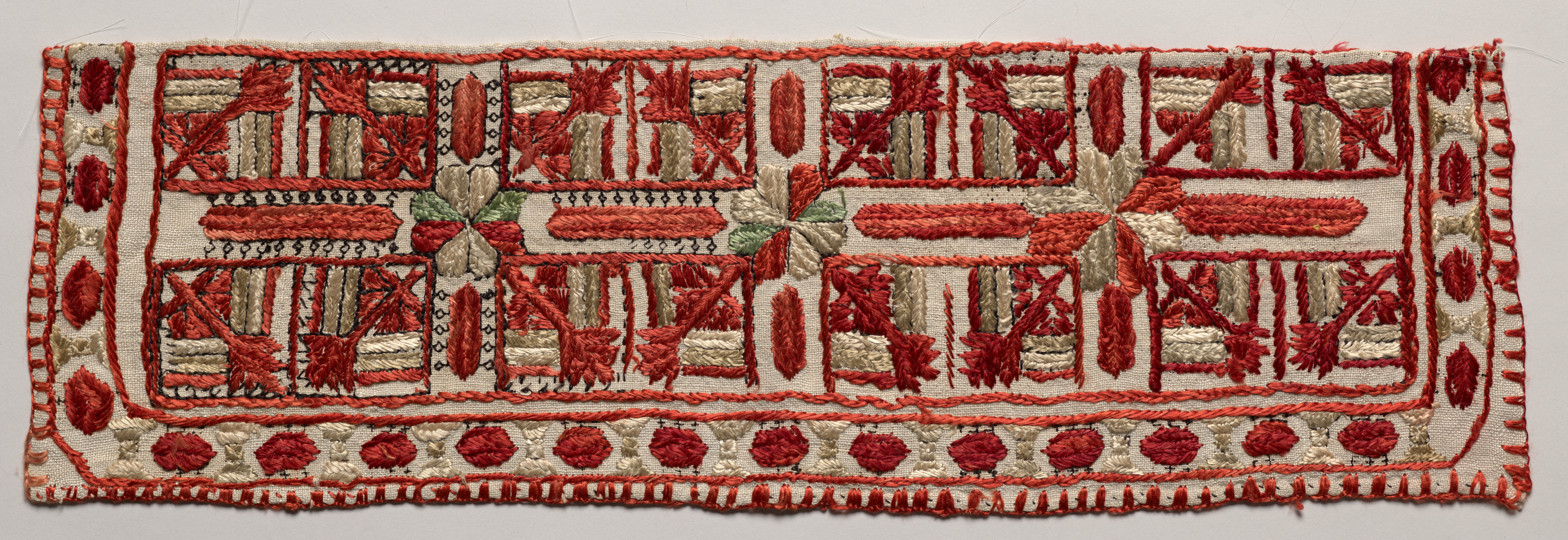
Deconstructing the Tambov Panel: An Avant-Garde Reading of Archival Resonance
At Zoey Fashion Lab, our mandate extends beyond the mere cataloging of textiles. We engage in a rigorous process of fabric deconstruction, peeling back the layers of historical context, material integrity, and cultural memory to reveal the latent avant-garde potential within archival objects. The subject of this analysis—a panel originating from the Tambov province of Russia—presents a fascinating paradox. On the surface, it is a relic of provincial craftsmanship, a utilitarian or ceremonial textile. Yet, beneath its linen warp and weft, interlaced with silk and embroidery, lies a blueprint for radical, contemporary design. This panel is not merely an artifact; it is a manifesto in thread, speaking to a future that we are only now prepared to understand.
Material Dialectics: Linen, Silk, and the Politics of Texture
The primary structural component of this panel is linen, woven in a plain, or tabby, weave. This choice is immediately significant. Linen, derived from the flax plant, is a material of the earth—rugged, breathable, and inherently democratic. In the context of 17th-century Russia, linen was the great equalizer, used for everything from peasant shirts to high-status household linens, its quality varying only by the fineness of the spin and the density of the weave. The plain weave itself is a testament to structural honesty; it is the most fundamental, unpretentious interlacing of warp and weft. This is not a fabric designed to deceive or to dazzle with complex construction. It is a fabric of primary substance.
Contrast this with the introduction of silk. Silk is the antithesis of linen's rustic pragmatism. It is a protein fiber, a product of the silkworm, historically associated with the East, with luxury, and with the aristocracy. The presence of silk in this Tambov panel signals a moment of cultural collision. It is the intrusion of the exotic into the provincial, a deliberate act of elevation. In our deconstruction, we view this not as a simple decorative addition, but as a dialectical tension. The sturdy, matte, grounded nature of the linen is challenged by the lustrous, fluid, and ethereal quality of the silk. This is the first layer of avant-garde resonance: the deliberate juxtaposition of opposing material philosophies to create a surface that is neither wholly rustic nor wholly refined, but a third, more complex entity.
The Embroidery as Disruption: Stitch as Gesture
If the weave provides the grammar, the embroidery is the poetry—and in this case, a very disruptive poetry. Traditional analysis might focus on the iconography of the embroidery, searching for folkloric motifs, pagan symbols, or Christian narratives. However, our deconstructionist lens prioritizes the act of stitching over the image it creates. The embroidery on this panel is not a passive illustration; it is an active intervention upon the plain-weave grid. The needle pierces the orderly, orthogonal structure of the linen, introducing a counter-rhythm of curves, diagonals, and dense, tactile clusters.
We observe a distinct tension between the regularity of the ground weave and the irregularity of the embroidered surface. The stitches—whether satin, stem, or cross—create a raised, sculptural topography. This is the transformation of a two-dimensional surface into a three-dimensional, textural landscape. In avant-garde fashion, this principle is paramount. We are not interested in flat, graphic prints. We are interested in tactile dimensionality. The embroidery on this panel demonstrates a primitive understanding of what we now call "surface architecture." It shows that the fabric itself can be a site of structural manipulation, where thread is not just a connector but a builder of form. The embroidery is a form of controlled chaos, a deliberate scarification of the pristine linen plane, prefiguring the deconstructed, raw-edged aesthetics of contemporary Japanese and Belgian designers.
Archival Resonance: Reinterpreting the 16th–17th Century Dialogue
The reference for this analysis, "Archive Resonance," speaks to the period of the 16th and 17th centuries as a crucible of cultural and aesthetic collision. This was the era of the Silk Road's late flowering, of Ivan the Terrible's expansionist policies, and of the nascent global trade that brought foreign goods and ideas into the Russian heartland. The Tambov panel is a microcosm of this macro-historical moment. It is a physical record of a conversation between the local (linen, indigenous embroidery techniques) and the global (silk, possibly imported from Central Asia or the Near East).
Our avant-garde interpretation does not seek to preserve this panel in a museum case. Instead, we "resonate" with its core principle: the synthesis of disparate cultural and material elements into a new, unified aesthetic language. The 16th and 17th centuries were not a period of pure, untouched tradition; they were a period of dynamic exchange. The panel is evidence that even in a remote province, the pulse of global aesthetics was felt. For Zoey Fashion Lab, this is the ultimate lesson. The avant-garde is not about creating from a vacuum; it is about curating collisions. It is about taking the humble, structural honesty of linen, the luxurious, globalized fluidity of silk, and the gestural, disruptive energy of embroidery, and forcing them into a cohesive, provocative whole.
From Artifact to Garment: A Blueprint for the Future
How does this translate into a contemporary fashion collection? We propose a series of design principles derived directly from this panel:
Principle of Material Contrast: We will pair heavy, unbleached linen with panels of iridescent, raw silk. The garment will eschew lining, allowing the two fabrics to interact directly with the body, creating a sensory experience of weight and lightness, matte and sheen.
Principle of Textural Disruption: The silhouette will be clean and architectural, perhaps a severe, columnar coat. Upon this minimalist form, we will apply embroidery not as decoration, but as armor. Dense, almost aggressive stitching will be placed at the shoulders, along the spine, and at the cuffs, creating a protective exoskeleton of thread. This echoes the panel's use of embroidery to reinforce and transform its base material.
Principle of Historical Collage: The garment will not be a direct copy of the panel’s motifs. Instead, it will be a re-contextualization of its structural logic. We will deconstruct the panel's embroidery patterns into abstract, geometric fragments and re-scale them, producing a new visual language that feels both ancient and futuristic. The "resonance" is achieved not through imitation, but through structural translation.
Conclusion: The Panel as a Living System
The Tambov panel is far more than a piece of old cloth. It is a complex information system, encoding centuries of cultural memory, material science, and aesthetic ambition. Through our deconstruction, we have uncovered its avant-garde DNA: a fearless commitment to material honesty, a willingness to embrace textural chaos, and an innate understanding of the power of cultural synthesis. For Zoey Fashion Lab, this panel is not a relic of the past; it is a directive for the future. It instructs us to be bold in our material pairings, to treat the fabric surface as a sculptural field, and to view the history of textiles not as a linear progression, but as a rich, circular archive from which we can draw endless, radical inspiration. The future of fashion is not in new fibers alone, but in the new eyes we bring to the old threads.