Deconstructing the Sacred: The Chasuble Fragment as Avant-Garde Catalyst
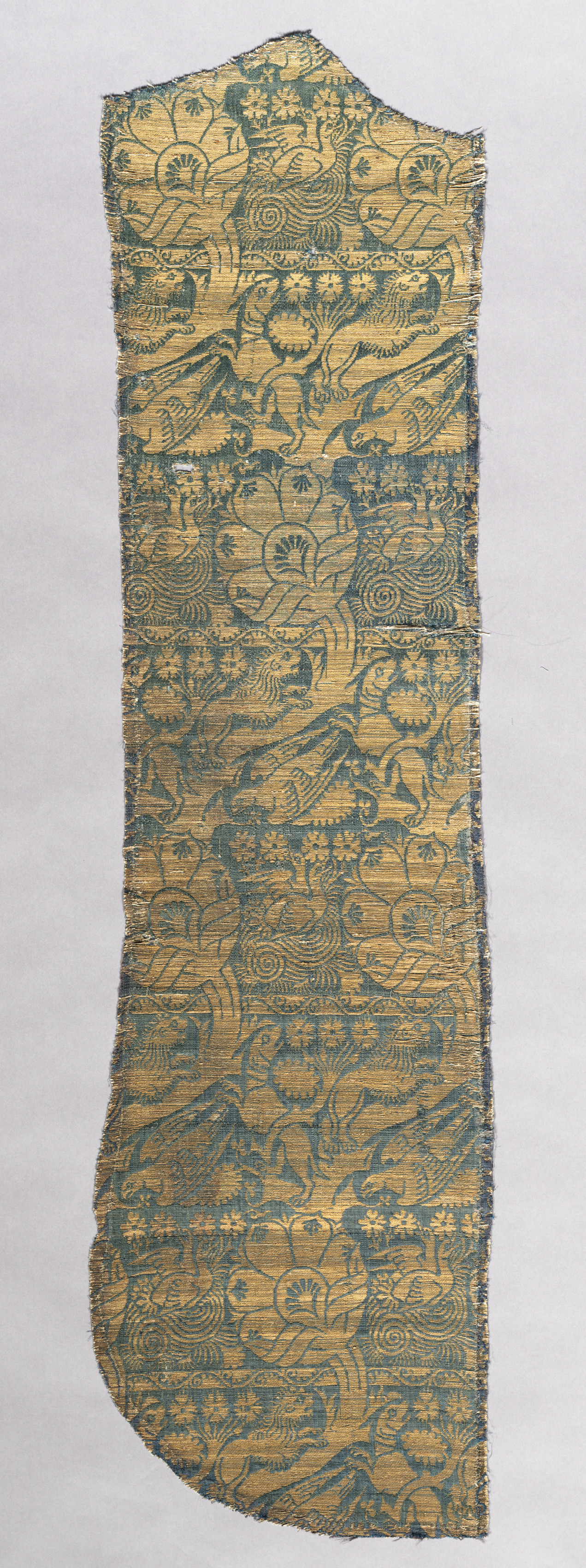
At Zoey Fashion Lab, we do not merely observe historical textiles; we interrogate them. We dissect their weave, challenge their original purpose, and extract the latent energy that lies dormant within their fibers. The Chasuble Fragment with Realistic Animals, originating from late 16th to early 17th century Italy, is a masterclass in this very process. Crafted from lustrous silk and gilded gold thread in a complex lampas weave, this ecclesiastical textile is far more than a relic of religious devotion. It is a proto-avant-garde manifesto, a collision of the natural world, imperial wealth, and sacred ritual that prefigures the disruptive aesthetics of contemporary fashion by four centuries.
Our analysis, framed by the concept of Archive Resonance, seeks to unearth the disruptive potential embedded in this fragment. The reference to the 16th and 17th centuries as a period of profound cultural collision and aesthetic fusion is not merely historical context; it is a blueprint for modern design innovation. The chasuble, a garment worn by clergy during the Eucharist, was intended to be a vessel of divine light. Yet, its surface teems with the profane—realistic, predatory animals woven in shimmering gold. This tension between the sacred vestment and the secular, untamed imagery is the first point of deconstruction.
Weaving Contradictions: The Lampas Technique as Structural Rebellion
The technical foundation of this fragment is the lampas weave, a sophisticated structure involving a main warp and weft, typically a plain or twill ground, with a supplementary pattern weft—in this case, the gold thread—creating the figurative design. From a technical standpoint, lampas is a testament to the weaver’s mathematical precision. However, from a deconstructionist perspective, the weave itself is a metaphor for societal layering. The ground fabric, often a solid, deep color, represents the established order—the Church, the state, the unchanging doctrine. The supplementary gold weft, however, floats freely across the surface, creating a secondary narrative that is both additive and subversive.
This is not a simple embroidery; it is a structural duality. The gold thread, often gilded silver or gold leaf wrapped around a silk core, does not merely decorate the ground; it overpowers it. The realistic animals—perhaps a lion, a leopard, or a mythical beast rendered with startling anatomical accuracy—appear to prowl across the fabric’s surface. In the context of avant-garde fashion, we can translate this technique into a design philosophy of visible construction. Just as the lampas weave reveals its two layers, an avant-garde garment must reveal its own contradictions. A structured, tailored blazer might be deconstructed to expose a flowing, chaotic silk lining. A minimalist shift dress could be disrupted by a metallic, three-dimensional appliqué that seems to crawl across the body. The lampas technique teaches us that true innovation lies not in hiding the seams, but in celebrating the tension between the foundation and the disruptive element.
Iconographic Disruption: The Realistic Animal as a Symbol of Uncontrolled Nature
The choice of realistic animals is the most potent avant-garde element of this fragment. In the medieval and Renaissance periods, bestiaries were moral allegories; animals were symbols of virtues or vices. However, the "realistic" rendering here suggests a shift. This is not the stylized, heraldic lion of a coat of arms. This is a creature with musculature, with a predatory gaze, with a sense of kinetic energy. This represents the uncontrolled—the natural world that exists outside the rigid hierarchy of the Church. By placing these creatures on a chasuble, the weaver—or the patron—was making a radical statement. They were suggesting that divine power could coexist with, or even be manifested through, the raw, untamed forces of nature.
For Zoey Fashion Lab, this iconography is a direct challenge to the contemporary fashion industry’s obsession with sterile perfection. The avant-garde aesthetic thrives on the sublime and the grotesque. We can reinterpret this fragment by incorporating realistic, almost hyper-realistic, depictions of fauna into our designs—not as cute motifs, but as powerful, unsettling presences. Imagine a flowing evening gown where a jacquard weave depicts a snarling wolf, its fur rendered in micro-detail, its eyes catching the light with a metallic sheen. This is not decoration; it is a statement of power, a nod to the wearer’s untamed interiority. The fragment validates the use of high-contrast, emotionally charged imagery as a tool for narrative disruption. It aligns perfectly with the modern avant-garde’s desire to challenge the wearer and the viewer, to provoke thought rather than simply provide comfort.
Material Alchemy: Gold Thread as a Signifier of Transient Power
The use of gold thread in this fragment is not merely about opulence. In the context of our deconstruction, gold represents a paradox. It is the most durable of metals, yet it is woven into a fragile textile. It signifies eternal wealth, yet the garment itself is a fragment, a remnant of a larger whole that has been lost to time. This is the essence of Archive Resonance—the idea that power is transient, that even the most magnificent creations are subject to decay and reinterpretation. The gold thread, now perhaps tarnished or dulled, speaks to the passage of time and the futility of seeking permanence.
In an avant-garde fashion context, we can utilize metallic materials not for their status value, but for their conceptual weight. We can use gold lamé, metallic leather, or even iridescent technical fabrics to create garments that feel heavy with meaning, yet are structurally ephemeral. The design should acknowledge its own fragility. A coat might be constructed from a metallic mesh that is both rigid and delicate, suggesting armor that is also a cage. The gold thread of the chasuble fragment is a reminder that luxury is not about comfort; it is about the powerful, sometimes uncomfortable, acknowledgment of our own mortality and the fleeting nature of all human constructs.
From Ecclesiastical Vestment to Wearable Art
The final deconstructionist move is to liberate the chasuble from its original function. By removing it from the altar and placing it in the context of a fashion archive, we transform its meaning. It is no longer a sacred object but a piece of wearable art. This is the ultimate avant-garde act. The chasuble fragment, with its complex weave, its realistic animals, and its golden shimmer, becomes a precursor to the work of designers like Alexander McQueen or Rei Kawakubo, who treat the human body as a canvas for exploring dark, complex, and often contradictory themes.
For Zoey Fashion Lab, this fragment is not a costume reference. It is a philosophical guide. It instructs us to embrace contradiction, to utilize high-level craftsmanship to express chaotic ideas, and to understand that true luxury lies in the depth of the narrative, not the superficiality of the surface. The chasuble’s journey from a liturgical garment to a source of avant-garde inspiration is a testament to the enduring power of textile. The Archive Resonance we feel is not nostalgia; it is a forward-looking energy, a recognition that the most radical ideas for the future are often found in the layered, complex, and beautiful fragments of our past. Our designs will not copy the chasuble; they will channel its spirit of disruptive beauty, its fearless fusion of the sacred and the profane, and its technical mastery used in service of a bold, untamed vision.